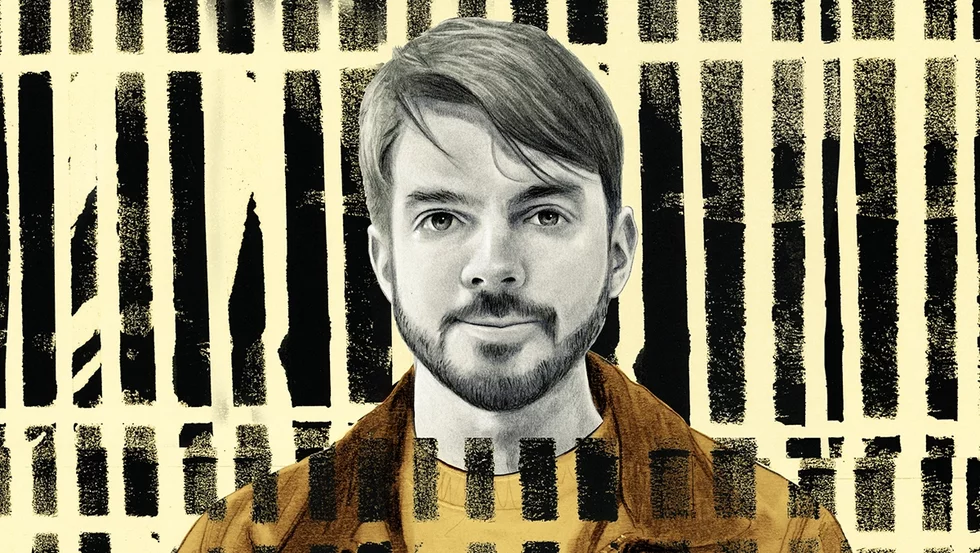
On May 1, Charles E. Littlejohn, a bearded 39-year-old, recorded a short video. “At 2 p.m.,” he said, “I will be reporting to the camp at USP Marion to begin my five-year sentence.” His eyes were deep brown and calm, his voice a nasal alto. “I’ve been here in St. Louis spending my last days surrounded by family”—he smiled and gestured behind himself at a wall, which bore a whimsical rendering of the Gateway Arch—“and I just want to take the opportunity to thank each and every one of you for your support. If it had not been for your donations, I would not have been able to cover my legal fees.”
This video was posted to a GoFundMe page dedicated to Littlejohn. The page described the crime for which he needed to fundraise a legal defense: “While working as a contractor for the IRS, Charles stole the tax returns of Donald Trump and thousands of other wealthy individuals and leaked them to the press.” The page also included links to two blockbuster investigations—one by The New York Times, the other by ProPublica—that had resulted from his leaks. The page did not describe Littlejohn’s acts the way one federal prosecutor did, as “one of the most serious crimes in the IRS’s history,” nor the way the federal judge who sentenced Littlejohn did, as “an intolerable attack on our constitutional democracy.”
Get a fresh take on the day’s top news
Subscribe to the St. Louis Daily newsletter for a smart, succinct guide to local news from award-winning journalists Sarah Fenske and Ryan Krull.
Littlejohn ended his GoFundMe video by explaining that he could not receive care packages while at the federal penitentiary in Illinois. He could, however, receive softcover books, magazines, and letters. “I look forward to receiving your letters, reading your letters, and corresponding with you,” he said.
I sent him several letters.
My curiosity centered at first on his motives. Why would someone do this, I wondered, knowing that prison was likely? (According to one court filing, he wrote the following at the time of his deeds: leaking IRS data “would almost certainly mean signing my life away to misery.”)
To the right, the answer was obvious. “Political purposes and personal gain,” said one of Trump’s attorneys. The U.S. Department of Justice used similar language, arguing that Littlejohn had “weaponized his access to unmasked taxpayer data to further his own personal, political agenda.” In this view, the St. Louis native merely indulged, as the Wall Street Journal’s editorial board put it, “a partisan political interest in embarrassing Mr. Trump and promoting policies to soak rich taxpayers.” Such taxpayers do pay, after all: The country’s wealthiest 5 percent already account for two-thirds of federal income tax revenue.
To the left, meanwhile, Littlejohn was not a weaponizer of data but rather a “whistleblower” who uncovered how a small group of ultrawealthy individuals (the top .001 percent) dodge taxes—taxes that are, as Oliver Wendell Holmes Jr. put it a century ago, “what we pay for civilized society.” One writer at the progressive magazine The American Prospect called Littlejohn “a public hero” who engaged in “a good kind of civil disobedience.”
I hoped to hear directly from Littlejohn about all this. On August 10, he finally wrote back:
As I’m sure you’ve surmised by now, I’m not in a position to speak about my case given my active appeal. The time will come when both I and the people who know me will be able to share their perspective but that time is still in the future. What is publicly available is, of course, at your disposal…. Sorry I couldn’t be of more help.
Best wishes,
Chaz
Initially, I thought this meant that neither he nor his loved ones would speak about his legal predicament. It soon became clear, though, he’d asked them not to speak about him at all. So I turned instead to court records, which contained excerpts from nearly 30 letters written to the judge by family and friends. (The court allowed their names to be redacted; although my reporting uncovered many of their identities, they’ll not be named here.)
The portrait of Littlejohn that emerges from those documents is that of neither a hero nor villain but rather a misguided idealist. His defense attorney wrote of him as “a principled, if flawed, man…. Who committed this offense out of a deep, moral belief that the American people had a right to know the information and sharing it was the only way to effect change.” A longtime friend wrote that “Chaz is a student of history and politics, but he is not inherently political” and likely “hoped others would consume the details of the reporting” to “evaluate the merits of various tax policy proposals in a more data-driven way like he might.” One former colleague mentioned the “enthusiasm and pride” with which Littlejohn tackled even “mundane” tasks he believed would improve government services little by little, “brick by brick, datapoint by datapoint.”
Yet he’s no longer able to do that work. When he leaves prison in a few years, it will be as a convicted felon. And neither tax policy nor public opinion about tax policy has budged much since the leaks.
His sacrifice raises a question: Is Chaz Littlejohn a brave man for sacrificing his freedom to expose Americans to the truth? Or a fool for thinking Americans would care?
One evening in 2018, a young woman named Kerrie Ford met Littlejohn at a Oaxacan eatery in Washington, D.C. for their first—and last—date. Over apps, mezcal, tacos, and pork loin, they chatted. He described himself as “sentimental”; a music lover into live pop, rap, and electronic shows; a fan of Sour Patch Kids and talking politics. Ford’s impressions of him: “good-looking,” “nice smile,” “had a really penetrating stare. At some point I felt a little bit violated, like, ‘You’re looking into my soul—stop!’”
The two were set up by The Washington Post Magazine as part of a series called Date Lab. Ultimately, they agreed they weren’t a good match. She was a bit turned off by his lack of spontaneity: Before submitting his form to participate, Littlejohn had shared it with friends via Google Docs so that they could edit it. In addition, Ford concluded that Littlejohn was “nerdier than guys that I tend to go out with.”
At the time, Littlejohn was employed by Booz Allen Hamilton, a government and military contractor. He worked on a team helping the IRS fine-tune its system for authenticating taxpayers who were trying to access their own records. As one colleague later wrote in a letter to the court, Littlejohn dutifully “labored over obscure processes and unglamorous spreadsheets in pursuit of the perfect combination of incremental changes to make things just a little bit better for everyone.” Whereas some co-workers “cynically completed only the basic tasks required,” this colleague noted, Littlejohn connected “his work to broader themes he had studied or was reading about.”
A different colleague speaking on condition of anonymity recalled Littlejohn’s quirks—his initial shyness; his fondness for the tech-bro-favorite nutritional shake Soylent—as well as his competence: “Chaz was reliable. Smart without having an ego…. He was very good at being able to see the bigger picture and solve the problem the government was trying to solve.” The only hint of political leanings, this colleague said, arose when he did Date Lab: “He was upset because [Ford] worked for a company that helped make nuclear weapons.”
Littlejohn’s sense of right and wrong may have derived, at least in part, from his time at Crossroads College Preparatory School in the St. Louis neighborhood of Skinker DeBaliviere. “His do-right mentality—I think that definitely came from Crossroads,” says Max Cassilly, who is the son of City Museum’s late founder, Bob Cassilly, and was a year behind Littlejohn at the small, private institution. Crossroads, he says, was a place of heavy homework loads, of students calling teachers by their first names, of lessons about civil disobedience and questioning authority. “Super liberal,” Cassilly labeled the school. “Crossroads people would break the rules to stay true to their moral compass. Laws did not equal morality.” (School leaders declined to comment.)
When Littlejohn was in seventh grade, a boy from Romania transferred into his class. In a letter written years later to the court, this person, now Littlejohn’s best friend, recalled, “At a time when the language barrier made it hard for me to find friends and fit in with fellow classmates, Chaz was one of the first people to embrace me and we became friends quickly.” Maybe Littlejohn could empathize with the need to fit in: His parents had divorced in 1990, when he was 5, leaving him, according to a court filing, “as the only child moving back and forth between two separate families per a court-ordered schedule.” The situation was “disruptive,” the filing continued, “[but] he learned to adapt and formed close bonds with his siblings—especially his younger brother and sisters.” Both of his half-sisters attended Crossroads.
Littlejohn then attended the University of North Carolina at Chapel Hill, where he picked up degrees in economics and physics. He also helped found the organization now known as Nourish International, a nonprofit that aims to fight extreme poverty. (He spent part of one summer on a project measuring the impact of peanut-shelling machines on a community in Uganda.)
After graduation, he moved to D.C. Over the next several years, Littlejohn, who was skilled in programming languages, launched an online poker business called Pokeit, but his main gig was working for Booz Allen on projects at the IRS. One college friend wrote in a letter to the court that Littlejohn “turned down more lucrative job opportunities” to do this. Another college friend who submitted a letter remembered feeling “befuddlement” at his choice: “It was, even then, a striking outlier among our friends. But what has stayed with me was his rationale. He believed, quite simply, that government should work better: that equitable education, healthcare, environmental safety, housing, and public parks—the very things we were quick to care about—depended on a functioning IRS: on taxpayer dollars, on people paying no more and no less than their fair share.”
Then family tragedy struck. In 2012, Littlejohn’s half-sister, a senior at Crossroads, was diagnosed with leukemia. She underwent multiple rounds of chemotherapy. According to a letter from Littlejohn’s family to the court, he relocated to St. Louis to be near her. He worked remotely at odd hours and spent so much time at the hospital over a period of months that “the nurses and staff…. remember him fondly to this day.” She died of an antibiotic-resistant infection in November 2013. (Soon thereafter, Littlejohn, who had not matched with her for a bone-marrow transplant, found out that he was indeed a match for a 64-year-old man. Littlejohn donated bone marrow and T-cells to that patient, saving his life.)
Littlejohn spent the next several years working on Pokeit. (For part of this period, he stayed in Delaware to help care for his grandfather, who’d suffered a stroke.) But by 2017, he was watching the new Trump presidency with alarm. Within days of taking office, Trump announced that, contrary to his previous promises and four decades of precedent, he wouldn’t release his tax returns. Then, as the F.B.I. investigated whether people in Trump’s orbit had colluded with Russia to influence the 2016 election, Trump fired F.B.I. director James Comey. Speculation was rampant, particularly on the left, that Trump wished to hide compromising financial ties to Russia.
Both of Trump’s actions were breaches of norms, not laws. Still, Trump’s refusal to release his tax returns “triggered a thought” in Littlejohn’s head, he would later say in a deposition: “Wow, I used to have access to this type of information.”
Littlejohn got rehired at Booz Allen and, in October 2017, was assigned to the team that was tweaking the IRS’s taxpayer authentication system. His stated goal for this career move: earn a higher and steadier income than what Pokeit could bring. But he harbored a secret goal, too, one he almost certainly didn’t mention on his date for Date Lab: He hoped to pilfer the returns of Trump and related businesses. In February 2018, he gained access to unmasked taxpayer data. By that November, he had a decade and a half’s worth of files.
For months, Littlejohn sat on the data, unsure what to do. He considered going to the Journal and the Post. But he was impressed with the Times’ recent coverage, which had already blown a hole in Trump’s narrative of a self-made billionaire: Records uncovered by Times reporters showed that Trump had received from his father at least $413 million, much of which came through helping his parents dodge taxes. This series won a Pulitzer Prize and resulted in the short Showtime documentary The Family Business: Trump and Taxes. Littlejohn watched it and noticed how carefully the reporters had handled sensitive records (e.g., by setting up a secure room).
According to a filing by his defense attorney, two events at last spurred him into action. On April 13, 2019, the Times published an op-ed under the headline, “Everyone’s Income Taxes Should Be Public.” The columnist, Binyamin Appelbaum, argued that shedding light on millionaire tax avoidance “could significantly reduce” it and also draw attention to the country’s lopsided wealth: “Inequality is easier to ignore in the absence of evidence.”
Two weeks later, Littlejohn’s father received an “unexpected” diagnosis, the nature of which is redacted in court records. But it apparently nudged Littlejohn forward: On May 14, 2019, he used an old iPhone to send a message via Signal, the encrypted messaging app, to the Times.
According to a court filing, Littlejohn wrote about that day in a journal he kept to memorialize his thoughts during this period: “I remember thinking about my Dad who just a few weeks earlier had been diagnosed…. I was thinking about my sister…and how brief our time on earth is. If ever I found myself scared to push further I would think about everything I had done so far, everything that led up to this moment, and I’d push through.”
Littlejohn met the Times reporters on several occasions in the ensuing months. At the first meeting, in a D.C. hotel room, he proved his bona fides by showing them his work badge with his name covered by tape. (He did not disclose his name until about halfway through the process.) Asked later, during a deposition, whether the reporters had ever solicited confidential records or offered him money, he said no. “They offered me a cookie,” he said. “I didn’t even take it.” Once Littlejohn trusted that the Times would put care and resources into the story, he handed them a flash drive. They downloaded the 15 years of Trump’s returns onto a laptop and handed it back to Littlejohn.
More than a year after the first contact, the Times story finally dropped on September 27, 2020. The trove of tax records revealed no hitherto unknown connections to Russia, the reporters noted, but they did reveal something new: that Trump had paid no income taxes in 10 of the previous 15 years “largely because he reported losing much more money than he made”—a reality that “undercuts his claims of financial acumen.” The records also showed that Trump’s businesses “put him in potential and often direct conflict of interest with his job as president.” (Trump’s attorney told the paper that “most, if not all, of the facts appear to be inaccurate”; the Times ran no corrections to this story.)
The scoop reverberated through mainstream outlets. Trump’s allies questioned the timing—a day before his debate with Joe Biden and 36 days before voters headed to the polls to pick a president. But the Democrats controlled the House, the Senate was gearing up for Amy Coney Barrett’s confirmation to the Supreme Court, and the story quickly got swallowed into the maw of the general election.
Meanwhile, in the background, Littlejohn was quietly communicating with a second media outlet: ProPublica. He had noticed, while helping the Times reporters navigate Trump’s returns, that some of the highest-net-worth individuals in the U.S. paid, in certain years, no income taxes or reported relatively little income to begin with. He didn’t fault them for such avoidance, he would later explain; if anything, Congress was allowing it to happen. But he concluded that the public had never seen a comprehensive examination of this phenomenon, so he decided to act. He focused on a 15-year period and stole, according to prosecutors, tax return data (including investments, trades, and audit results) from approximately 7,600 wealthy individuals and more than 600 entities.
Littlejohn turned to ProPublica because he admired its 2018 reporting that had discovered, in essence, that certain low-income filers were likelier to face IRS scrutiny than those who made 20 times as much. Again using Signal, he reached out.
It was a fateful move: At the time, according to the Journal, investigators looking into the first leak couldn’t figure out whether its source had been inside or outside the government. Littlejohn, therefore, may have gotten away with that one. But the upcoming journalistic coverage would leave little doubt about where law enforcement should focus.
ProPublica kicked off its series in June 2021. Titled “The Secret IRS Files: Inside the Tax Records of the .001%,” it found that the leaked data “demolishes the cornerstone myth of the American tax system”—that “the richest pay the most.”
Most Americans earn income through wages. In recent years, ProPublica found, the tax rate for the median wage-earning household was 14 percent, and the highest tax rate (for couples making more than $628,300) was 37 percent. But the income of the top 25 richest Americans on the Forbes list was commonly not wages but other sources of wealth, and if you compared the growth in that group’s wealth from 2014–2018 to the federal taxes they paid in that period, you got what ProPublica called a “true tax rate” of 3.4 percent. And they accomplished this “perfectly legally,” the reporters wrote, through tax avoidance.
The ultrawealthy, the ProPublica series would go on to reveal, rely not on wages but on investment returns (e.g., dividends and profitable stock trades). These are capital gains, which are taxed at lower rates than wages. When the ultrawealthy’s securities or properties balloon in value but don’t change hands, such capital gains are considered “unrealized” and not taxed at all, even as they can be used as collateral for personal loans with low interest rates. In addition, the ultrawealthy can shrink their tax liabilities, for example, by reporting business losses—even at companies through which they appear to be pursuing hobbies, such as thoroughbred horse racing.
“Experts have long understood the broad outlines of how little the wealthy are taxed in the United States,” the ProPublica reporters wrote in their first story, on June 8, but “it is only by seeing the specifics that the public can understand the realities of the country’s tax system.”
That same day, the White House and several Democrats in the Senate reacted with laments about the tax code. “The rich do not pay their fair share of taxes,” said the left-populist icon Bernie Sanders.
But there was bipartisan worry about the leak itself—a worry acknowledged even at the highest levels of the DOJ. At a Senate hearing the next day, U.S. Attorney General Merrick Garland said the ProPublica piece had “astonished” him. Asked about the leak, he said: “I promise you, it will be at the top of my list.”
On November 1, 2021—about five months after the first ProPublica story—two federal agents paid a surprise visit to Littlejohn’s home in D.C. As he would recall later in a deposition, the agents were curious about certain IRS-data queries he’d run; he asked whether the agents were police; they responded, basically, yes (they were from the Treasury Inspector General for Tax Administration, or TIGTA); and he told them he wouldn’t be speaking to police without an attorney present. So they left. The conversation lasted maybe 10 minutes.
“I didn’t expect them to come that day,” Littlejohn would later say. By that point, he’d left Booz Allen to work on developing a board game. “But I knew what I had done was not going to just be ignored.” He hired a lawyer.
Soon after that first visit, Littlejohn was summoned before a grand jury. He ended up testifying but took the fifth. More than a year passed. (TIGTA declined an interview for this story.)
Then, on July 7, 2023, TIGTA agents raided the home where he lived with his girlfriend. In his recollection, some 30 agents spent hours inside. They didn’t find the phones he’d used to chat with reporters; he’d already wiped those and tossed them in the garbage. As far as he knew, no illicit data was stored anywhere in the house. But the agents did seize and walk out with a variety of electronic devices.
Recalling this juncture later, Littlejohn said he came to realize over the next couple of months that TIGTA “had the upper hand.”
Littlejohn sat down with TIGTA and the DOJ for an initial proffer session in mid-September 2023 and then a second one months later. “Primarily, I wanted to come clean, take responsibility for my actions,” he would later explain. “I, at the outset, objected to the government’s characterization that I thought I was above the law. I never thought I was above the law. And at this point, I was ready to take responsibility.”
Federal prosecutors filed an information against Littlejohn on September 29. He pleaded guilty within two weeks to one count of unauthorized disclosure of tax records while working as an IRS contractor. (A spokesperson for Booz Allen wrote in an email: “We wholly condemn Littlejohn’s criminal actions and fully cooperated with the government’s investigation in this matter.”)
At the plea hearing, one of Trump’s lawyers, Alina Habba, weighed in. “This likely cost my client thousands of votes and was all by design,” Habba said. The underlying offense, she said, was “not a one-man job,” merited further investigation, and was “an atrocious betrayal of public trust.”
U.S. District Judge Ana Reyes, a Biden appointee, said she agreed “completely” on a citizen’s duty to obey taxpayer-privacy laws. She ran through the history of them: how returns were actually public record when the income tax was first rolled out in 1862 to drum up funds for the Civil War; how transparency waxed and waned for the next century; and how, after President Richard Nixon’s administration pulled tax records of his political opponents, Congress passed the Tax Reform Act of 1976, prohibiting (with narrow exceptions) the disclosure of tax returns.
“This isn’t something that the country has done on a whim,” Reyes said. “It’s important that there be privacy in tax returns, because otherwise people are less likely to be honest with the IRS.” The judge informed Littlejohn that he could make a statement at sentencing, but that in the meantime, if any observers were lauding his crime as justified, “they are wrong.”
Inside a packed federal courtroom, on January 29, Judge Reyes began Littlejohn’s sentencing hearing by speaking directly to him. “Yesterday, I brought my laptop and all of my papers in here, and I sat at the defense table,” she said. “And I sat in the seat that you’re sitting in right now to do my final preparation. And I worked there in particular to make it impossible for me to forget that I’m going to be responsible today for taking away someone’s liberty”—someone, she said, whom friends and family had described in 29 letters as a person of “immense intelligence, deep caring, and unwavering loyalty.” Yet at this hearing, she continued, she was sitting in a different chair. Littlejohn had committed “an attack on our constitutional democracy,” she said, and as a judge, she had “to punish it with a firmness of purpose that such an attack demands.”
First, she wanted to hear from the victims. Out of the thousands, only one showed up to speak: U.S. Senator Rick Scott. “There are more victims of this crime than can fit in the courtroom today,” said the Florida Republican, “all attacked for political purposes: because they are wealthy or Republican or both.” The DOJ had settled, however, for Littlejohn’s plea to only one count. The defendant, Scott suggested, was “getting this sweetheart deal” because “his crimes advanced somebody’s political agenda.” Reyes cut him off at one point, saying: “I’m not going to listen about allegations of corruption at DOJ. That’s not why we’re here today.”
But Reyes, after reminding the courtroom that “the wealthy are no less entitled to privacy than other Americans,” read aloud excerpts from six victim impact statements. One victim wrote: “We in our family were threatened personally” and “our company certainly lost business and incurred reputational damage that cannot be fully quantified.” Another described “the resulting backlash and unwelcome attention” and how their “family’s safety has been jeopardized.” One group of victims complained that “misguided media coverage” based on the leak served to “enable patently false assertions” about their behavior when, in reality, they “fully comply with their federal income tax obligations.”
Littlejohn himself stood up. He apologized to Scott. “I alone am responsible for this crime, and I received no compensation in return for committing it,” he said. “I acted out of a sincere, if misguided, belief that I was serving the public interest…. I believed then, as I do now, that we as a country make the best decisions when we are all properly informed.” Still, he acknowledged, his actions “were illegal and have caused significant harm.”
Reyes had the last word. She had already sentenced six participants of the January 6 riot at the U.S. Capitol, she pointed out, and in her view, Littlejohn’s case “engenders the same fear” that that event had. “We are told by the press that democracy dies in darkness,” Reyes said. “Democracy also dies in lawlessness. And our democracy will surely die if our governing philosophy becomes: Partisan political ends justify illegal means. Today, we are not presented with a pick-your-poison question—death by darkness or death by lawlessness—and that is so because there are innumerable lawful means of bringing information to light.” Littlejohn’s deeds, she concluded, “did not produce a single social good” that couldn’t have been “produced in some way by lawful means.”
She sentenced him to the statutory maximum of five years.
Five years after Chaz Littlejohn risked his freedom to give tax data to The New York Times, not much has changed in the regulatory framework. Congress has not codified into law the norm of presidential candidates releasing their returns. As for the ultrawealthy’s tax avoidance, the IRS did receive, in the wake of the leaks, a budget boost, with which it has stepped up enforcement on “high-income, high-wealth” individuals. And the Democratic candidate for president, Kamala Harris, has endorsed a proposal for a “billionaire minimum tax” on the unrealized capital gains of those with wealth above $100 million. But it’s difficult to gauge how much Littlejohn’s leaks influenced those developments. In any case, Congress hasn’t done much to change the laws that enable the avoidance strategies to begin with.
Littlejohn hoped his fellow citizens would get informed about those strategies, but making facts available doesn’t mean they’ll be absorbed, and by some measures, public opinion on this issue hasn’t moved. In 2017, Pew Research Center found that 60 percent of Americans were bothered “a lot” that “some wealthy people don’t pay their fair share” of federal taxes. In 2023—two years after the ProPublica series began—that number was still 60 percent. One wonders how Littlejohn might interpret this; after all, he is, by many accounts, an incrementalist. Maybe he believes the revelations from his leaks will seep into the public consciousness over time. Brick by brick, datapoint by datapoint.
If Littlejohn has grown embittered, he isn’t letting on publicly. Nearly two months into his sentence, he wrote an update that his girlfriend posted on his GoFundMe page. It’s remarkable for its good cheer—and lack of self-pity:
Hope this message finds all of you well. Today marks my 8th week of incarceration here at USP Marion Satellite Camp. It’s been terribly hot here in southern Illinois as of late but the thunderstorms last night have cooled things off today. So far I’ve been getting on fine. The letters, books, and emails I’ve received from you all have kept my mind occupied and my spirits high. The advice I’ve been hearing since I first arrived is that if you find a routine your time will fly. To that end I spend my mornings working in the education department as a GED tutor. At noon I do my daily calisthenics and in the afternoons I’m available for one-on-one tutoring. In between I read, write letters, play chess, and attend chapel. When it’s not raining, and I have no other obligations, I’ll sit outside on a blanket underneath a tree and read. If it’s past 8pm, and I’m still there, I’ll get to see the fireflies dancing around me in the waning light. Looking forward to staying in touch. Thank you again for all your support.”
The GoFundMe campaign’s goal is to raise $250,000. At press time, donations totaled $56,207, or 22 percent.
The page offers no clue as to whether Littlejohn’s thinking has evolved on the leaks. But in his final weeks of freedom, he was deposed in a civil suit that Ken Griffin—founder of the hedge fund Citadel and a victim of the leak—filed against the IRS. Griffin’s lawyer asked what harm Littlejohn believed he’d caused. A violation of privacy, Littlejohn said. Then he hinted at ambivalence.
“I was never under any presumption that what I was doing wasn’t wrong,” Littlejohn said. “I mean, it’s against the law, it was wrong, it was sneaking around. People don’t do those things if they’re doing virtuous things. All I thought was that it served a public interest, which—I don’t know. I don’t know how I feel now about it.”
Editor’s Note: This story has been updated from the print version to accurately reflect the U.S. president who appointed Judge Ana Reyes.