While planting a tree might seem the most appropriate way to celebrate Arbor Day—April 26 this year—we can think of a much more enjoyable way to spend it: strolling around one of St. Louis’ accredited arboretums. What’s an arboretum? It’s basically a botanical garden for trees, a curated collection of living, woody plants, in a setting that serves to promote education, research, conservation, and beauty. Bellefontaine Cemetery and Tower Grove Park are St. Louis’ Level II arboretums, of which there are less than 100 worldwide. (Arboretum accreditation comes from ArbNet, a program created by the reputable Chicago-area Morton Arboretum, and applicants worldwide are ranked from 1-4 based on criteria such as tree diversity, collections policies, and educational programming.)
Both sites are rich in local history, as well as plenty of gorgeous old trees. And when you start really looking, you’ll likely be overwhelmed by the variety. This range is important in the accreditation process, as well as the overall health of the trees’ population. Where there is more diversity of tree species, there is less susceptibility of losing large quantities of trees to disease and infestations. Bellefontaine and Tower Grove have developed a reputation as leaders in arboriculture, making them even more of an asset to our city. We spoke with the arborists at each place about the accreditation process, managing their trees, and some of their top choices for trees to visit.
Get a fresh take on the day’s top news
Subscribe to the St. Louis Daily newsletter for a smart, succinct guide to local news from award-winning journalists Sarah Fenske and Ryan Krull.
But first, Bellefontaine and Tower Grove both have mobile-friendly, interactive tree maps online to help you locate all of these featured trees. Trees at Bellefontaine can be found on their searchable interactive map here, and Tower Grove’s interactive, GPS-enabled map can be found here.
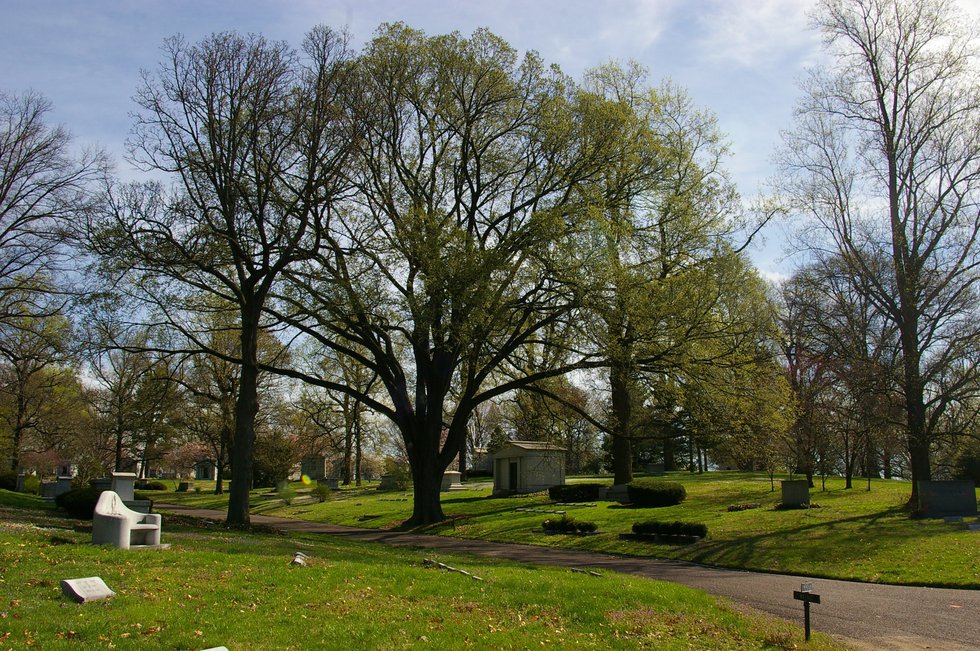
Bellefontaine Cemetery and Arboretum
Bellefontaine—the self-proclaimed “other Forest Park”—was established in 1849, and offers recurring tours. One, Bellefontaine in Bloom, is a plant-centric tour that takes place a few times per month through the springtime.
Kyle Cheesborough is the director of horticulture and living collections curator at Bellefontaine and has managed the tree population there for the past six years. He elaborated on the process of meeting some of the arboretum criteria: “We have a lot of diversity anyway. We do put an emphasis on trying to use as many native species as possible. That’s been a challenge, looking for things that native but also uncommon. And always without a doubt we are avoiding anything invasive.” For example, all of the invasive callery pears and honeysuckle has been removed. Of the almost 9,000 trees and shrubs, Cheesborough shared with us some of the best trees to check out that are impressive for their stature, their beauty, and their rarity.
For stature: American elm (Ulmus americana)
If you only have time to check out one tree, pay a visit to the former state champion American elm. Bellefontaine is home to two other state champion trees as well, but this American elm, which towers over the James S. McDonnell lot, is sure to impress. It is thought to be older than the cemetery and stands over 100 feet tall with a canopy spread of 122 feet. American elms are an iconic tree in U.S. history, as they used to line the streets of nearly every American town until Dutch elm disease slowly spread across the country throughout 20th century, decimating the population by way of fungal disease. This particular tree receives injections to help resist the disease.
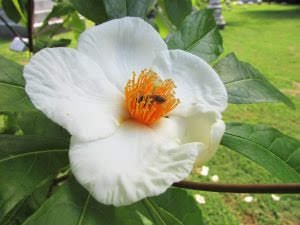
For beauty: Franklin tree (Franklinia alatamaha)
With large, fragrant white flowers in the late summer and stunning red-purple fall color on the leaves, this tree is not only beautiful, but it has an interesting history. Cheesborough explains, “With some of the new plantings, we’ve done some things that are pretty amazing. Franklinia is extinct in the wild. It used to grow down in southeast Georgia, but then it went extinct.” This means that this tree has only lived on through horticultural propagation, and all trees of these species living today can actually be traced back to the garden of American botanist William Bartram, who discovered the plant in the late 1700s and grew it from seed in his garden. There is a great Franklin tree at Bellefontaine near the Busch Mausoleum, a little northeast of the center of the park.
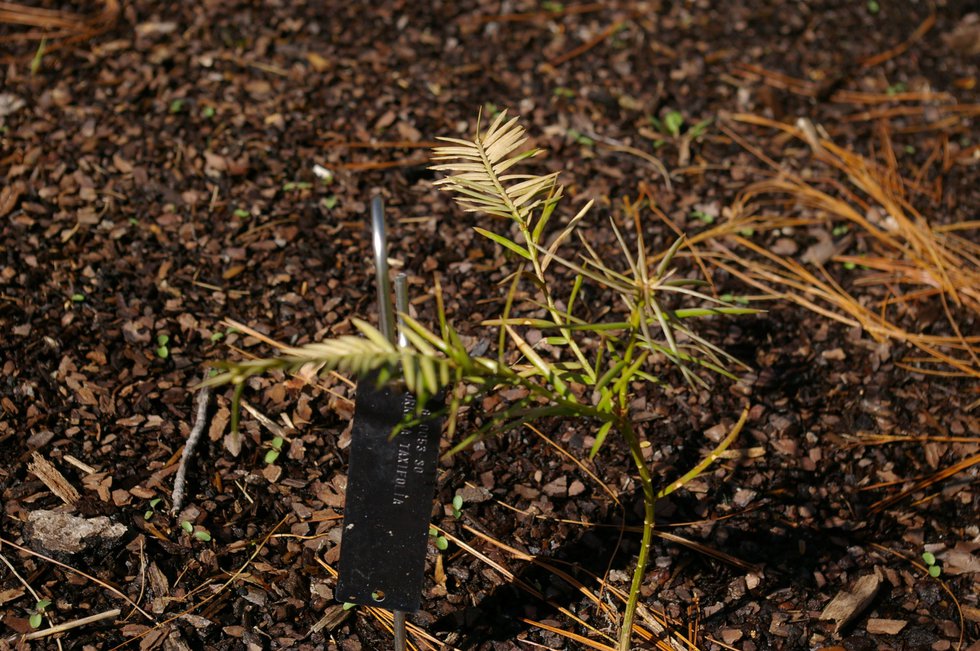
For rarity: Florida nutmeg (Torreya taxifolia)
Considered by some to be the rarest conifer in the world, the Florida nutmeg is a critically endangered plant native to Florida. The plant has been suffering from a fungal blight in its native region, and its population has declined in recent history due to issues related to geographical restriction. Cheesborough recently initiated an effort to revitalize the species, and he now has several saplings established at Bellefontaine. Another name for this evergreen plant is the “stinking cedar,” due to the pungent odor that occurs when the foliage and twigs are crushed. The young trees are only about 1 foot now, but if everything goes well, they could be 15 feet in 10 years. Visit these odd little plants, and follow their progress.
Tower Grove Park
Tower Grove Park is one of just a few parks in the country recognized as a National Historic Landmark, and it’s home to over 7,000 trees, managed by Andy Berg, arboriculture supervisor at the park. Berg is a certified master arborist through the International Society of Arboriculture (ISA). He was also recently awarded with the ISA 2018 Award of Merit. Berg spoke with us about a few of the most interesting trees visitors can check out.
For stature: Osage orange trees (Maclura pomifera)
These gnarly giants are known by many for the green “brains” they drop in the late summer. Osage orange are impressive year-round for their size and unique, irregular branching habit. Berg explained the Osage orange trees functioned historically as living barriers. “Our large Osage oranges are impressive and were more than likely planted in the late 1800s, early 1900s as functional buffers along old roads/paths.” You’ll find an impressive grouping right by the Music Stand along South East Drive, close to the pond and the Piper Palm House.
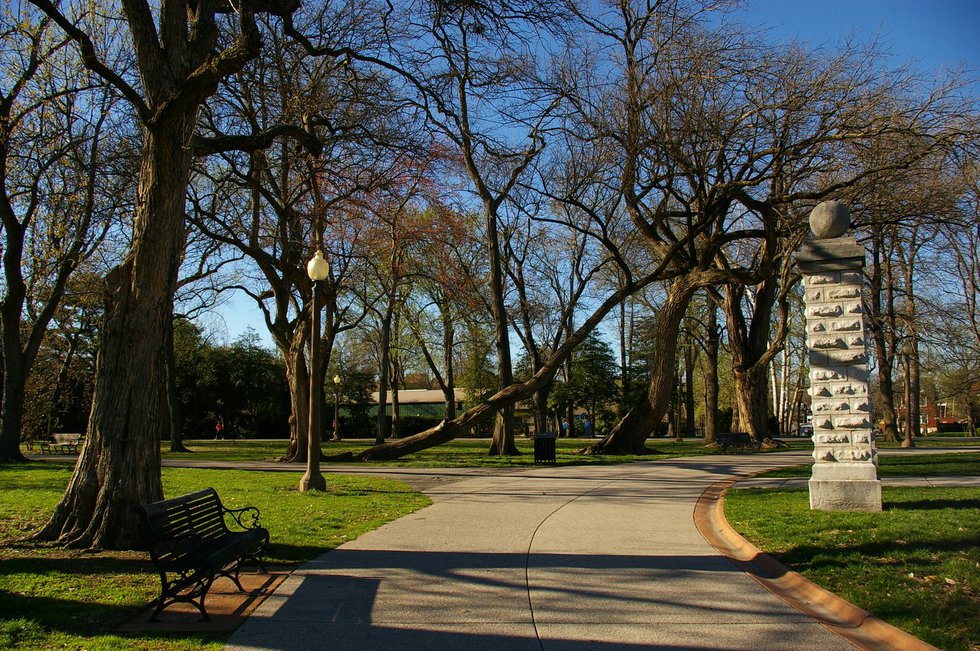
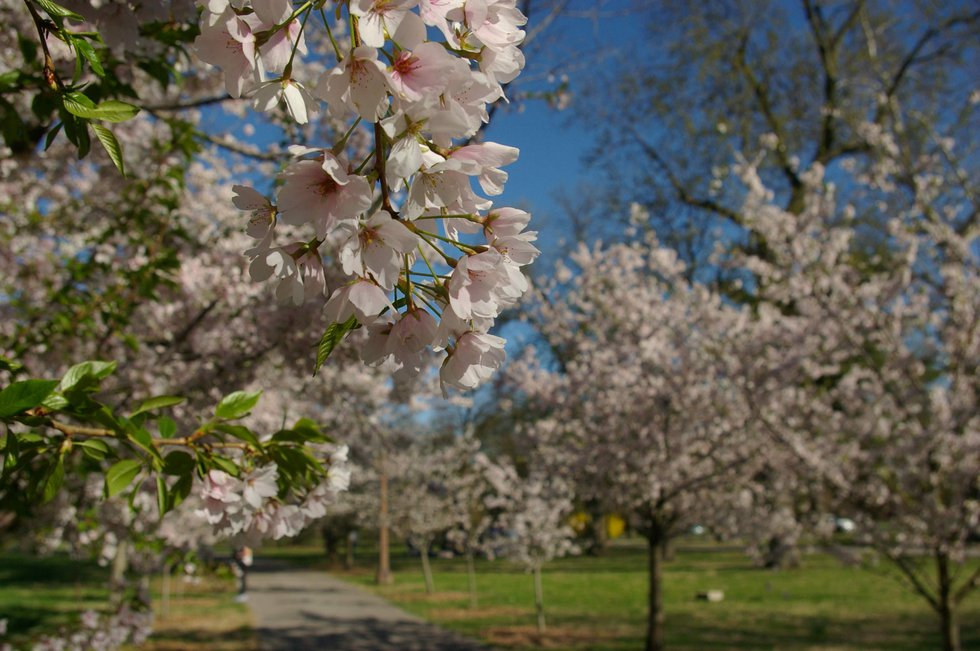
For beauty: Yoshino cherry trees (Prunus x yedoensis “Yoshino”)
Cherry trees are admired all over the world as an emblematic sign of springtime, and when planted en masse, their beauty is overwhelming. If you head east from the Music Stand, there’s a row of white-flowering cherry trees that lines the sidewalk, known to some as Cherry Lane.
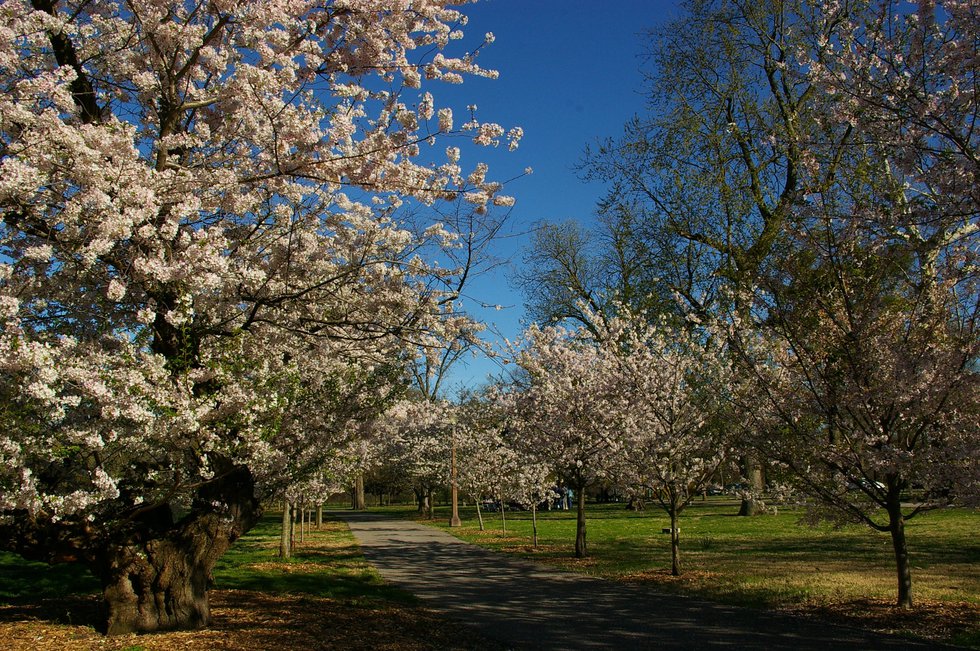
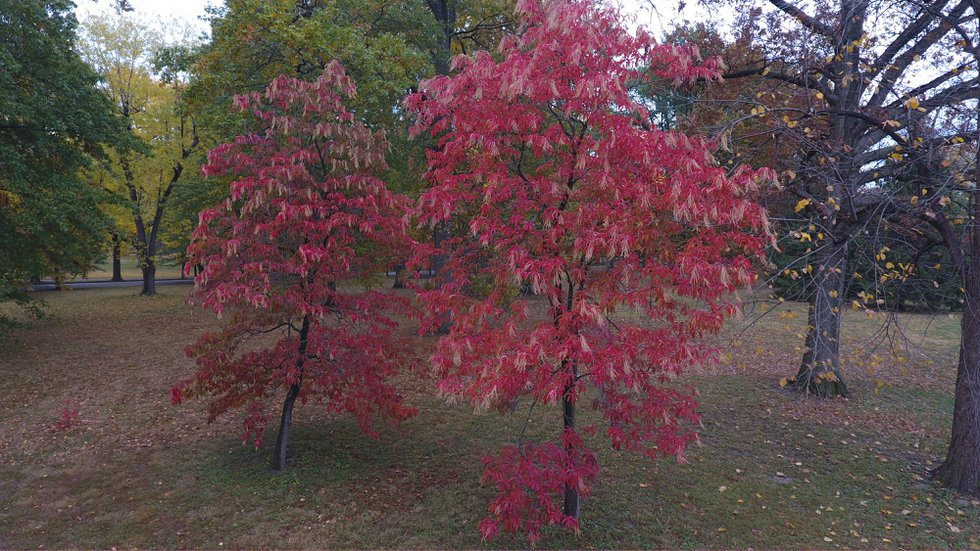
For rarity: Sourwood trees (Oxydendrum arboreum)
You won’t find many sourwood trees in the St. Louis area or even in Missouri. According to Berg, they’re too difficult to grow here. The success and well-being of these trees is probably due in part to the rich, undisturbed soil in the park. These trees are native to the eastern U.S., and they have interesting white flowers that hang in clusters in the summertime, as well as a gorgeous saturated red fall color. The group of sourwood at Tower Grove can be found near the west entrance, a little southeast of the circle drive portion of West Drive.