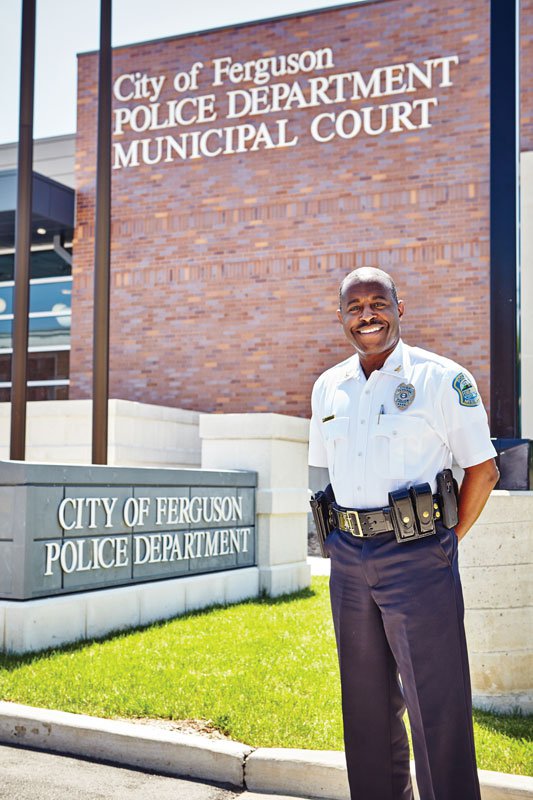
Delrish Moss, 51, took over as police chief of Ferguson in May. Moss was with the Miami Police Department for 32 years, serving for the last two decades as a public information officer. He’s tasked with implementing a consent decree with the U.S. Department of Justice, resulting from inquiries precipitated by the killing of Michael Brown.
How did you become a public information officer? Lt. Bill Schwartz came up to me and asked me if I ever thought about being a public information officer. I said “No, I don’t even know what that is.” At that time I was a homicide detective. They said “You’d be a good spokesman for the department. You have good ideas and you have a good way of expressing yourself.” Initially I said no. About three months later they came back. That second time around I went ahead and took the challenge.
Get a fresh take on the day’s top news
Subscribe to the St. Louis Daily newsletter for a smart, succinct guide to local news from award-winning journalists Sarah Fenske and Ryan Krull.
When you became a PIO, what did you think the public misunderstood about the police? There is the police perception of the public, and a public perception of the police, that’s often, kind of, off. I think what the public needs to know is a more detailed explanation about why we do some of the things we do. When people understand why reasonable force is necessary, it’s a bitter pill to swallow. Sometimes police today, particularly with social media and with negative feedback about police, think all of the public is out to get them. Nothing could be further from the truth. When I talk to people, they like the police. They may not have liked what the police did in a particular incident, but they like the police, and for the most part, they support them.
What would you say to a young black man or woman considering becoming a cop? I would tell that person to apply, because you have a voice that needs to be heard. We police have to be of the community in order to understand the community. It can be a prevention tool more than anything else. When we sit down and figure out what challenges the people have, the better we are in a position to prevent crime and stop repeat criminals.
You are coming to Ferguson from Miami, a place that is not without problems. Does that help? Miami has had its problems. It had civil unrest, and I’ve been on both sides of that—living in the neighborhood when it happened and also being a young policeman patrolling an area where it happened. Miami has had a consent decree on more than one occasion. I’ve worked closely with chiefs of police. All that will aid my work in Ferguson. Mine has been a 32-year training ground for this job.
When you heard about the killing of Michael Brown and the aftermath, what did it look like to you? When I first heard of it, the city was engulfed in civic unrest. People were already talking about Michael Brown on social media. Everyone had an opinion. One of the things I’ve learned is that often the prevailing opinion may not be in line with the facts. I like to reserve judgment until I get the facts. What I think is that Michael Brown was not the only problem. The Michael Brown situation was a catalyst, a peeling back of layers of more deeply rooted problems.
Did you think about retiring before taking this job? My retirement date was scheduled for Sept. 27, 2016. Most people who know me knew I had a countdown on my phone to the day of retirement. For some reason, when I heard about the job, when I saw some of the things on TV, I thought I could put retirement off for a few years. I’ve got to go out there and try this.
Did anyone call you crazy for taking this job? Every day. I have family members who still think I’m crazy, but I don’t think I’m crazy. The challenge called to me, and I heeded that call.
Had you considered any other job? I wasn’t considering any other job. My job was going to be a full-time beach bum. I love the beach. I worked long and hard and I thought it was time to kick back and relax. In my spare time, I like to go out and take pictures of wildlife. I’ve spent a lot of time in the Everglades, taking pictures of alligators and things like that. That’s what I had planned to do. But this came up, and I said, “No, you can put that off.”
How would you compare being a cop today to when you started? A lot of people think through social media the police profession is being assailed. But 30 years ago, when I started this job, we could pull up on a certain avenue and we would be pelted with rocks and bottles. If people are talking about you on social media, trust me, that is a much better day than what we got back then. I think it’s much better, in part because of the communication. Social media—for all of the things that are wrong with it—it’s a great democratization of life. Now people have a voice.
Anything you want to add? To the people of Ferguson: I have not come to lord over you; I’ve come to help. Together, we can make a difference.