His musical Merrily We Roll Along has returned to the stage, and Stephen Sondheim has invited Lana Pepper to the opening-night party. She’s stunned, and she knows he’ll be thronged with fans, so she barely expects a nod—but they wind up chatting all evening. When she says, “I see you value friendship the way I do,” he leans forward. “I just looked back at my body of work,” he says, “and I think it’s all about friendship.”
A few times, Sondheim breaks off to chat with various celebrities. Pepper recognizes J.T. Rogers, whose play Oslo was just staged in St. Louis. Dazed, she turns to the woman seated next to her, a stranger until that evening, and whispers, “How did I get here? My mother grew up in a house with dirt floors!”
Stay up-to-date with the local arts scene
Subscribe to the weekly St. Louis Arts+Culture newsletter to discover must-attend art exhibits, performances, festivals, and more.
Technically, the journey was straightforward: Pepper was president of the Saint Louis University Library Associates board for years, and she hosted a dinner for Sondheim when he flew in to receive the organization’s 2018 St. Louis Literary Award. Hearing that he drank vodka, she was dismayed—“All we had was rotgut”—and raced out to get something finer. That evening, Sondheim poured himself a glass of white wine. “But you drink vodka!” she exclaimed in dismay, and he shook his head sadly: “Can’t drink that anymore.”
Pepper nodded. “We’re in the age of subtraction,” she said, and they fell into a long conversation about aging, giving up little indulgences, losing friends, facing death. Later, he asked if she’d made up “the age of subtraction” herself and warned that he might steal it.
Now, as he chats with Rogers, she thinks about the arc of her own life, and her favorite Sondheim lyrics come back to her: “Bit by bit, putting it together/Piece by piece, only way to make a work of art.” Her first bit was her childhood in Boss, Missouri, and the one-room schoolhouse built of thick-mortared gray stones as a work project during the Depression. Eight grades, one teacher. All she remembers learning is how to teach the younger kids to read. She begged her parents hard to send her to Salem, a bigger high school. The Sunday after graduation, she moved to St. Louis.
What she wanted was this: music, drama, compelling ideas, interesting people to talk to, and dinner someplace besides White Castle, where her high school boyfriend took her with a flourish when he snagged a job at the Chevy plant in St. Louis. If he hadn’t dumped her, she’s dead sure she would have wound up living “in a kid-filled trailer in my parents’ backyard,” not starting the St. Louis Shakespeare Festival, directing plays, organizing galas, and flying to New York to hang with Stephen Sondheim.
Pepper isn’t religious; her dad was the only professed atheist in Boss. (Also the man all the Christians turned to when they needed help or mercy.) Her life doesn’t feel predestined to her, or even porous enough for divine intervention. As far as she can tell, the forces at work have been love, grit, and the kind of optimism that creates luck. Everything that happens to you, she believes, is the upshot of a lot of tiny decisions made along the way. “Every moment makes a contribution,” as Sondheim put it. “Every little detail plays a part.”
The woman next to her smiles, maybe a little too politely, at the “dirt floors” remark. Pepper is used to people not knowing quite how to respond to her directness. It’s weird, and sometimes a little lonely, moving between such different worlds—especially when you’re the sort to blurt the honest truth. There have been so many times she could easily have held it back, faked a background she never had.
Except, the way she got here was by being herself.
“First of all, you need a good foundation.”
Lana’s mother warms a blanket on an enameled wood stove—fancy for the country, a Heatilator. Wrapping it around Lana, who’s just learning to walk, she carries her upstairs to bed. The added warmth is necessary: The only heat on the second story comes from the chimney. But the memory of being swaddled in that blanket will warm Lana for the rest of her life.
Their next house, her dad builds himself, board by board. Her mother glories in it, sweeping and polishing in supreme contentment. She’s not especially curious about the larger world, just happy to be running her own house. One of the prettiest girls in Boss, she married late, because she had to keep house for 12 brothers. She hadn’t even gone to grade school, because she had no shoes. The house she grew up in had cracks in the wall so wide that the snow blew in, and they’d wake up with icy white flakes on their blankets.
Lana’s dad reads like he’s starving and books are steak and potatoes. He fills all available space with newspapers and magazines, understands history, worries about current events. His daughter catches his enthusiasm but isn’t yet sure what to do with it.
He runs a general store in Boss, and he brings Lana whenever he drives to St. Louis to buy dented canned goods at the salvage store. Her little nose wrinkles and she laughs in delight when they drive under the Gravois viaduct and she can “smell the city.”
Lana moves to St. Louis at 18 with no money, no job, and no car in which to look for one. A cousin has agreed to let her sleep in the basement until she can afford rent. What she really wants is to go to college, but it’s the ’60s, and students are doing everything but study, as far as her father can tell. “If you want to go bad enough, you’ll find a way,” he tells her, “and if you pay for it yourself, you’ll be serious about it.”
Lana arrives on a Sunday, and on Wednesday, he calls: “Found a job yet?” When she says no, spluttering about the difficulties of transport, he says, “I’ll be up in the morning.” He rises at 4 a.m., reaches St. Louis by 8, and drives her around town. By noon, she has a job at the American National Insurance Company. Her fingers are soon crisscrossed with paper cuts from all the filing, but she saves enough money to enroll at Southwest Missouri State that spring.
Alas, she soon runs out of money, so she finds a job working for the manager of a new plant. The owner’s son, he’s not much older than she is, and neither one of them is qualified to do what they’re doing. After months of trying, she takes a rare weekend off and drives to New Orleans with high school friends for the Sugar Bowl. She doesn’t sleep a wink all weekend, and they drop her off at her women’s boarding house at 4 a.m. on Monday. Five hours later, someone’s shaking her awake: “Your boss is on the phone.” She stumbles to the hall phone and hears a peremptory “Are you coming to work today?” Still half asleep, she replies, “Why, are you busy?”
He fires her. Years later, she and her husband, Dr. Ted Pepper, will be heading toward a tennis court in Hawaii and hear a man’s voice boom, “Lana Rae?” They’ll have a brief, bubbly exchange, and as soon as he’s out of earshot, she’ll mutter, “I can’t believe he remembered me,” and Ted will chuckle: “You always remember the first person you fire.”

“Every word, every line…you improve and refine.”
You also remember, if you’re Eliza, your Henry Higgins. For Lana, it’s Alan Ash, a former radio announcer from New York. She’s 20; he’s 50. They both know this romance won’t last. But he reads her poetry in his deep radio announcer voice, and suggests good books, and introduces her to shrimp scampi…
(Decades later, in Chicago with Ted for one of his medical conferences, Lana will look Ash up in the phone book. “I’m where I am today because of you,” she’ll tell him. “I don’t think Ted Pepper would have liked who I was if it hadn’t been for you.” Ash, who’s just home after cancer surgery and hasn’t long to live, will reply, “You can’t imagine how important this call is to me.”)
Lana does some Pygmalion work for herself, too, modulating her “twangy Ozark country accent.” She grew up hearing “They was” or “I seen,” never the word “were.” St. Louisans keep asking, “Where are you from?” So, she makes her friends promise to stop her immediately if she makes a grammar mistake, and she trains herself—“Me, who has a mouth that runs before the brain”—to stop and think before speaking.
Luckily, she has plenty of social confidence; gaps in her knowledge of the world just prompt her to fill them. Born on the Fourth of July, Lana thought at first that the fireworks were for her. (“My parents supported that for far too long,” she says dryly.) An only child, she had a mother who was “just all love” and a father who took daily delight in her, and they lived in a town where 6-year-old Lana felt comfortable writing in her diary, under Notify in Case of Emergency, “anyone in Boss.”
After the thousand cuts of the insurance company, she applies for a hotel job. Her prospective boss suggests they meet for the interview in the evening, in a bar. On Lana’s first day of work, a Frenchwoman in the department warned her, “He’s going to hit on you. And he’s married.”
Primed, Lana rebuffs him. From that day on, though, nothing she does seems adequate. He insults her in front of everyone. She finds a deserted hallway in the basement where she can weep.
It’s a shame, because she’s learning so much, sitting in on planning meetings and working with florists, ice carvers, butchers, bakers… The experience will come in handier than she knows. But the job is untenable. She goes to work as a secretary downtown and spends evenings as a live-in nanny on Westmoreland, eating her dinner “alone at a little round table on the other side of the dining room door. I could hear everything!” When babysitting every evening exhausts her, she and a girlfriend splurge on a “convertible” apartment at Mansion House, “with a little accordion door you could draw across the room.”
There’s a tall, earnest med student in their building, so mild-mannered, Lana barely notices him. But when he hears that she’s taking a Greyhound bus to Boss for Easter, he urges her to drive his new car instead, a metallic-green Buick Electra convertible.
She agrees—then backs down her family’s driveway crooked and drives straight into a woodpile, putting a dent in that nice new convertible. Her relatives tease her, because she doesn’t usually drive so crazily. But she insists that she’s not in love, says all weekend that Ted Pepper is just “one of the nicest guys I’ve ever met.” Says it so often, in fact, that she starts to hear herself, and the significance of the words sinks in.
She returns Ted’s car with a changed heart, and they date with increasing fervor. One evening, they’re at the ballpark, and Ted goes off to buy a box of Cracker Jack. When he hands it to her, he teases, “If there’s a ring in it, you know what that means,” referring to a scene in Breakfast at Tiffany’s, which they saw together.
She opens the box, and the prize is a ring. Jumping up and down, she falls off the curb and sprains her ankle. Home with her swollen ankle propped, she comes down with the mumps. Who gets the mumps? Her boss will never believe her.
“You know what?” Ted says. “Why don’t you just quit?’”
They marry in 1970. A year later, their son is born, and in 1974, their daughter.
“Adding up to make a work of art…”
Freshman year at Salem High School. Lana does a monologue called “I’m Engaged to Lemuel” and wins the talent contest. “Over the Heitman brothers, who played the trumpet,” she tells her parents, elated and a little worried. She’s not sure she deserved it.
The monologue, by W’ilma Faye Yokely, is indexed alongside “Sis Hopkins and Her Beau, Bilious,” “Uncle Josh’s Idees on Wimmin,” and “Oh! To Be an Actoress!” This will be Lana’s peak experience of drama until her twenties, when she and Ted see Othello. In the middle of his grueling medical residency, Ted falls asleep as soon as they settle themselves in the warm theater. Lana sits forward, teetering on her seat’s edge until the final curtain, dazzled by the wordplay.
Once both children reach school-age, she goes back to college, telling nobody. She studies in the back of her Volkswagen bus, cozy and private, as she waits to pick up the kids. She plans to major in sociology, because it’s about “people and how people work.” But along the way, she takes a history of theater class at Fontbonne College, then another, and another. “I believed you could judge a country’s civilization by its theater,” she explains. “I still kind of think that.”
Lana goes on for an MFA in theater at Lindenwood University, and she’s just finishing when R. Crosby Kemper III decides that St. Louis needs a Shakespeare Festival. Anabeth Weil (then Calkins, not yet married, and the manager of Forest Park) tells him he needs Lana Pepper. “She’s unflappable.”
Working gratis for the first two years, using her sunporch as her office, Lana starts the St. Louis Shakespeare Festival. Once she’s raised enough money to hire an artistic director, he says he’ll take care of everything onstage and the rest is up to her: lining up six different groups of entertainers every night for the green show; wrangling 25 volunteers a night for 16 nights; finding vendors; getting the program printed; selling the ads; arranging free housing for the actors; schlepping green plastic lawn chairs from various dollar stores. If she stacks them just right, she can cram 40 at a time into her station wagon.
Her only help is a Russian intern who’s seven months pregnant. The Festival needs a website. So when Lana’s daughter, Haley, is in the Baltic learning to captain a tall ship, and she hasn’t slept for days, and a kindly couple takes her in, and Lana calls to thank them, and they mention a young German woman who wants an internship in the States, Lana asks instantly, “Can she do a website?”
Melanie Steinborn comes to live with the Peppers for many months, and longsuffering Ted endures cascades of chatter as he cooks and restocks the pantry. Lana works “concentrated and ambitious on countless tasks,” Steinborn will say, watching the older woman “networking, working under time pressure, going optimistic into unplannable situations.”
Here’s an example of how Lana fundraises: She wants to add a touring
educational show, so she calls Graybar Electric Supply and speaks to vice president Dennis Grousosky, who likes her so much, he invites her to dinner. When she assures him that she eats “everything but liver,” he says, “Life’s too short for liver.” So Lana writes him a poem, “Life’s Too Short for Liver,” which he frames and hangs on his dining room wall. Her original purpose had been to find a van to haul actors, sets, and costumes around Missouri; she finds it easier to ask for in-kind donations than money. For many years, Graybar donates a van—and money.
Eventually, Lana moves on to direct an arts management MFA program at Webster University and to direct plays herself. She works at Stray Dog Theatre, the New Jewish Theater, and the St. Louis Actors Studio. Actor Glynis Bell says Lana gives her cast free rein to interpret, “but every once in a while, she’ll say, ‘I have an idea.’ And it’ll turn out to be the one thing people love most and talk about.” Her direction, like her conversation, is lively, full of emotion and humor, with plenty of room for individual quirks of character—but a solid internal logic. Theater critic Gerry Kowarsky can detect Lana’s hand even in the monologues she directs, because they shift so smoothly, and with such clarity, “to signal changes in time, speaker, and mood.” Directing shows and running an arts organization “require different kinds of talent,” he adds. “Lana has both. That’s rare.”
“Everything depends on execution.”
“Lie down on this mat,” instructs Lana’s close friend Donna Rogers-Beard.
“Donna, you mean to tell me I got out of bed just to lie on the floor?” Lana demands. Her small, taut body is vibrating with energy, and now Rogers-Beard can’t relax. She gently informs her friend that yoga is not something they’ll be able to share. Months later, Lana, all excited, mentions this great yoga place she’s found for them to try. Rogers-Beard sighs: “Lana, if you like it, it’s not yoga.”
Ted has the same strong work ethic she does, Lana tells me: “Just give us a basement to clean out, and you’ll see.” The Pepper family started making Pepper’s Ginger Ale in Pennsylvania in 1885, and presidents have drunk the stuff. Mrs. Tommy Dorsey, wife of the bandleader, was said to find it so delicious, she had it shipped to her wherever she traveled.Ted worked at the plant as a kid, and he remembers how to roll up his sleeves. As for Lana, her son gave her a plumber’s wrench because she kept tackling her own repairs at their Central West End condo and at the contemporary three-bedroom in Tower Grove South that she designed herself.
That project started as an effort by Ted to channel some of his wife’s exuberant energy. “You’ve always wanted to design a house from the ground up,” he said. “Why don’t you?” What Lana came up with was so much cooler than the surrounding homes, it was impossible to sell for a profit. So she turned it into an Airbnb, art gallery–sleek, with a built-in wine fridge, a long black table with Lucite chairs, Juliet balconies off the living room.
She furnished her Airbnb by haunting the Habitat for Humanity Restore for two years, plucking the best granite, cabinetry, light fixtures, iron railings. Between guests, she’s often cleaned the place herself, ironing the pillowcases and top sheets, “making everything five-star. I put on some great music, and I make it a challenge, see how fast I can do it.” Once the house sparkles, she fills baskets with small comforts and—a practical romantic—tucks in a packet of condoms.
One afternoon, I watch her tear through the Airbnb to ready it for that evening’s guests. She’s worried about her neighbor not having enough air-
conditioning for the heat wave. She makes sure there are ice cream treats in the freezer, spots a smudge on the shower door, resets a clock that’s not the right time, notices a missing white patch that covered a nail hole. I see none of this. I’m enjoying the subtle touches: a lamp base wrapped in rope, set in front of a blown-up, textural photo of a dock; a striped pillowcase border that picks up a tiny striped patch in a contemporary painting above the bed.
“She’s got this incredible taste,” marvels Bell. “She’s very sure, and she doesn’t settle. She has this vision in her head, and unless something strikes her as absolutely right, she won’t buy it.” It’s far more fun, Lana thinks, to create something beautiful for next to nothing. “She can go to Goodwill,” says Bell, “come out with a cartful of things and put them in place, and they’ll look amazing.”
At an age before tact, Haley once announced, as they were visiting a friend of Lana’s, “My mom said that if you’re poor and you live in a gaudy house, then when you get money, you will live in a big gaudy house.”
“And there we were,” says Lana wryly, “in a big gaudy house.” She quickly finessed her daughter’s faux pas, just as she redeemed herself after Sondheim’s opening night party, when she was so engrossed, she kept picking up his wine glass by mistake. “Lana, that’s my wine,” he’d tease. So she came home, picked out some fabric (she’d snapped up hundreds of samples when they were being discarded) and made him three pillows. The first, she had monogrammed in small script, “that’s”; the second in large caps, “MY”; the third, “wine.”
“It’s risky from the start.”
Flashback: Lana’s 21 and, fed up with the hotel job, she’s ready to sell her car, TV, record player, and all her best clothes so she can take the first transatlantic trip of her life. She lands in Luxembourg and manages a train to Wiesbaden, where a friend is working for the U.S. Air Force. Except that instead of welcoming Lana with a big hug, the friend announces, “I went to Morocco and spent all my money, so I have to go home.” So Lana’s alone in Europe, and so freezing cold (she packed the lightest of what clothes remained) that she bounces into a travel agency and asks if $180 will get her someplace warm. She winds up in Majorca—her first sight of the sea—and falls briefly, madly in love. When it’s time to leave, she goes up to the hotel’s roof and sobs. But grief doesn’t stop her from taking a weekend bus trip to Paris and heading to Oktober-fest in Frankfurt.
Years later, at a time when Ted’s busy, Lana changes her mind about refusing a trip with friends and flies alone to Ireland to surprise them. Having had no food, drink, or sleep for many hours, she straps herself in behind the left-side steering wheel and drives a rental car down rock-walled country roads and around dizzying roundabouts, clutching convoluted handwritten directions in her left hand. Miraculously, she finds the country house that her friends are renting, but they’re gone and the door is locked. I’ve got to find food, she thinks, but I can’t get lost. I’ll just keep making right turns.
When she pulls over a few minutes later, second-guessing her plan, someone waves from a lit cottage window. Two couples from England are vacationing there, and they’re eating in tonight, and they have plenty of food, even an extra dessert. They feed Lana, pour her wine, and lend her a blanket to wrap up in while she waits for her friends.
She’ll stay in touch with these couples for the next quarter-century, and they’ll wind up visiting her in St. Louis.
On a trip to Italy, Rogers-Beard sits next to Ted in the back seat, arms folded tightly over her stomach, while Lana drives along the Amalfi Coast at dizzying speed, hands relaxed on the wheel as she navigates the twists and turns. Beneath her terror, Rogers-Beard knows instinctively that they will arrive intact.
She thinks back to the first time Lana scared her: Having met an elderly man at Schnucks, she said, “He looked so tired, and it was such a cold, awful day that I asked if I could give him a ride home. I gave him my phone number, and he wants to go to lunch. Would you like to come?” Rogers-Beard sighed that time, too. She couldn’t let Lana go alone. And it turned out the gentleman was delightful, self-educated but a sensitive soul, and they had a wonderful conversation. Another time, Lana hosted a Prison Performing Arts party at which alumni of the program, now out of prison, mingled with board members. You wouldn’t do that, Rogers-Beard told herself. Lana’s fearless. She’s always bringing together people who would not ordinarily find themselves in the same space.
“Takes a lot of earnest conversation”
At an auction in St. Charles, Lana’s meant to be looking for furniture. Two years married, she and Ted have just bought a gorgeous old house on Kingsbury Place with big high-ceilinged rooms they can’t quite afford to furnish. But she spots a 1946 Wurlitzer jukebox with bubbles, and every time the auctioneer looks at her, she gives a tremulous little nod. She drives home with butterflies trapped in her stomach, terrified that Ted will be upset. He likes it. So they have a sock hop, inviting their new neighbors and his medical colleagues, and they all dance, and Lana has so much fun, she forgets to bring out the food that’s in the oven.
The sock hop sparks a social creativity that will grow into an avocation. Soon Lana throws a not-going-away party for one of Ted’s doctor friends, who’s from Chile and has decided not to move back after all. Lana writes a script, tells all the docs what to say when, and syncs a tape with sound effects—the president of Chile speaking, people celebrating New Year’s Eve in Times Square…
For another party, she and Ted refine their bouillabaisse recipe and she turns the garage into a French bistro, blacking out one window, adding an Eiffel Tower silhouette, setting up little tables with red-checked cloths, sticking candles into wine bottles with melted wax, and hiring the Poor People of Paris to play.
Soon she’s planning galas for a cause: an antique show for The Rep, a gala for the Kevin Kline Awards, a benefit for Operation Food Search; a Tennessee Williams–themed fundraiser for The Beacon; all the Shakespeare Festival opening- and closing- night parties. Pretending she’s a guest, she starts with receiving the invitation and walks every step.
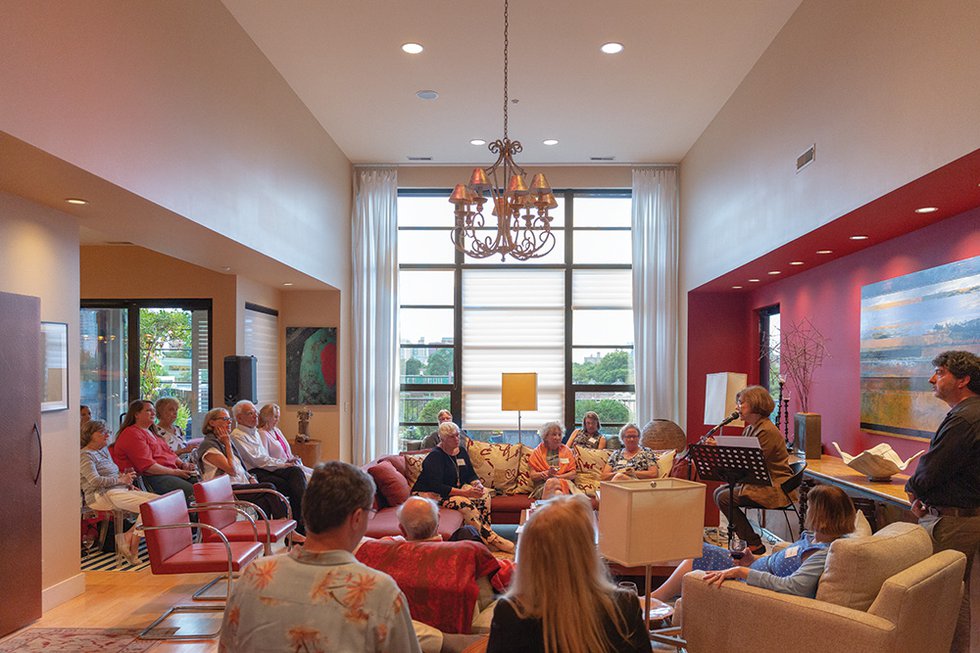
Many a St. Louisan has stood on the Peppers’ wraparound terrace, sipping wine and watching the sun set. I’ve been part of Shakespeare dinners there, and the group’s a motley one: Some are brilliant but flat broke; others are scions of
St. Louis’ oldest families. Elizabeth Oldham, a ninetysomething Quaker from England, sounds like Vanessa Redgrave when she reads the Bard’s lines aloud.
The common denominator in Lana’s guest lists isn’t social standing or common history, observes makeup artist Scarlett Monks. It’s creativity: “Every time she invites you to dinner, you change your plans and go, because the people you meet will be amazing. Graphic designers, antique shop owners, writers… They all love the arts.”
When Monks agreed to move here from London for her husband’s job, a friend of a friend of her father’s announced that she simply had to meet Lana Pepper. “We came for nine days to look for an apartment, and Lana had planned a dinner party for me. She hadn’t even met me yet! She invited all the cool young people in her building.” One, an immigrant from Iran, was just Monks’ age, and they wound up having baby girls at the same time. “We bump into Lana when we’re together, and she’s like a proud mother. I don’t think I could have gotten through last year without both of them.”
Lana took New York editor George Hodgman under her wing, too, after he moved back to his small Missouri hometown to write his best-selling memoir, Bettyville. “She didn’t know me from Adam,” he told me shortly before his death, “but she organized a reading for me, and she turned it into an occasion. She turned it into a beautiful thing. It was very smart, because nobody knew who I was, so she made the reading a destination.” They became friends, as invariably happens with Lana and anyone she likes. “I relate to Lana, because she sees so much from the vision of a small-town girl who’s come to the city,” Hodgman told me. “Everything is still just a few times more interesting, a few times more wonderful. She wants things for the city that she loves—she wants it to stay that city in her mind—and she’s willing to do the work. She’s not on a chaise longue in Ladue.” He thought a minute, smiled. “There’s part of her that likes running the show a little bit. But she’s not skulking in the background scheming—she’s direct and straightforward, not coy behind her fan, pushing the pieces around. She has real ambition. I have a lot of respect for her.”
Some friends call her LAH-nah and some call her LANN-nuh, and to anybody from Boss, she’s still Lana Rae. “She’s always been open,” says her cousin Sis Miner. “If anyone from the country needed a place to stay, she’d fix up a room.” When the Saint Louis University Library Associates brought in Margaret Atwood, Lana wound up dancing the Charleston with her.
The hospitality even crosses species lines. When her kids were little, the family dog, a golden retriever named Pepper, sat at the dinner table with them. And Rogers-Beard, who isn’t fond of birds, was appalled to learn that her friend could talk turkey. The women were walking at Forest Park when a large specimen appeared. Hearing Lana’s gobbled greeting, he strutted toward her. “I don’t know what you just said to your little friend,” Rogers-Beard gasped, “but tell him to get the hell away from us!”
“Wiping all the scenic ostentation”
At an elegant summer picnic, the conversation turns to economics, and a corporate lawyer notes Walmart’s generous employee benefits. Lana isn’t buying it. She pulls out her phone and texts a relative in southern Missouri who works at Walmart. “What you’re talking about must only be for management,” she informs her friend.
The boundaries of Lana’s life expand to contain everything bad that ever happens to anyone in her orbit, every outrage born of injustice, every tragedy on the news. She raised her kids to listen to NPR—not for political reasons but instead because she thought its reporting would provoke curiosity and compassion. Long before the closet doors opened, she tactfully began addressing all correspondence to an old friend to include her “roommate.” As exacting as she is about things being done right, she accepts people just as they are.
“When you live in a small town, you are exposed to all levels of society,” she explains. “You know the village idiot, you know the bank president, you know the doctor—and you know them all personally. I’ve known people who lived in shacks during the winter and as soon as spring came, they took their five kids and moved to a river bank and camped out the entire summer. One of the myths is ‘Oh, if they just tried harder.’ Well, let me tell you: There are levels of intelligence you are born with that you cannot do a damned thing about. When they say there are people who aren’t smart enough to come in out of the rain, it’s true. You can’t say those people are lazy. That’s just how they’re equipped. Or maybe they’re smart about intellectual things, but they have this glitch that keeps them from being able to hold a job. I’ve known all kinds. The people I worry about are kids who grow up in suburbs where the houses all cost about the same, and the education of the parents is all the same, and they don’t know how to accept people who are different.”
When Lana received the St. Louis Visionary Award in 2018, honoring years of tireless service in the arts, she told the audience, “Compassion is what keeps us civil and kind and able to play with others on the world’s playground.” I ask what works have moved her most profoundly. “I’ll never get over ‘Master Harold’…and the Boys,” she says. “The failure of the old man trying to change generations of inbred social injustice and racism…”
The arts pry open closed minds, she says. “They make us more human.”
She reads avidly, goes to the theater, inhales the paintings and music she was starved for as a kid. She’s still filling in gaps. Her grandsons teach her about the sun and the moon, about science, about history. Before seeing Hamilton, she digested the book, the score, and the libretto.
“When I went to sign up for high school, I had never heard the word ‘biology’ before,” she remarks. “When I told my mother I’d gotten a job working for the Shakespeare Festival, she’d never heard of Shakespeare.”
Those gaps left Lana hungry for knowledge, unwilling to tolerate anything less than excellence. Any event she’s connected with will be visually stunning, comfortable, and alive with stimulating ideas. As her German former intern puts it, she has “a talent for the great all and the detail at the same time.”
“And she pulls it off,” concedes Rogers-Beard, “but at the end of the evening, I’ll look at an exhausted Lana Pepper and think, ‘How did you do this? The person who caters couldn’t do it this time so you made everything from scratch?’”
Lana readily agrees that her biggest fault is “not letting people do things for me. I want to do it myself, hands on—and I’m turning into one of those old women who walk down the street and mumble about how things should be done better!” Maybe, but she delivers criticism with such warm enthusiasm that people tend not to bristle. They know she’s on their side.
“I want to be the old lady people come to for advice,” she decides. “That would be fun.”