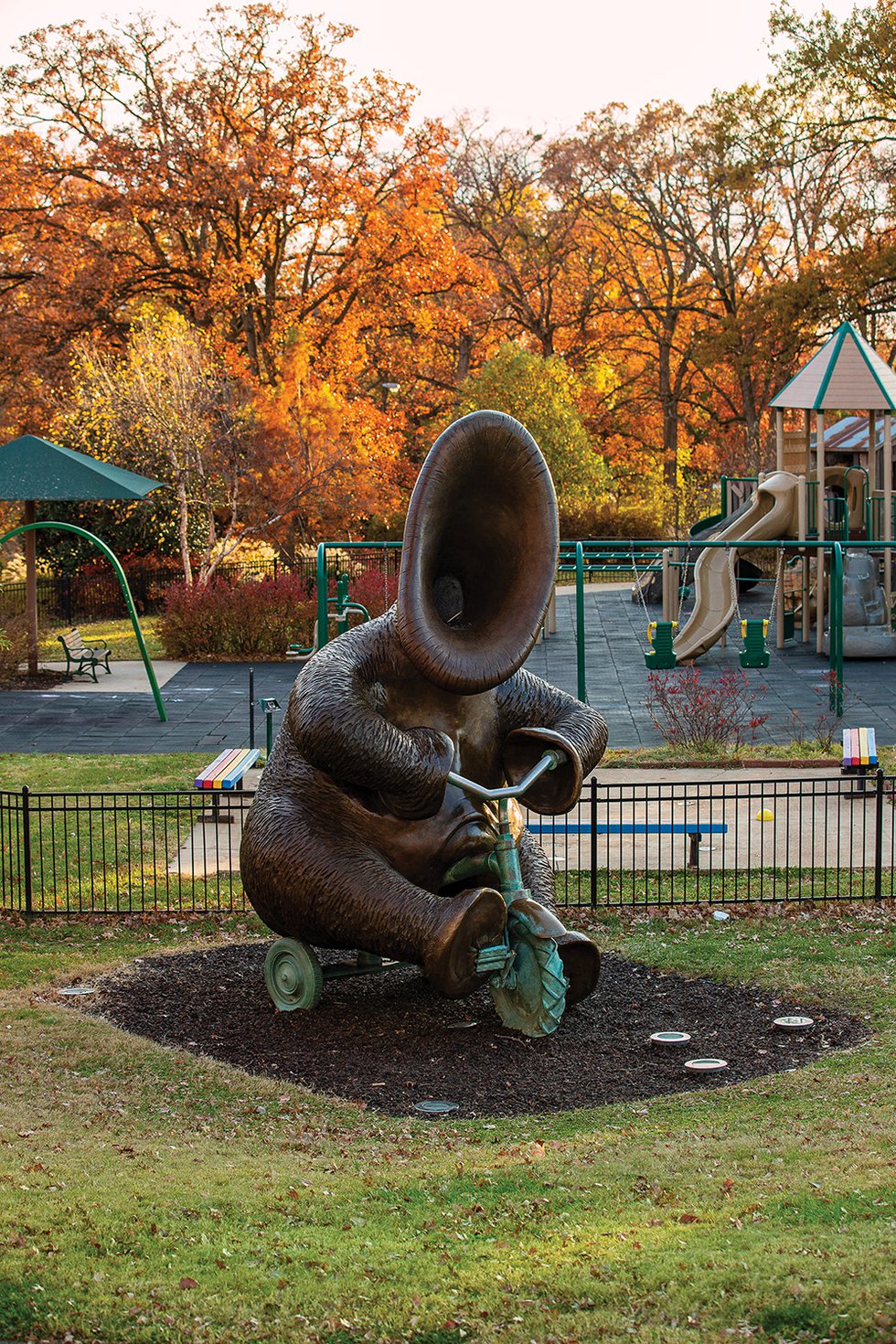
A 16-foot-tall bronze elephant is riding a bicycle near Treetop Playground in Clayton’s Shaw Park. Children clamber up its arms and legs in fruitless attempts to reach its trunk. The giant sculpture is as popular with kids as the monkey bars just a few feet away.
“One of Us on a Tricycle” is the work of London artist Steven Gregory, and it’s on loan from the Gateway Foundation to the city of Clayton. One of more than 30 artworks around the St. Louis suburb, it is there because of an initiative launched in the late ’90s to help make the region a destination for public art.
Stay up-to-date with the local arts scene
Subscribe to the weekly St. Louis Arts+Culture newsletter to discover must-attend art exhibits, performances, festivals, and more.
“There are a lot of reasons public art is a focus for us,” says Clayton Mayor Michelle Harris. “It provides places for people to gather, stimulates conversation, encourages community-building. Public art enriches the physical landscape and gives people a sense of place.”
Of all of the sculptures installed in the municipality, the city of Clayton owns just a dozen. The others are on loan from St. Louis County, the Saint Louis Art Museum, private individuals, and the aforementioned Gateway Foundation. “While not a requirement, the city planning process highly encourages private art in public spaces for all new developments,” says Harris, noting the sculptures outside The Ritz-Carlton and the new Le Méridien St. Louis hotel.
Jacob Reby, a ward chairman and head of Clayton’s Public Art Advisory Committee, says the city has identified more than 20 additional locations suitable for public art. However, he says, finding locations that align with the needs and requirements for installing a particular piece of art can be a challenge: “We have to take into account a lot of factors before placing art. Is this a site where people will be inclined to climb on the structure? Is it in a traffic thoroughfare? Art can’t impede traffic visibility.”
But community interaction with art is an important goal. The city’s website offers a map of a self-guided walking tour. The information is also available on Otocast, a free mobile app that doubles as an audio guide for learning about art and cultural landmarks around cities nationwide.
From the looks on the faces of kids outside the Treetop Playground, it appears that Reby and his team have hit a home run with the bronze elephant sculpture. Five-year-old Clayton resident Sawyer Waldman has a nickname for it: “Trunk Head.”
“I like to climb all the way up its arms, because then I’m really high,” he says. “I pretend that I’m king of the elephants!”