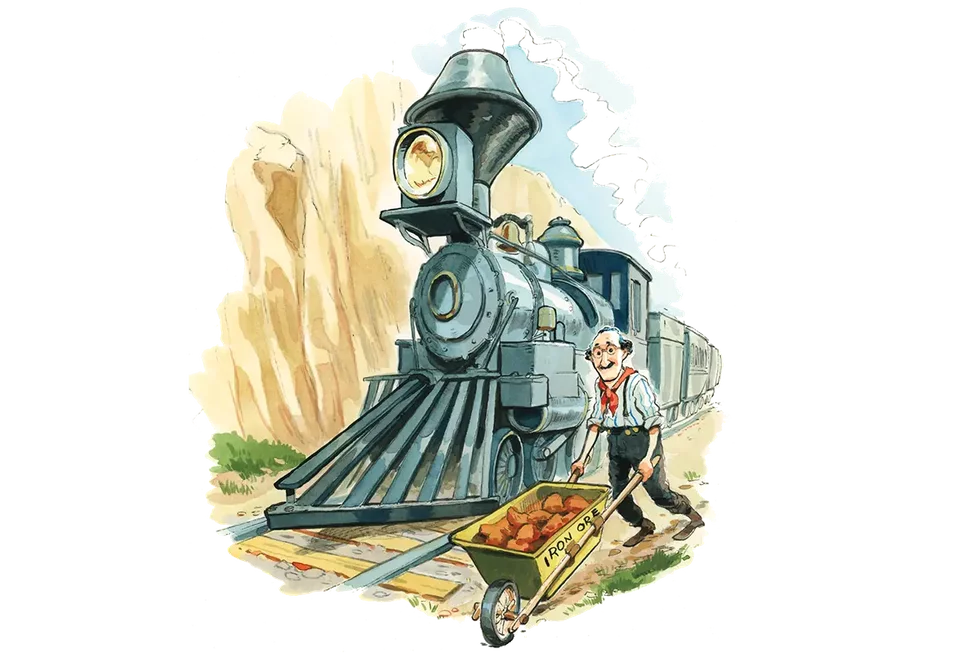
FEW ST. LOUIS INSTITUTIONS can claim to have played a pivotal role in a Civil War battle, and a train robbery by Jesse James and his gang, and a corporate raid by the infamous tycoon Jay Gould. But the St. Louis and Iron Mountain Railroad can. And that’s to say nothing about how it helped shape the growth of the South Side and its industry. In a time of unbridled optimism, the railroad represented St. Louis when it was growing as fast as track could be laid down.
The story begins with what now seems an absurd claim: that an entire mountain was made of iron ore. Nevertheless, the landform in St. Francois County was named Iron Mountain. A book published in 1855 even states that it possessed veins of pure iron among its supposed 212 million tons of ore. The author, Henry Cobb, mused that it held the greatest deposit of the metal in the world. Nearby Pilot Knob Mountain was just as rich in iron deposits; by the time the book was published, there were already three blast furnaces there creating pig iron for export. Mining the mountains consisted of lopping off the top of the summit and then digging out a deep pit to extract the ore. When that was exhausted, tunnels burrowed deep into the bedrock to find more.
The Iron Mountain Railroad was designed to transport the mountains’ riches to St. Louis, but first it had to be built. The charter was granted in 1851. The first leg, between the new town of Pilot Knob and a depot just south of downtown St. Louis, took until 1858. The railroad ran along the south riverfront, between the water and the bluff, and famous breweries such as Lemp and Anheuser-Busch had their own stations on it as it headed toward Iron Mountain, picking up passengers and freight in the bustling factories and steel mills of Carondelet.
The iron and the railroad were critical during the final years of the Civil War. Gen. Sterling Price’s Confederate raid in 1864 led to the Battle of Pilot Knob, where Union defenders—after repelling wave after wave of attackers—fled in the middle of the night, covered by the explosion of Fort Davidson’s remaining gunpowder stores. After the Civil War, former bushwhacker Jesse James and his James–Younger Gang would hold up an Iron Mountain train at Gads Hill, netting at least $12,000 from passengers in 1874. But perhaps they were amateurs compared to the likes of Jay Gould, the infamous robber baron who bought up railroads through manipulation and other underhanded practices. He purchased the Iron Mountain Railroad in 1883, and the name eventually ceased to exist when it was merged into the Union Pacific Railroad in 1917.
HISTORY ROCKS
ANOTHER MINERAL FROM SOUTHEAST MISSOURI PLAYED A KEY ROLE IN SHAPING THE STATE: RED GRANITE. SOME OF THE AREA’S MOST FAMOUS MANSIONS—FOR INSTANCE, THE COLUMNS IN FRONT OF THE GOVERNOR’S MANSION IN JEFFERSON CITY, AS WELL AS THE CASTLE-LIKE SAMUEL CUPPLES HOUSE ON SAINT LOUIS UNIVERSITY’S CAMPUS—WERE BUILT WITH THE IGNEOUS ROCK. PERHAPS MISSOURI’S MOST IMPRESSIVE EXAMPLE OF RED GRANITE, HOWEVER, IS ELEPHANT ROCKS STATE PARK, WHERE VISITORS CAN STILL SEE THE RUINS OF AN ENGINE HOUSE WHERE WORKERS ONCE REPAIRED TRAIN CARS ALONG THE IRON MOUNTAIN AND SOUTHERN RAILROAD.