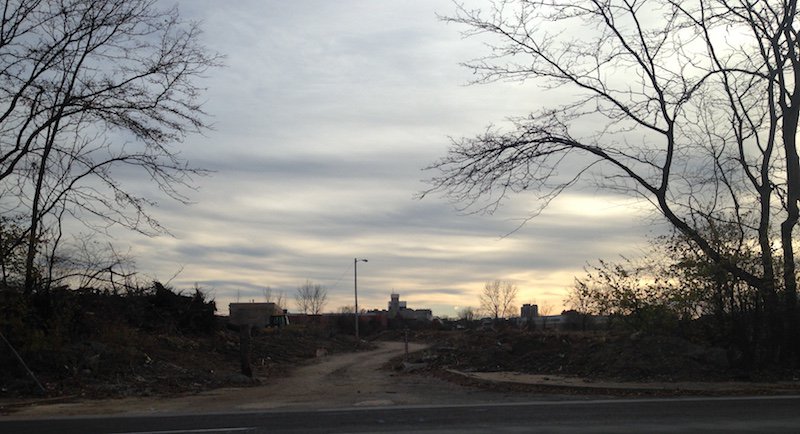
I was greeted with a startling sight recently, driving west down Cass Avenue after checking in on the James Clemens House (update: nothing has changed). As I neared Jefferson Avenue, I glanced over to the old Pruitt-Igoe site, and lo and behold, the thick overgrowth has been largely demolished. Previously impossible views of downtown St. Louis have opened up from the intersection, and here and there, Caterpillar bulldozers sat on piles of dirt and trees. Apparently, work really has begun on what is currently being called “the NorthSide Regeneration ER Hospital,” built by Paul McKee as part of his Northside TIF. I wonder how the recently announced plans for a “micro-hospital” by a very reputable group of health professionals in Downtown West will affect the viability of the new Pruitt-Igoe plans.
I also wonder about the symbolism of finally building on what has basically been a completely abandoned site since the 1970s, when the final towers of Pruitt-Igoe were demolished. The Pruitt-Igoe Myth and others have already delved into the issues surrounding the doomed public housing project and its destruction, but I find myself intrigued and saddened at what that vacant expanse of volunteer trees represents as well. How and why does the absence of something speak just as loudly as the presence of something to me? I have tramped around the forest, where old concrete slabs create allées in the trees. It was weirdly quiet, and surprisingly void of human habitation. I remember listening to a former resident point out the location of his building as we stood in its footprint, imagining how a giant reinforced concrete edifice would have towered over me a half-century ago.
Why has the site remained abandoned for the most part? Yes, small parts have been partitioned off for a nearby middle school, and the almost iconic electric transformer building survived the implosions (due to its continued necessity), but there are no practical reasons the site could not have been developed by now. It is a 10 minutes’ walk from downtown, and in any normal city, this land would be valuable. Living in and visiting cities such as Washington, DC, Baltimore, New York, or Chicago, I’m always struck at the beauty of being able to walk continuously without interruption from healthy residential neighborhoods to the central business districts of those cities. St. Louis leadership seems to embrace the stranglehold of vacant land surrounding its core. And please don’t repeat the myth that the old foundations from the towers have held up development.
I turned to Paul Fehler, one of the producers of The Pruitt-Igoe Myth, who has spoken to hundreds of former residents of the projects before, during and after the release of the film.
“It’s important to remember that these 57 acres hold a great significance to a great many people,” Fehler told me on Monday. “Many former residents will tell you that the happiest memories they have are of Pruitt-Igoe. For many, this is a sacred site, and a crucial part of their identity. Others who were there at a different time had different experiences. The site holds a different significance to them. I’m thinking now of a former resident who lost two brothers to gun violence while living there, who describes a childhood where he was constantly afraid.”
Michael Allen, Senior Lecturer of Architecture and Landscape Architecture at Washington University, whom I also consulted due to his considerable experience investigating Pruitt-Igoe, also reminds us of the importance of those past residents.
“The city should have required that parts of the site that are heritage elements—trees that sheltered families, a barbeque pit built by residents—were saved or documented. The reversion to productive sue was coming, but the total clearance is willful erasure of one of the city’s most significant stories,” Allen says. “Someday, this will be just another place that looks like other places, and that is the shame. St. Louis seems to prefer architectural amnesia to honest displays of cultural heritage.”
Allen’s and Fehler’s comments remind me of those people who are so often forgotten in the discussions of Pruitt-Igoe. Are we sweeping away history by not memorializing the people who lived and often times suffered on those 57 acres? If demolition of the buildings was an attempt to hide a grievous mistake inflicted on thousands of people, is sweeping away the forest again going to further erase that history? The history of that site reverberates to the present day more than many of us realize. It was where St. Louis County Prosecutor Robert McCulloch’s father died while pursuing a suspect. How did the death of McCulloch’s father influence events in Ferguson decades later? That is a question that will be debated for years to come.
Fehler left me with these final thoughts. “When people ask me for my opinion on the site’s redevelopment, I always answer the same way: My one and only consideration—not ‘main’ consideration, truly my one and only consideration—is that it respect the wishes of former residents.”
As the trees come crashing down north of downtown, the voices of the people who once called Pruitt-Igoe home are now, in turn, calling out to us. Will we listen?
Chris Naffziger writes about architecture at St. Louis Patina. Contact him via email at [email protected].