Long before the Gateway Arch welcomed visitors to St. Louis, a tower and a trench located in the same area were used to keep visitors out. In 1780, St. Louis was a modest fur-trading village under Spanish rule. Its local leader, Fernando de Leyba, was an officer in the Spanish Army whose cold approach to governance made him unpopular among the townspeople. De Leyba’s role in St. Louis was already a challenge. And then the British invaded.
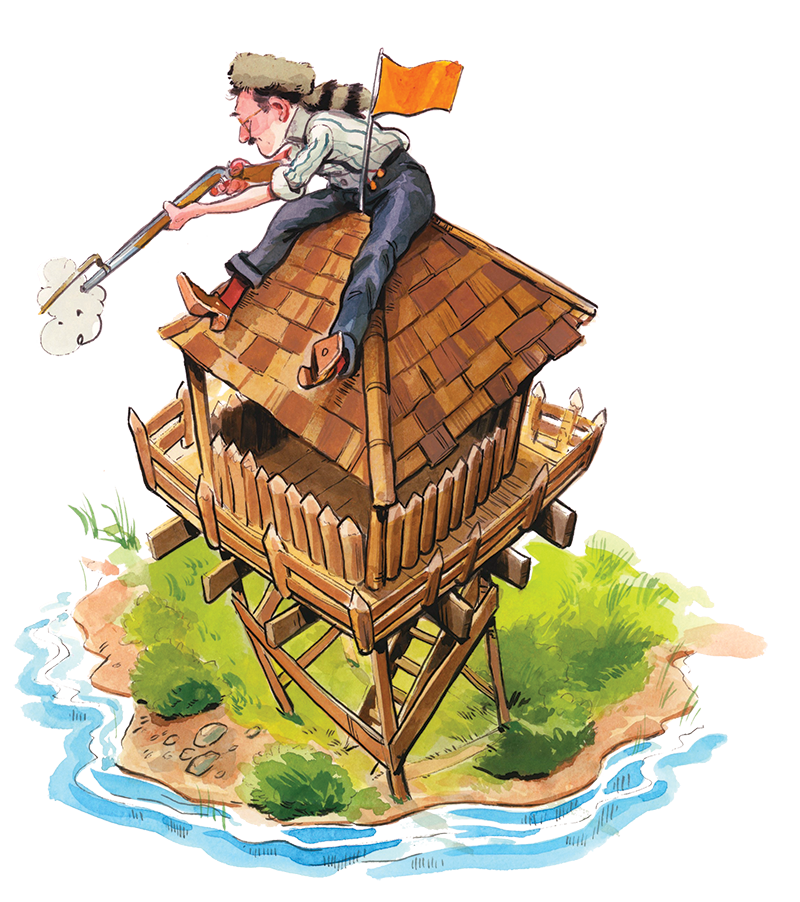
On May 26, 1780, the hamlet became the site of an unlikely yet crucial fight during the Revolutionary War: the Battle of St. Louis. Earlier that spring, de Leyba had learned of a British plan to attack the town and seize control of the Mississippi River and surrounding valley. For this mission, the British recruited local Native American tribes to blitz St. Louis on their behalf. Without any forts or defensive structures, de Leyba recognized that the town would be especially vulnerable. So he quickly planned the construction of several limestone towers. Due to time and budget constraints, however, only one was built, Fort San Carlos. It was three stories tall and approximately 30 feet wide, standing approximately on the current-day Arch grounds. For additional protection, de Leyba also had a 2,000-yard trench built, from which the militia could defend the village.
When the British force of Native Americans charged from the north that afternoon, the battle was on. As the clash unfolded, the St. Louis militia began firing cannons at the invaders to stem their advance. The sound and force of the cannons shocked the Native Americans, some of whom later referred to the tower as a “house of thunder.” The invaders quickly recognized that they were unequipped to withstand the cannons and retreated. Although the fighting lasted only a couple of hours that afternoon, it is believed that 21 St. Louisans died and 25 more were captured.
Even victory was not enough to repair de Leyba’s reputation among the locals. They blamed him for the loss of their livestock and crops, which were set ablaze by the retreating Native Americans. De Leyba was incredulous. He had gone broke from preparing for the battle by spending his own money on supplies and defense. Just a few weeks after the battle, de Leyba died destitute.
Today, this little-known piece of local history has received its due, thanks to the book The Battle of St. Louis, the Attack on Cahokia, and the American Revolution in the West by Stephen L. Kling Jr., Kristine Sjostrom, and Marysia T. Lopez, as well as Paul Schenkman’s 2021 documentary House of Thunder. As Schenkman noted when the film was released, the battle was “much more significant than anyone ever realized.”
By the Ballpark
A historical marker commemorating the site of the Battle of St. Louis can be found at the corner of Walnut and Broadway downtown, outside the Hilton at the Ballpark. The plaque, donated in 1946 by the General Society—Sons of the Revolution, reads:
Near this spot stood Fort San Carlos erected in 1780. It was attacked May [26], 1780 by the British & Indians, and successfully defended by the Spanish Garrison under Capt. Fernando de Leyba. This victory prevented Great Britain from gaining control of the Mississippi Valley in the later years of the American Revolutionary War.