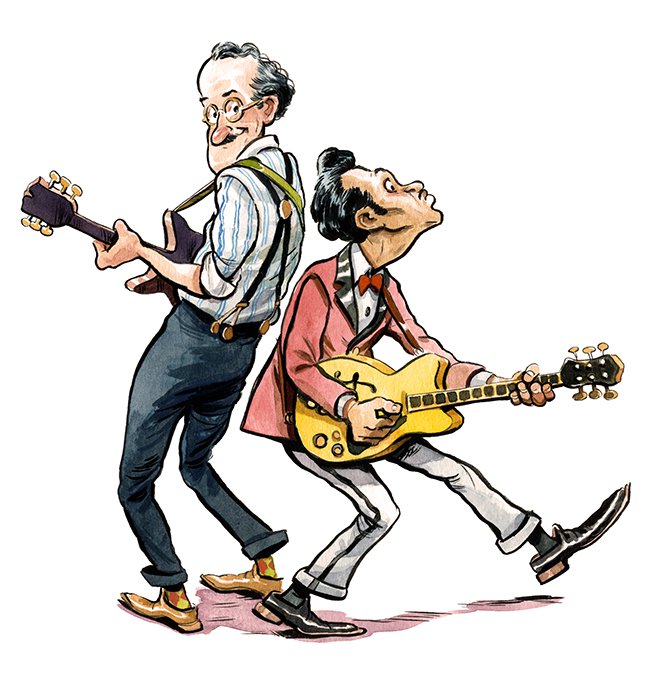
John Lennon said it best: “If you tried to give rock ’n’ roll another name, you might call it Chuck Berry.” Charles Edward Anderson Berry was arguably the first to create the brash new music that became a rallying cry for generations of rebellious youth. “School Days” and “You Can’t Catch Me” captured the urges and anxieties of adolescence, and backbeat rockers like “Johnny B. Goode” and “Roll Over Beethoven” drove them to dance those cares away.
Berry grew up in The Ville, a black neighborhood on the North Side that was then middle-class. After shocking his devout parents by stealing a car at gunpoint, he landed in reform school, where he started a singing quartet and launched his performing career. He was released on his 21st birthday, got bored working at auto plants, and decided to become a beautician, enrolling at Poro College to study cosmetology.
Along the way, he played in clubs, eventually joining Johnnie Johnson’s trio and performing regularly at the Cosmopolitan Club in East St. Louis. His unique brand of string-bending blues attracted both white and black devotees to what he called “salt and pepper clubs” across the region.
As the gigs multiplied, he began traveling beyond St. Louis, eventually meeting his idol, Muddy Waters, who hooked him up with Chess Records. Berry had a rocked-up version of the country song “Ida Red” that he called “Ida May,” but Chess wanted a new name. (Johnson credited a box of mascara named “Maybellene”; Berry remembered a cow with that name from a childhood storybook.) The song shot up to No. 1 on the R&B charts, then No. 5 on the pop charts, and a young singer named Elvis Presley began performing it.
It was one of Berry’s later records that, in 1961, brought Mick Jagger and Keith Richards together. It was “Johnny B. Goode” that was launched into space in 1977. And it was Berry’s signature “duck walk” that Michael J. Fox imitated in 1985’s Back to the Future—a spot-on choice, considering that, as The New York Times noted, Berry “understood what the kids wanted before they knew themselves.”
He was impulsive and restless and had to fight racism and piracy every step of the way. Flaws and genius were bound up together in this man, and though the world claimed him as a rock god, he never wandered far from home. He put down stakes on 35 acres outside Wentzville, and he made Blueberry Hill his base. Now he’s gone, but the music he forged here—imbued with his life’s struggles and pain and exuberant joy—will live forever.
Top 5 songs that climbed the highest on the Billboard Hot 100
#1: “My Ding-a-Ling” (1972)
#8: “Nadine (Is It You?)”(1964)
#10: “No Particular Place to Go” (1964)
#14: “You Can Never Tell”(1964)
#18: “Carol”(1958)