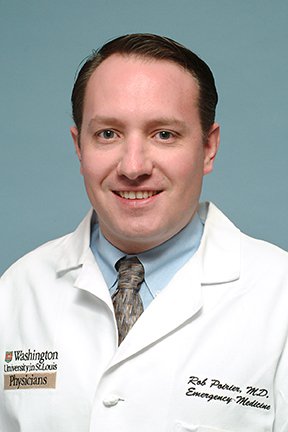
In 1990, Dr. Robert Poirier, then a high schooler, joined a problem-solving team at his school in Rhode Island. One of the topics he addressed: How to solve an epidemic to come in the year 2020. Now, he’s treating COVID-19 patients as the clinical chief of the emergency department at Barnes-Jewish Hospital.
The Future Problem Solving Program International is an academic program that encourages students and teachers to tackle potential issues or new realities. Like a debate team, students work in teams to address the topic at hand and then present their solutions in a paper.
Your guide to a healthier, happier you
Sign up for the St. Louis Wellness newsletter and get practical tips for a balanced, healthy life in St. Louis.
“These are important exercises,” Poirier says, “we should be doing it yearly. It should be a part of our risk mitigation strategies, no matter what profession.”
For his high school competition, Poirier and his team, fortuitously, chose a topic and the year it would happen. When faced with the proposed epidemic for 2020, high school senior Poirier predicted technology would drastically advance in the next 30 years. The team researched the 1918 influenza, as many medical professionals have done this year. They addressed questions the nation is facing today: How would we isolate and quarantine a community? A country? How would we mobilize to find a cure or a treatment? How would the country enforce protocols, and what are the ethics of forcing people to do things they may not want to do? They discussed how to best educate the public on hygiene. They brainstormed ways to coordinate the manufacturing of needed medical supplies or tools the public could use to prevent the spread. They even discussed how to retrain the unemployed to help the government with tracing and containment of the virus.
“Although, we felt by 2020, computers would be advanced enough to track and trace,” Poirier says, “which is very important in preventing the spread of a viral-based epidemic.”
His team won and went on to the program’s national finals. He remembers flying into St. Louis, where the national competition was held, on June 7, 1990. Nine years later, he returned to the city as an emergency medicine resident at Washington University School of Medicine and worked at Barnes Jewish Hospital and St. Louis Children’s Hospital. Throughout his career, he’s been a part of a number of clinical trials relating to new antiviral and medications for influenza.
Now at Barnes, he’s still problem-solving: “We didn’t know exactly how the coronavirus would play out in our region,” he says. The hospital first focused on preventive measures for staff, then stopped elective surgeries to free up the hospital space. The emergency department also saw a drop in patients.
“The world works in mysterious ways,” Poirier says. “Even though I had forgotten a little bit about the competition, I think it stayed with me and was the reason why I spent time as a principal investigator working on all these influenza trials over the last 15 years.”