Addled and hyperdistracted, I was searching for something—aren’t we always?—and I came across a YouTube music video called “6 Hour Study Focus Music: Concentration Music, Exam Music, Study Music, Alpha Waves 605.”
Now, the only use I’ve ever had for New-Agey music was to calm our dog, who used to lie on her back in wanton bliss right next to the speaker.
Your guide to a healthier, happier you
Sign up for the St. Louis Wellness newsletter and get practical tips for a balanced, healthy life in St. Louis.
But when I played this music, my mental fuss smoothed away. An hour later, I’d completed my project, and it suddenly occurred to me to ask my husband (our home offices are adjacent) if the music had bothered him.
“Are you kidding?” he asked. “I think it helped me get this six-page job application done.”
I bookmarked the video and subscribed to its channel, curious what other wonders it might work. Next I received an email—the morning after a bout with insomnia that insomnia won flat-out—suggesting a “Delta Waves Deep Sleep” recording. Like Alice chomping down on the mushroom, I played it. It induced, not the state of calm mental alertness the alpha music promised, but an entirely drowsy state.
Was there really a difference, or was this some diabolical combination of the placebo effect and credulity? I found a 2008 study in Acta Horticulturae that showed the brain producing more alpha waves when we look at nature, signaling a state of relaxed alertness and lowered anxiety. But that didn’t tell me if music could have the same effect.
I called Dr. Marcus Raichle, a preeminent neurologist at Washington University School of Medicine, and timidly asked if there was anything to all this.
Raichle warned me he had no scientific interest in the topic and no way to know anything about my music videos. But he was gentle about it. “Maybe if you just explain alpha and delta waves?” I said hopefully.
He cleared his throat. “If you record the electrical activity of the normal brain, there’s a lot going on, and on the EEG, there are a bunch of wiggles,” even when we’re at rest. It’s called dark energy, this ceaseless brain activity. “If you’re at all mathematically inclined”—not—“the waves contain different frequencies. Delta waves are the slowest—they’re the waves of deep sleep. Theta waves come next, then alpha, then beta and gamma.
“If you have a pile of electrodes pasted all over your skull,” he continues, “people have noticed that the alpha rhythm tends to be seen most frequently in the back of the brain. Put your hand in the back, up high.” He’s directing me, with necessary vagueness, to the visual cortex.
“The EEG is not very good at telling you where things are,” he adds. “But the alpha rhythm was described back in 1929. If you are wide awake, and you close your eyes, it becomes very prominent in the back of the brain. If you open your eyes, it goes away.”
It’s a focused state that’s undistracted, then. Wakeful relaxation. Alert tranquillity. Can music really take me there? Raichle’s not about to say.
I read further and find that Gregorian chant is rumored to have the same effect as my little YouTube video, and that alpha waves have been used for biofeedback, to help people meditate, calm hyperactivity, and reduce phobias or garden-variety stress. Composer John Levine has come up with something he calls Alphamusic Therapy, and he claims EEGs show its efficacy. Others have created music using actual brain wave recordings. And all sorts of sites talk about brain entrainment, in which the brain syncs its waves to external frequencies—like music.
The word sounds a little…airy…to me, but board-certified music therapist Crystal Weaver (more on her work tomorrow) tells me that entrainment is a fact of the body. “If music’s 66 to 72 beats per minute, your body starts to slow down to match the rhythm. Human beings are the only species on Earth that can sync with a beat, and our bodies love to match the rhythms around us.”
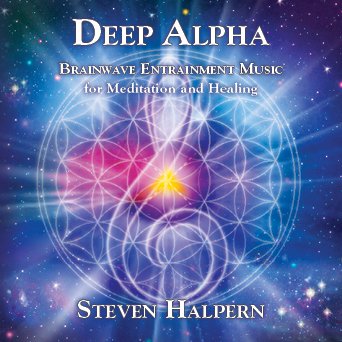
It all sounds plausible enough, but most of the album art looks like somebody computer generated the ’60s—it’s as nebulous and ethereal as the music itself. There’s nothing that guarantees those melodic alpha waves are doing anything more than provide just enough stimuli to focus and not distract my mind, and setting a pace that will slow my body to a calmer state.
But that’s enough for me.
And what about the slower, delta-wave music? If you start to doze off during an EEG, the graph shows “a number of curious little waves,” Raichle says, “and when you fall more deeply asleep, you get delta waves. But to relate specific rhythms to specific behavioral states? People have worked at that. My response is almost at the level of a layperson: I can increase my alpha waves, I think, if I just quietly close my eyes and quietly sit here and think about something.”
Me, I need music.
Tomorrow, read about music’s profound therapeutic benefits.