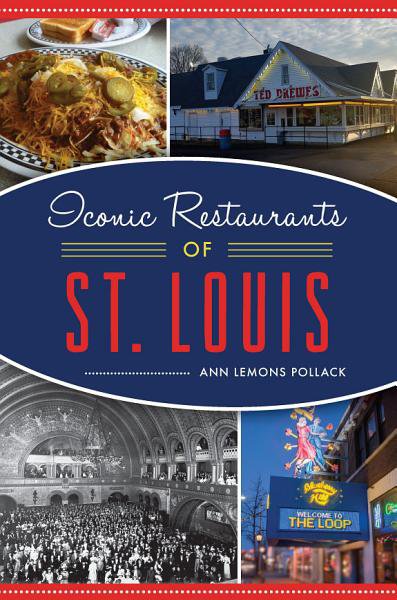
In her latest book, Iconic Restaurants of St. Louis, author Ann Lemons Pollack quickly answers the big question: “What makes a restaurant iconic?” This is important because everyone has varying definitions of the term. “It comes to us from the Greek word eikenai, meaning ‘to seem or be like,’” Lemons Pollack notes. “I’m happy to use the definition ‘an emblem or representative symbol.’”
The 41 restaurants highlighted in the book—from Beffa’s to Blueberry Hill, Gioia’s Deli to Goody Goody Diner, Tony’s to Trattoria Marcella—certainly live up to it. Each entry feels representative of its neighborhood and emblematic of the region.
Find the best food in St. Louis
Subscribe to the St. Louis Dining In and Dining Out newsletters to stay up-to-date on the local restaurant and culinary scene.

This marks the fifth book that Lemons Pollack has written or contributed. She and her late husband, St. Louis Post-Dispatch dining critic Joe Pollack, partnered on three guide books to the city’s food. Her first solo project, Lost Restaurants of St. Louis, included only a few of the great St. Louis restaurants still in existence. “So when The History Press approached me to do a second book as part of its Iconic Restaurant Series,” she says, “it seemed like a logical next step.”
Published by Arcadia Publishing and History Press, the book is a snackable chronicling of the stories behind the restaurants, both past and present. They achieved a level of success where the name and concept became ingrained in St. Louisans’ minds, even if we’ve never dined there. Even if you’ve never been to Tony’s, don’t you kind of feel like you know what it would be like?
Lemons Pollack makes it clear that one of the common threads throughout the book is that these stories underscore the importance of family. “Families working hard, working together, not only to make a living but also to share with their community,” Pollack writes. “In many cases, it’s the American dream personified.”
As as you read each story behind the story, you’re literally reading the histories of the places that have shaped the lives of not only those who worked there, but the generations of St. Louisans who adopted these restaurants into the fabric of their lives.
One of the accidental charms of organizing the chapters alphabetically is the transition at times from fine or upscale dining to charming “joints” or “holes-in-the-wall” that make up the list. From the tale of acclaimed chef Bill Cardwell and his renowned restaurants to the story behind the burgers and root beer that made the legend of Carl’s Drive-In, Pollack showcases a wide range of choices.
Lemons Pollack’s detailed storytelling is impressive. As she tells the history of Chuck-A-Burger, you almost feel like a teenager in 1957 St. Louis, “scarfing down the hamburgers made with ground chuck—thus the name.” And many will relive the soothing effects of that late-night slinger at Courtesy Diner. Now, however, readers will also learn that the chili came from a “company called Edmonds, a St. Louis tradition that’s an offshoot of the now-gone O.T. Hodge Chili Parlor.”
Photographs throughout the book also bring the establishments to life. One image, for example, captures “a quiet moment at the ancient Broadway Oyster Bar.” It allows readers to imagine the patrons who stood at the bar and the smoke-filled, spilled beer–scented atmosphere as the beat of live music permeated the air.
As a bonus, Lemons Pollack has included more than a dozen recipes from her list of iconic restaurants. “They range from the fairly simple dishes to a very involved one that’s an example of how today’s fine-dining kitchens have to work,” writes Lemons Pollack.
Altogether, the book shares 41 stories of St. Louis restaurants and 41 stories of St. Louis families who dedicated themselves to their craft, not knowing how deeply they would impact the community and generations of loyal customers.
Iconic Restaurants of St. Louis is available online and at at local bookstores.