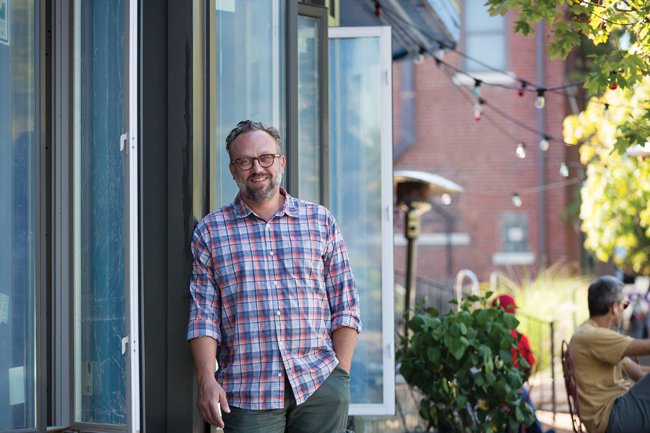
Matt McGuire has run some of St. Louis’ finest restaurants: Monarch, Herbie’s, Central Table Food Hall, Brasserie, Niche. But it all started at “a neighborhood restaurant with no neighborhood,” the legendary King Louie’s, off an industrial stretch of Chouteau. The King retired its crown in 2007. McGuire plans to open its successor, Louie, on DeMun Ave, in early November.
Did you ever consider another career path? I went to the Art Institute of Chicago and studied painting and sculpture, thinking I’d eventually teach that in school, because there aren’t many other options for art majors. I caught the restaurant bug while in school. Back then, it didn’t feel like work. Once you get a little older, it does.
Find the best food in St. Louis
Subscribe to the St. Louis Dining In and Dining Out newsletters to stay up-to-date on the local restaurant and culinary scene.
Did you still paint or sculpt? Not on any sort of scale, but both my kids are artistic, so I stay connected. And restaurants support working artists in a number of ways…not the least of which is employing them.
Can the restaurant business be compared to any other occupation? It’s like theater—or maybe a carnival: You open the doors every night and participate in a new performance. That part is intoxicating, but it’s intense and pressure-packed. Things get screwed up, and people cry—but even that gets comfortable.
It doesn’t sound comfortable. In addition to the creative aspects of cooking, I enjoyed putting teams of people together and being the coach. I’ve met outstanding people along the way.
Like whom? Like Chris[tine] Meyer [co-owner of Kitchen Kulture and Kounter Kulture]. I’m prone to hyperbolic statements at times, but I don’t think there’s been a better front of the house person in St. Louis, ever. I learned more from her about how to truly care for people and a build a crew of people than from any other person in the business. And I’ve worked for some that on paper are the best there is. There are very few chef managers who are special like that. Now she’s combined her people skills with her chef skills
How do you develop those skills? Before she came to King Louie’s, she’d been a manager at Blueberry Hill, where she was able to spot the good kids and teach them.
How did King Louie’s come about? A few college buddies and myself got together and bought a college bar, but I was the one who knew about food and could cook. It developed into a neighborhood bar and grill—except we didn’t have a neighborhood—and from there, as a survival tactic, really, we turned it into a fine dining restaurant. For people to make the trek, it had to be special.
What made King Louie’s so special? The isolated industrial setting definitely played in our favor. It was like an oasis, a hideaway people wanted to keep secret. People from the county would get taken there, and you could read the Where the hell are we? reaction on their faces.
That back patio was an oasis, for sure. It was the most hidden patio in town at the time.
What do people miss, do you think? On the surface, it looks so easy, but it’s rare to catch restaurant lighting in a bottle. But occasionally, a collective of people and an atmosphere combine to create a unique alchemy.
It always helps when the food is good. John O’Brien [of Three Flags Tavern, Herbie’s] was a chef there, as was my cousin, Kirk Warner [of Savor, Kirk’s Traveling Kitchen]. Also Steve Ciapciak [of McGurk’s] and Cary McDowell [of The Crossing, Liluma, Winslow’s Home, Revival, Pi Pizzeria, ‘ZZA]. I was the opening chef but ended up with way more talented cooks than I.
King Louie’s closed in 2007. We almost made it, but the viaduct that connected us closed and it took two years to reopen rather than one. People could still get there, but our sales were cut in half. My young daughter, who was able to skateboard across the bridge, said this is so cool, and I remember thinking, you have no idea how uncool this is. Then the building sat vacant for awhile and eventually became Revival, which supposedly met its fate when Highway 40 was closed for renovation.
You’ve worked at several notable places in town. How about a quick hit about each?
Monarch: Mixology was new to me, so I learned a lot working with Ted Kilgore, the father of local cocktail culture in St. Louis. I hired Josh Galliano, and that made a difference, but after the halcyon days of Monarch as a nightclub were over—which they were—it was hard to make a 10,000 square foot restaurant feel good to be in.
Brasserie: It was a mature restaurant when I came on the scene. Michael Petres was, and is, an awesome chef. I’ll give him and maybe myself credit with making Brasserie better.
Central Table Food Hall: Having all those production areas working in unison under one roof was a challenging undertaking, one that none of us really understood, but it was fun to try to execute, and I had the best chefs in town—in Elliot Harris and Nick Martinkovic—to do it. Nick liked making tofu with Japanese sea water, which showed how far he went to do things the right way.
And then you worked for Gerard Craft again, at Niche and Brasserie. By that time, Gerard had four restaurants, so my job as service director became nurturing—or finding new—people, both managers and employees. I was good at having that ‘maybe this isn’t for you’ conversation as well as convincing people who never thought of management that they’d be good at it. You must recruit people that connect with customers, the people that induce handshakes and hugs.
At which stop did you learn the most? King Louie’s by far. For a lot of us it was like a small science fair project. Gaining knowledge often means implementation and doing, and there was a lot of opportunity there to do. Fortunately, it wasn’t an expensive project and it grew organically. When we made mistakes, they weren’t costly.
What’s your management style? I identify the best people and empower them, so hopefully others will see that and step up. I tell them to say yes and make it sound like a good idea—even if it’s not. What I enjoy most is establishing the trust and building the culture, making room for the tree to grow.
What’s the biggest mistake made by floor managers? Thinking they know what’s going on at every table. They’re the last people to know because they’re rarely privy to what’s being experienced or said. Customers don’t want to disappoint the manager—or the owner—or get anyone in trouble. A restaurant floor is no place for a control freak.
Any other managerial secrets? I try to get employees to realize that in any job, how you conduct yourself is how you end up being later on. A person might give themselves a pass for always being late, for example, but we don’t. I try to convince them the value of getting how you see yourself as close as possible as to how we see you.
How did the King Louie’s idea get rekindled? It was timing. When my mother passed away, I started thinking about time, and why not to waste it. And my job had the potential of taking me out of town and travel isn’t as appealing as when I was in my 20s. At 48 and with two kids, I’m not the ideal road warrior. And I’ve always liked the DeMun area personally, so when I heard the Jimmy’s Café space was being subdivided, it was time.
And there was the grocery connection. The building had been home to several family-run markets and my grandfather owned a grocery store in Paw Paw Michigan, so there was a deep down familiarity. It felt right for me to be there.
How much of Louie is doing something new and how much is recreating King Louie’s? The fundamentals are always the same, it’s next to impossible to recreate a restaurant. Calling it Louie is a nod to the folks who helped me when I did it before. We called it Louie back then, too.
Describe Louie’s interior. The scale is right for a long, skinny space, but it’s pretty garage band. No tablecloths, minimal distractions, 70-ish seats, a wood-burning pizza oven, a leather banquette, white marble on one wall, and a bar that wraps to join a kitchen counter with 21 stools.
Will Louie be an everyday joint, or a special-occasion place? I want to address what the neighbors want, so I’m shooting for $35–$40 per person, food and drink included. Offering pizza and items like oven-baked gnocchi helps lower the price point.
What style of pizza? I’m not looking to win an Italian pledge pin, but it’s similar to Neapolitan. Ted Wilson [co-owner of Union Loafers] is the most knowledgeable dough person in St. Louis, and our chef, Sean Turner, who’s returning home from New York City, spent a lot of time with him. Sean had been working there with French Laundry alum Jonathan Benno at Lincoln, an acclaimed Italian restaurant. Josh Poletti [formerly of Pastaria, The Libertine, and Basso] will be joining him, so the kitchen will be solid. I want people to think of Louie as a very good Italian restaurant.
Why Italian cuisine? I’m not going to be dogmatic in my Italian-ness, but I had a wood-burning oven at King Louie’s, so a lot of the menu will be centered around that tool: wood-roasted chicken, hanger steak, oven-roasted fish specials… What we’re doing is not overly complex—we buy good stuff and apply good technique. We won’t want to be so hard core that we keep ourselves from cooking what we want to cook and what people want to eat.
Talk about the menu. Focused, manageable. Four pizzas, pastas, shareable vegetables, and mains, plus eight or so small plates and specials—about 30 items in all.
Jimmy’s had a small patio. Will Louie? When I get licensed for that, maybe six small tables. All the windows will open up to that area. It won’t be much. There’s not room for much.
Will the wine list lean toward Italy? Italian wines pair incredibly well with food, many are affordable, I know the most about them, and I personally love them. So, yes. Maybe fifty wines total, hopefully nothing over $60. I hope we can keep a lot of stuff open, so lots of glasses and quartinos.
Describe Louie’s cocktail program. Personally, I’m not that interested in everything that can be mixed with Elderflower, but I have hired someone who is. But Louie is a small place, so the beverage program will be space appropriate.
So what does that mean to the beer drinker? I love beer, but there’s no room for a big, ball card collection of beers. We have an ample, food-friendly bottle and can selection. To avoid any squabbles we have one draft beer, Bell’s Amber, a seminal beer that goes with everything. I’ve known Larry Bell for a long time and the Amber been my favorite beer for almost as long.
How will Louie differ from the competition? The food will be better and served by a staff that will make you feel welcome but also knows how to skillfully leave you alone. I want to create a space that feels right, and realize that’s a hard thing. The scale of the old Balaban’s bar—the shape of the bar, the perimeter booths, the corner booths—is a prime example. Layout, lighting, feel…that place felt perfect to me.
Will you take reservations? I have to. I still have people asking me to get them reservations at places I haven’t worked in for three years. It makes better business sense to not take them, but practically speaking, it’s necessary. It’s expected. And people already have my number!
Lunch, dinner, brunch? No brunch. Sunday is the day I cook for my kids, the one day when they know I’m going to be home.
Will this Louie iteration be easier than the prior one? I’ve been in a restaurant every night for the last billion years, so it’s not like I’m coming out of retirement. The fundamentals are the same, it’s stressful especially at the beginning and you have to compartmentalize to survive. So no, I’m not crazy enough to think it will be easier, but it does feel good to make decisions instead of making them based on somebody else’s vision.
What’s your take on excessive noise in restaurants? It’s a common complaint, one that I hear a lot in St. Louis. But ironically, every Cornell restaurant industry study says that diners are attracted to the excitement and the noise…even while they’re complaining about it. Maybe it’s a twist on the Yogi Berra thing…nobody goes there because it’s too crowded. Then they all go there.
If someone tells you they want to get into the business, what do you say? I’ve been at this long enough that I’ve become a go-to guy for parents who want me to talk their kids out of getting into the business. Telling a young person they can’t do something, or that it won’t work, is the worst thing you can say, especially if the person is driven, because those are the people who can make it work. A better question to ask is do they want to do it. Schedule-wise, restaurants are very ugly and they don’t work when you’re not there. A person needs to honestly answer if several years down the road they want to be standing in a restaurant six nights a week. In most cases, the answer is no. They have to realize these things tend to live longer than a goldfish.