It’s been almost a year since an EF3 tornado tore through neighborhoods across St. Louis, leaving devastation in its wake and claiming the lives of at least five people. As we approach the one-year anniversary of the storm on May 16, 2025, we asked three homeowners affected by the natural disaster to share their stories of recovering and rebuilding.
Sequoi Edwards
Neighborhood: O’Fallon Park
Get a weekly dose of home and style inspiration
Subscribe to the St. Louis Design+Home newsletter to explore the latest stories from the local interior design, fashion, and retail scene.
Sequoi Edwards was driving his 15-year-old nephew home from school when a sheet of dark gray sky surrounded his car in North City.
“It’s not like on television where you see an upside-down triangle. It was more like a gigantic rectangle, and it was just dark gray,” Edwards recalls. “And I realized that the tornado was literally over us and we were like in that eye of the storm. So I’m talking to the Lord by now. I’m all like, ‘All right Jesus, what am I supposed to be doing?’”
Fortunately, Edwards and his nephew weren’t harmed. Yet, in the immediate aftermath, Edwards says it took him about 2.5 hours to get to his house; from where his car stalled during the storm, it’s usually about a 12 minute drive. He remembers stopping often, dodging downed power lines, to help those in need or to clear fallen trees or limbs from the road.
“It was devastating the whole ride,” he says. “One of the most eerie things that I remember is how quiet it was. It was just humbling devastation. It looked like the end of the world. Everybody was outside on their porches looking at each other, offering people if they needed to make phone calls to check on their families.”
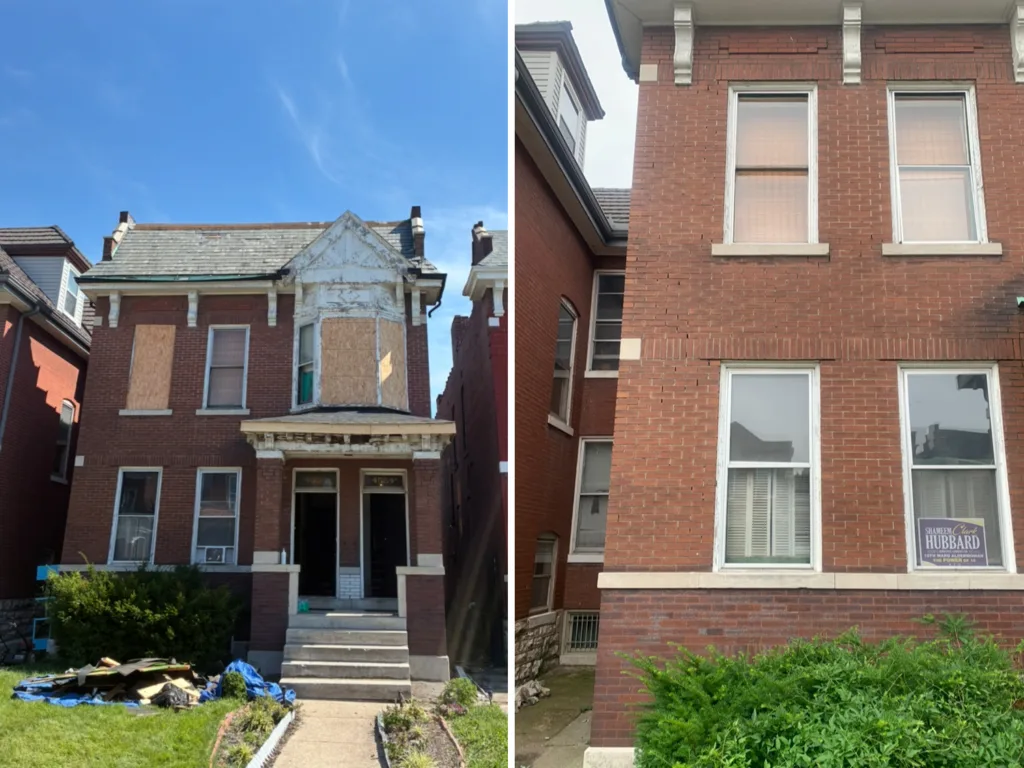
When Edwards finally arrived at his home, a two-story brick house built in 1914 and located between O’Fallon Park and Fairground Park in the O’Fallon neighborhood, the scope of the destruction sunk in.
“When I got to the house, that was probably the worst part. That’s all my neighbors out there, and it’s a bunch of old ladies, and they were out there crying. Some of the roofs were gone. Some of the front porches were gone. By the time I even got to my house, I was looking in my upstairs living room because the curtains had fallen out of the window and I could just see straight in the house.”
Edwards’ home sustained roof damage, which days later, during a heavy rain storm, made a bad situation worse. His back porch was demolished and windows throughout his home were shattered. A neighbor’s shed or carport — not from Edwards’ block, he notes — was sprawled across his backyard.
“Lost the roof, lost the back porch, lost the windows, lost my clothes, lost a lot of my personal items. But you know what? People lost their lives that day. I was talking to a man, and he said, ‘Somebody couldn’t get sleep last night. Somebody couldn’t wake up this morning. We’re thanking God, we did both.’”
Despite the damage to his home, Edwards felt called to put the needs of his neighbors ahead of his own. With no electricity and so much damage to neighboring businesses and homes, he knew people would need help in myriad ways: access to food, water, medical attention, diapers and pullups for babies and young children and other necessities. With support from other folks in his neighborhood, he set up a pop-up tent at the corner of West Florissant and Fair avenues to distribute resources and help however he could.
“And once that became the priority, I was like, look, if my lights are off, their lights are off. If I’m hungry, they’re hungry. If I have to do those things, so do my neighbors,” Edwards says.
As the one-year anniversary of the tornado approaches, Edwards says his situation is similar to many of his neighbors: He’s been able to finish some home repair projects, but his house still needs extensive work. He estimates he received about $700 in recovery funds from FEMA and the Red Cross and a few thousand dollars from his homeowners insurance. He’s been able to clean up his backyard, tarp his roof, and fix windows, although the windows remain boarded up on the outside due to other home projects.
“I still have most of the problems that I started with,” Edwards says. “I need a new roof. But then we also have kept getting rain since I needed a roof, and then an ice storm since I needed a roof. And I didn’t need new pipes, but because of the ice storm, the pipes burst and I got some flooding.”
Edwards is still living in his home despite the needed repairs. He hopes sharing his story will shine a light on the continued need for tornado victims in his neighborhood and across St. Louis.
“When you’re building (a house), you have to have a strong foundation. And you have to have an endgame plan. That means you have to start off strong and you have to end strong,” Edwards says. “When you’re rebuilding, you’re starting from the middle and having to work outward in each situation. It’s like, no, the house is already here. We can’t lift it up and redo the foundation of it, redo all of the plumbing, the gas, and all of the woodwork, and we’re not building houses from scratch. And we don’t want to, because then that takes away from the historic value of St. Louis.”
Lyle Seddon
Neighborhood: DeBaliviere Place
Lyle Seddon was reluctant to leave her teenage daughter at home alone. Seddon wouldn’t even be gone overnight, but she felt anxiety about leaving town for a very quick trip to watch her son graduate from business school in Texas. After a lot of consideration, she decided to join her husband at the graduation, with plans to depart St. Louis early in the morning and arrive home in the early evening. She asked a neighbor to be on-call just in case her daughter needed any help.
During the graduation ceremony, Seddon received a call from that same neighbor, who uttered words that didn’t immediately register: “We just got a direct hit from a tornado. It’s really bad.”
The neighbor is also the president of Seddon’s neighborhood’s homeowners association, which she’s been an active member of for 30 years. Her husband’s family roots in the neighborhood stretch back much further; the Seddons’ Greek Revival-style home in DeBaliviere Place was built by her husband’s grandfather in 1895 and the house has remained in the family for 131 years. The couple care deeply about their home, as well as their neighborhood.
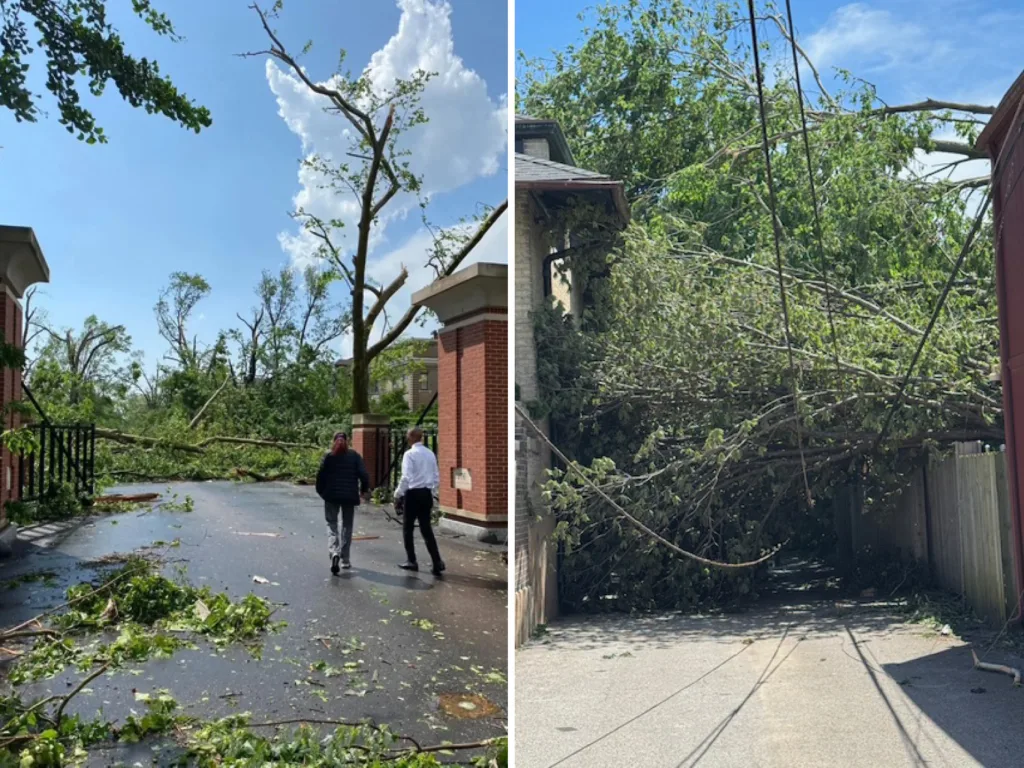
Once Seddon was back in St. Louis and was able to access her street — due to downed trees, she couldn’t drive down her block in the immediate aftermath — she learned the damage to her home was fairly minor, at least compared to what her neighbors experienced.
“This tornado came from the south, and our house is facing south. So the front of our house got the tornado, the back was not nearly as much. The worst damage that we had inside was that we have very large front windows — they’re probably 5 feet wide and 6 feet tall — and one of those windows blew out. I had a couple friends that came over and helped me clean up the glass. We moved a storm window from a different window and were able to get it kind of in place to protect the house from being open to everything.”
Yet as she surveyed the damage to her neighbors’ homes, she understood the extent of the devastation. A combination of tornado damage and tree damage caused by the storm had ripped off roofs, walls, and porches from homes, shattered windows, doors, and left some homes forever changed.
“Our cousins live down the street, and they had a big tree that was very close to the house, and it basically tore off a two-story porch,” Seddon recalls. “They’re rebuilding that into a one-story porch because they found the original blueprint that it was one story. Almost every garage in our alley is gone. That particular cousin’s garage fell in the alley last October — just fell over one day.”
As a longtime member of her neighborhood’s HOA, Seddon witnessed firsthand the extent of the damage to her neighborhood in the days, weeks, and months that followed the tornado.
“I think it’s hard to understand how — I mean, I think we’ve kind of come to accept it to an extent right now because it’s kind of just your every day — but I have friends who don’t live in the neighborhood, who will say to me ‘How’s your damage? Is everything back?’ And I’m like, ‘No.’”
As the one-year anniversary of the tornado approaches, Seddon reflects on how changed her beloved neighborhood remains. Some neighbors across the street have yet to begin repairing exterior damage to their home; they no longer live in the neighborhood, Seddon says, and maybe they’ll rehab it only to sell. Two homes at the far end of Seddon’s street were just sold to new owners; one, she thinks, was purchased by “flippers, rehabbers, whatever you want to call them.” Both homes sustained bad damage in the tornado.
“We personally have just a few minor things to do still, but it’s hard to see when it will be back to some level of normalcy,” Seddon says. “I’m sure the tree situation will not return in my lifetime. It’s just hard to imagine that we’d ever get those big trees back. It was one thing about this neighborhood that was so enticing and beautiful, just the age of the trees, the age of the homes. It had a long history and was always going to be here, and now it feels different.”
Jimmy Jamieson
Neighborhood: Central West End
Jimmy Jamieson was at work when the sky turned black. Instead of seeking shelter, he jumped in his car. His office is located only about a five-minute drive from his Central West End home, and he takes care of a group of neighborhood cats who he wanted to protect from the storm.
“I entered the neighborhood at the same time as the tornado,” Jamieson recalls. “No sooner than I turned into the neighborhood, a tree fell in front of my car. I naturally slammed on the brakes and stopped, and no sooner than that, a tree fell on top of the car and crushed the car.”
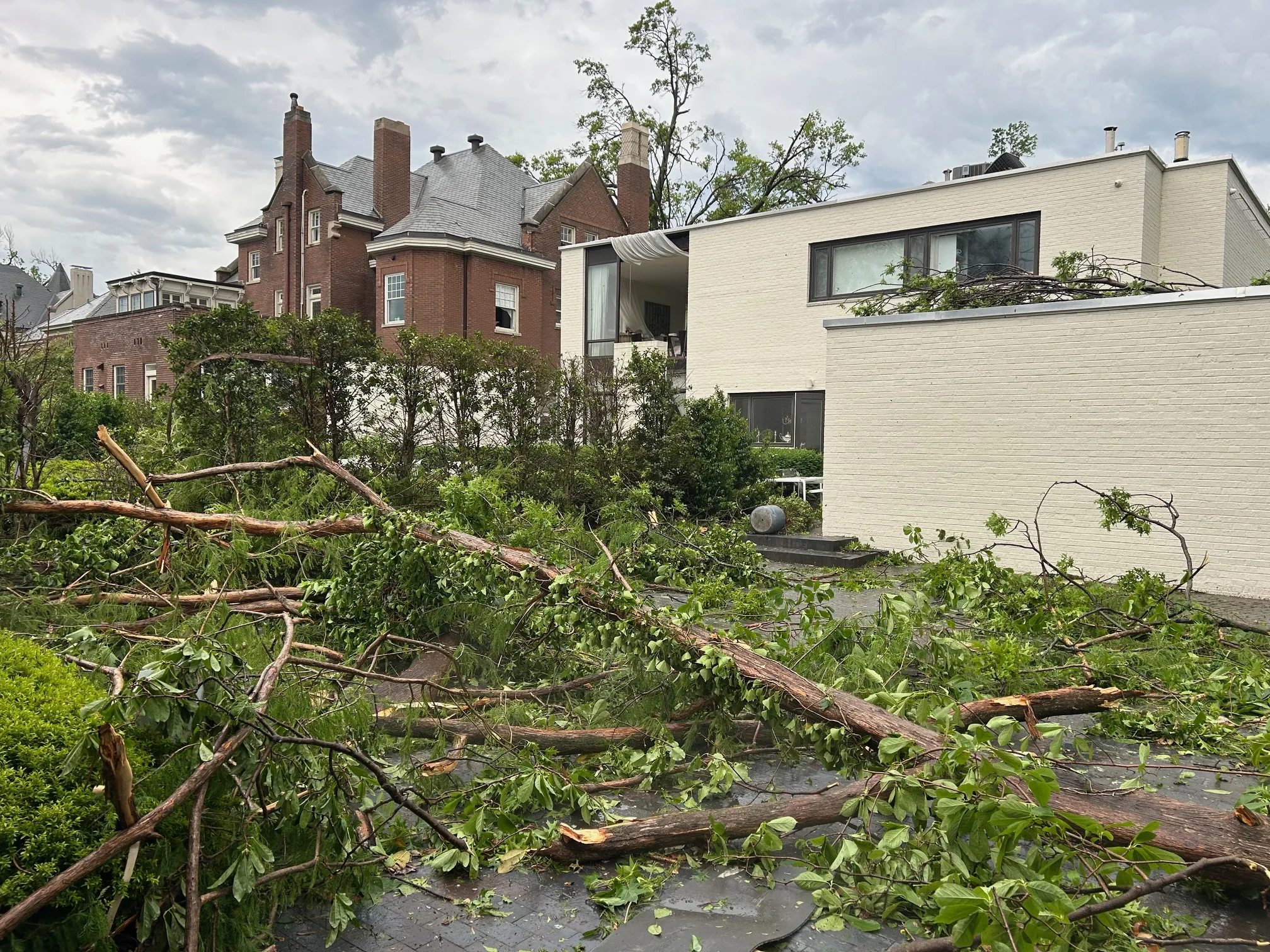
Jamieson wasn’t injured in the wreck, fortunately, and by sheer force was able to exit the vehicle and walk to his home, a beautiful modern house built in the International Style in 1948. It’s the only house like it in the City of St. Louis, he says, and one of only a few houses like it in the metropolitan area due to its unique design.
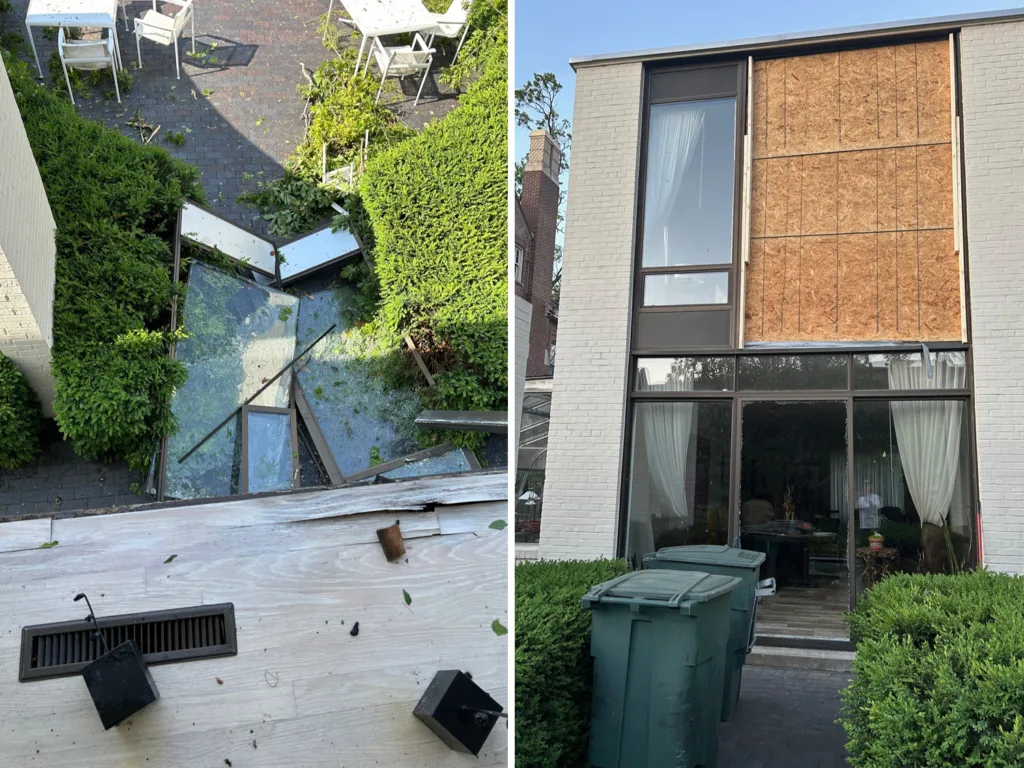
“I walked in the storm to my house, only to discover that the curtains were blowing outside the house; the front windows had blown in and all the back windows were sucked out of the house,” he recalls. “It blew out the windows, tore off the doors, tore off the air conditioning units, ruined the electrical system, and destroyed the brick. It was a disaster.”
Jamieson could see the devastation as plain as day, but he couldn’t immediately enter his home due to a 10-foot debris field around the house. His street, just minutes prior lined with mature trees, was ravaged as well, with downed trees, limbs, power lines, and widespread damage to neighboring homes and homes across his neighborhood.
“It took the neighborhood about six months just to be able to get the trees, debris, and everything associated with it out of the neighborhood,” Jamieson says. “This is very much still fluid.”
Despite the widespread damage to his house, Jamieson has continued to live in his home. He credits his contractor and crew, who spent hours working to source plywood and materials to board up Jamieson’s home on the day of the tornado. By that evening, the team had boarded up and secured his home. “I lived in it that night; I slept in the house,” he says. “The house was boarded up that night and I’ve been living in it every day since. It was very cold some nights in the winter.”
In the many months since the disaster, Jamieson has been able to make some progress on rebuilding, but acknowledges it’s a slow and often non-linear process. Some projects have been completed, like a new electrical system, but many others remain, some of them stalled by long shipping delays and contractor availability.
“New windows and doors were ordered in July [2025], and they just arrived,” he says. “So hopefully in the next month, those will go in. And then all the other work — maybe 25 percent of the work has been completed. Hopefully the balance of the work will be completed with luck by the end of the summer.”
Jamieson, who runs interior design and interior architecture firm Jamieson Design, has spent his career specializing in both residential and commercial design. He acknowledges that his profession and expertise were benefits to rebuilding in some ways, including having existing relationships with architects and builders, while in other ways, he’s experienced the same delays, setbacks, and challenges as other homeowners.
“Ordinarily when you’re building from scratch, it’s a pretty easy sequence,” he says. “The sequencing is the big thing. It’s like in any construction, you’ve got to do A, B, and C before you do D, E, and F. But this is identifying materials, sourcing those materials, ordering them, and then taking delivery of them, and that in of itself is an arduous process.”
As the city approaches the one-year anniversary of the tornado and Jamieson continues to rebuild, he expresses gratitude that he survived that fateful Friday, knowing at least five people lost their lives.
“When something like this happens, it makes you realize you really do go through life taking so much for granted and, literally, in a few minutes time you can lose it all,” he says. “And to be grateful for all that you have, and be grateful for the people who surround you and and are there to help. It’s extraordinary how many people were there to help, and that great outpouring of sympathy and goodwill — it reminds you that people are basically good.”
And all of the neighborhood cats Jamieson cared for — Catzanova, Catmandu, Catty Hearst, Catty Wampus, Catatonic, and Caddy Shack — are all alive and well today.
“After everyone left, I went out to look for the cats,” Jamieson recalls. “After about an hour or so of me calling them, dazed, exhausted, and worried, I finally just sat down on the ground thinking that I might never see them again. After some time, Catsanova came out from under a boxwood hedge, terrified and hungry. It took a while but she finally calmed down enough for me to pick her up to comfort her. As comforting as it may have been for the tiny cat, it was equally comforting to me — funny how that works.
“It wasn’t ’til the next morning that Catmandu, Catatonic, and Catty Hearst felt safe enough to come to the back door, but was I ever happy to see them. I think that was the first time that I got teary-eyed, finally knowing that they were all safe and felt comfortable enough to come to the door to resume their morning routine.”
Although his street and neighborhood have changed, he feels confident they will rebuild as best as they can. It may not be a fast process, but even as he works to find a new normal, he worries for those who have fewer resources and support to do the same.
“I think that the most important thing is there’s so many areas of the city where people didn’t have the resources to rebuild,” he says. “I think that maybe some of those people won’t be fine, and that’s really heartbreaking.”