If you’re an admirer of 17th-century European decorative arts, you’re likely a fan of chinoiserie. Broadly defined as the West’s interpretation of Asian culture, chinoiserie—its name taken from the French term for “in the Chinese style”—can be seen in everything from textiles to wallcoverings, objects, and furniture decorated with images of birds, pagodas, dragons, and other fanciful creatures.
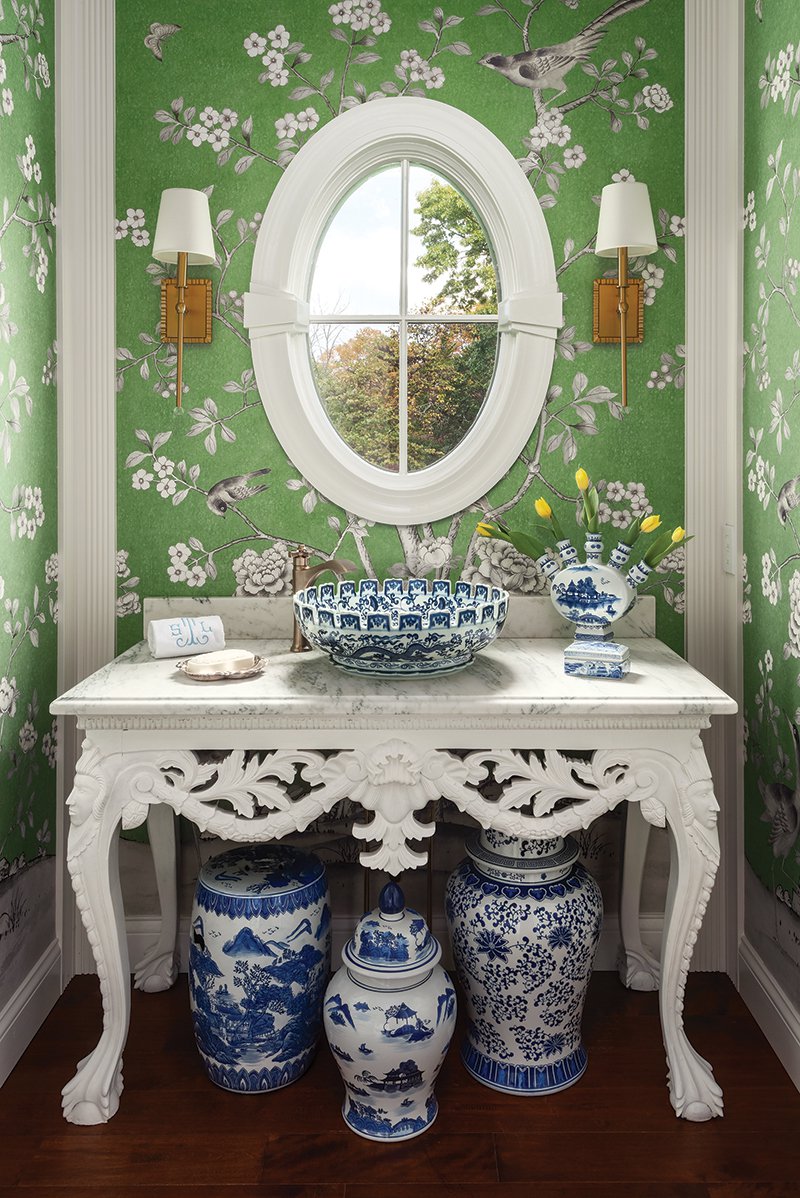
St. Louis interior designer Suzanne Tullock, owner of Suzanne Tullock Interiors, recently used chinoiserie to enliven the powder room of her Wildwood home. By hanging Schumacher’s Chinois Palais wallpaper, inspired by an antique Chinese silk panel and emblazoned with cherry blossoms and birds, she imparted an elegant look to the small room. The ceiling’s black-and-white bamboo lattice paper, porcelain chinoiserie vessel sink, and blue-and-white ginger jars add more layers to the aesthetic.
Get a weekly dose of home and style inspiration
Subscribe to the St. Louis Design+Home newsletter to explore the latest stories from the local interior design, fashion, and retail scene.
“It’s timeless and classic,” she says. “Chinoiserie will never go out of style.”
The décor style is enjoying a resurgence on Instagram, in the home collections of national retailers and high-end firms, and with homeowners who want to impart historic and cultural motifs into their homes. But because it draws inspiration from various cultures, it’s important to understand the context in which the genre was developed. Chinoiserie began to take hold in the West after the Dutch East India Company established a trade route to China in 1602. This new route, taken from the Portuguese, enabled the import of Chinese tea, silk, spices, and porcelain to Europe, which spurred interest in faraway lands. “Europeans, enamored by the Asian aesthetic, began copying the imagery found on the goods brought back from the Far East. Eventually they started copying it and making it their own,” says David Conradsen, the Grace L. Brumbaugh and Richard E. Brumbaugh Curator of Decorative Arts and Design at the Saint Louis Art Museum.
The first expression of this aesthetic was Delftware, famed for its blue-and-white designs similar to those first seen in China and, later, in high demand by Europeans who appreciated the craftsmanship and attention to detail found in the original wares. “Chinoiserie first started as porcelain in the Netherlands,” says Conradsen. “The Dutch made cheaper European facsimiles; then it spread. The imagery gets applied to other types of ceramics, the decorative arts, fabrics, furniture, and even architectural elements.”
The longevity of chinoiserie as a decorative style is due in part to the ease with which it can slip into a variety of interiors. “Today,” Tullock says, “I see people use chinoiserie in more of a modern sense, with a high lacquer, with colorful bamboo furniture, or very high-gloss walls and ceilings with strong punches of color.”
Karla Schulster, business development coordinator at the Refind Room, in Brentwood, has seen an uptick in the popularity of Asian-inspired looks. At press time, the shop was selling a striking black-and-gold chinoiserie secretary. Schulster doesn’t expect the piece to last long there: “Chinoiserie pieces are really hot,” she says. “The ginger jar trend brought back an interest in the style, and the Grandmillennial look that’s so in right now is contributing to its popularity [among young people].”
Robert Fletcher, owner of St. Louis–based online antique shop Fletcher-Green, describes chinoiserie as timeless, not trendy. “Good decorators are always going to use it. Chinoiserie can be used in any arena in every decade and every century of décor, even in contemporary interiors,” he says. Millennials, Fletcher posits, have gravitated to the style because of their commitment to the environment: “They are green and interested in preservation. There is nothing more green than antiques, chinoiserie included.”