Gate technology has come a long way. Not long ago, a dead battery or faulty sensor meant walking down your driveway in the dark to manually let guests in. Today, those scenarios are largely obsolete — but with so many new options on the market, knowing where to start can feel overwhelming.
Jerry Gianopulos is the sales manager for The Birdsong Company, a 70-year-old, St. Louis-based business specializing in garage door repair, gate installation, opener replacement, and access control systems. I called him to get his expert take on advances in access control technology, whether you live in a single-family residence or a multi-unit building.
Get a weekly dose of home and style inspiration
Subscribe to the St. Louis Design+Home newsletter to explore the latest stories from the local interior design, fashion, and retail scene.
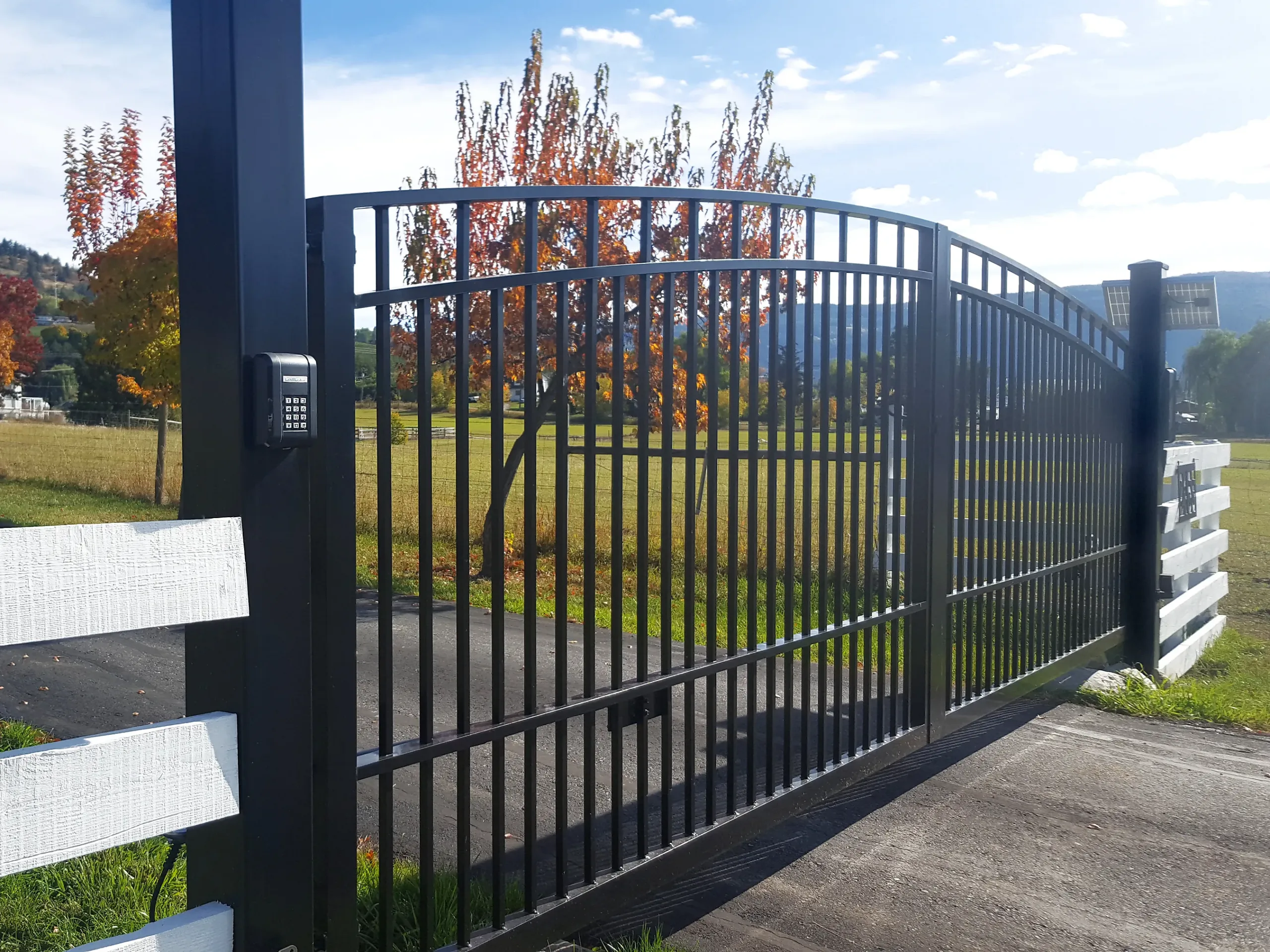
“The simplest option is a driveway gate where customers are used to entering and exiting with a simple remote,” he says. This battery-operated technology, similar to a keypad used to open a garage door, is easy to use but comes with a caveat: Make sure to change the batteries as needed. If the homeowner forgets to change the batteries, it won’t work. “It always happens at an opportune time,” says Gianopulos. “They can’t use the code because the battery’s dead.” For this reason, Gianopulos encourages the use of a wired keypad with free exits, meaning a sensor or an “eye” picks up the presence of a vehicle 25 feet away and automatically opens the gates. Professional installation is required. “We pour a concrete pad with a gooseneck. The screen mounts onto that gooseneck and we trench from there to the gate opener. The wiring is laid in that trench,” he says.
Multi-tenant units, this could mean a large neighborhood, apartment complex, or even the alley gates built into a subdivision, can use keypad and code technology, but newer technology calls for telephone entry systems. These systems, which look like a smaller version of an iPad mounted onto a post, use video or photos to announce a guest and send that information to a cell phone. “The screen automatically takes a snapshot of me, so you can view that before you grant me access,” says Gianopulos. “So even people that aren’t used to the newer technology, they warm up to it pretty quick, because it’s so simple to use,” he says. And if there’s no answer when a visitor calls? The system is designed to cycle through up to nine stored phone numbers per residence to gain entry.
Permanent or temporary access codes offer another way to allow entry to frequent vendors or guests. “If I’m a frequent vendor of yours and you really don’t want to be bothered with me calling you all the time, you can give me my own code,” says Gianopulos. Conversely, access codes can be eliminated if the homeowner wants to revoke someone’s access.
Advances in technology make access so convenient that homeowners no longer need to carry anything except their phones. In the past, homeowners were required to use an HID card, or a physical smart card. These worked by manually raising the card near a reader to access a gate or door. Now the codes are built into the entry screen. QR codes are also gaining in popularity. Homeowners send them to anyone they wish to grant gate entry. They are helpful in situations where the homeowners want to give temporary access. “Let’s say you’re having an event this weekend and you’re going to have 50 people in attendance. You can give all 50 people that QR code,” says Gianopulos. “Then, on Sunday, the codes no longer work.”
Another option for operating gates is the windshield tag reader. These function when a camera reads a code embedded on a car and signals the gate to open. While they can be applied to residential settings, they’re best suited to high-traffic areas with frequent gate use. Birdsong’s owner Derek McCutcheon, who oversees operations, says one drawback of the windshield technology is that the reader needs to be within 15 feet of the car and well positioned to be picked up by the tag. “Typically, a homeowner will use an app or a remote because it offers the most convenience,” says McCutcheon.
Whether you’re ready to send out a custom QR code or exploring the use of screen technology, before moving forward ask your vendor about monthly service costs, cellular activation fees, and whether the system can be upgraded as technology evolves.