Look to the skies (safely!) this weekend for a glimpse at an amazing natural phenomenon. No, it’s not the total solar eclipse—that’s coming next April. This weekend, you can see a partial annular eclipse between about 10:30 a.m. at 1:30 p.m, with the high point happening just before noon.
“In St. Louis on Saturday, assuming the skies are clear, we’ll get to see a roughly 55 percent partial eclipse,” says William Snyder, manager of the Saint Louis Science Center‘s James S. McDonell Planetarium.
Stay up-to-date with the local arts scene
Subscribe to the weekly St. Louis Arts+Culture newsletter to discover must-attend art exhibits, performances, festivals, and more.
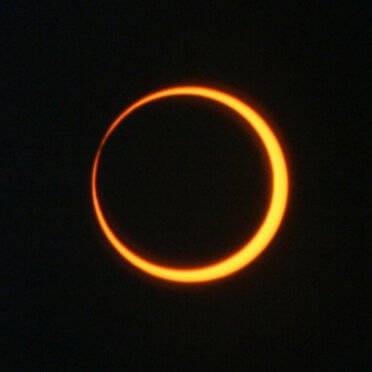
This weekend’s eclipse is an annular eclipse, which is different from the total solar eclipse that Missouri saw in 2017 and will see again in 2024. With an annular eclipse, the moon is too far away to completely block out the sun as it does for a total eclipse. Instead, there’s a “ring of fire” remaining outside the circumference of the moon, for those lucky enough to see totality.
An important reminder: There’s no point at which you can safely remove your eclipse glasses—do not look at the sun with unprotected eyes!
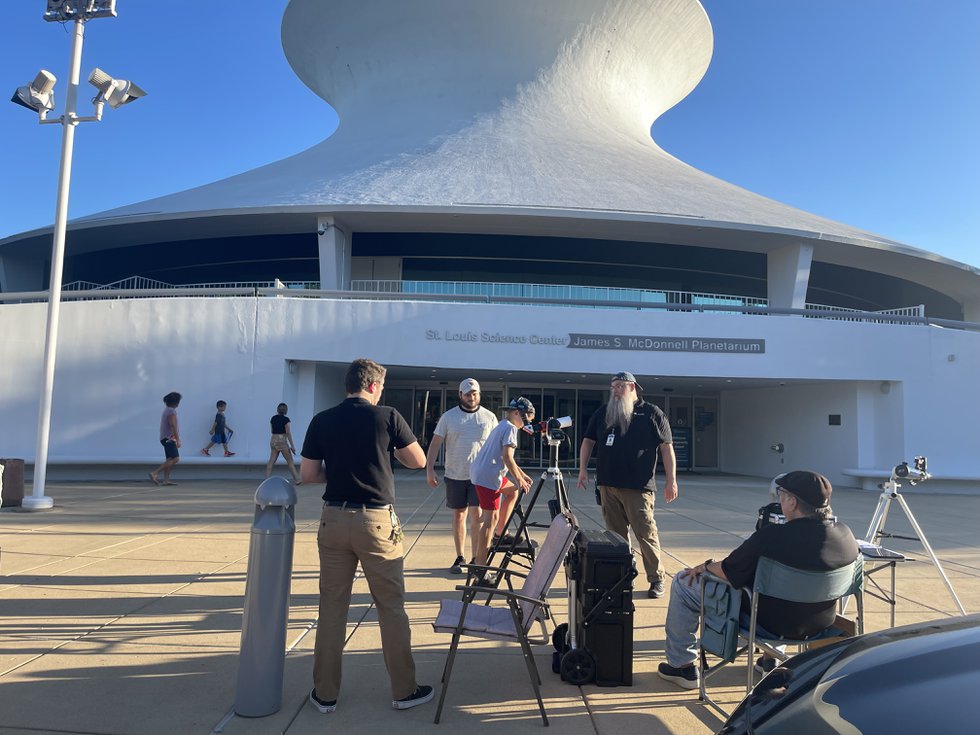
The Science Center has lots of programing planned for the day. SciFest: The Great Outdoors/Eclipse Expo is built around outdoor-related STEM areas and will offer opportunities to view the eclipse through solar telescopes. There will also be a livestream from the path of totality in the Southwest. Catch a 45-minute star show inside the planetarium (for $7) that explains what happens during eclipses. The SciFest event will happen rain or shine. (“If it’s cloudy on Saturday, then we can try again in six months!” Snyder says.)
“Personally, what I like about solar eclipses is that people come together for them, people who might not otherwise be looking to the sky,” Snyder says. “It does capture our curiosity.”
Observation Points
More places to watch the partial solar eclipse (with eclipse glasses)
Gateway Arch: The St. Louis Astronomical Society hosts a viewing event at the Gateway Arch Entrance Plaza. The group will have at least one filtered telescope and a limited supply of eclipse glasses available. Kids can pick up a Junior Ranger Eclipse Explorer booklet and earn a badge. The event starts at 10:30 a.m.
Shaw Nature Reserve: A limited number of sky-watchers can head here to view the eclipse from the prairie. Glasses are included, and an astronomical expert will be on hand for questions. Buy tickets in advance; $7 for adult non-members. 307 Pinetum Loop, Gray Summit.
Mastodon State Historic Site: View the eclipse at the picnic area across from the playground at Mastodon State Historic Site, and learn details from interpreters. Bring your own eclipse glasses. 9 a.m.–1 p.m. 1800 Seckman Road, Imperial.
Jefferson College Observatory: The observatory at Jefferson College’s dome, 16-inch telescope, and solar safe telescopes will be available for public eclipse viewing on Saturday from 10:30 a.m.–1:30 p.m. 9873 Farm Road, Hillsboro.
Carlyle Lake: The River Bend Astronomy Club brings telescopes with solar-safe filters and eclipse glasses to the Dam East boat ramp. Club members will be on hand to answer question. 10 a.m.–2 p.m. 13552 E. Dam Access Area, Carlyle, Illinois.