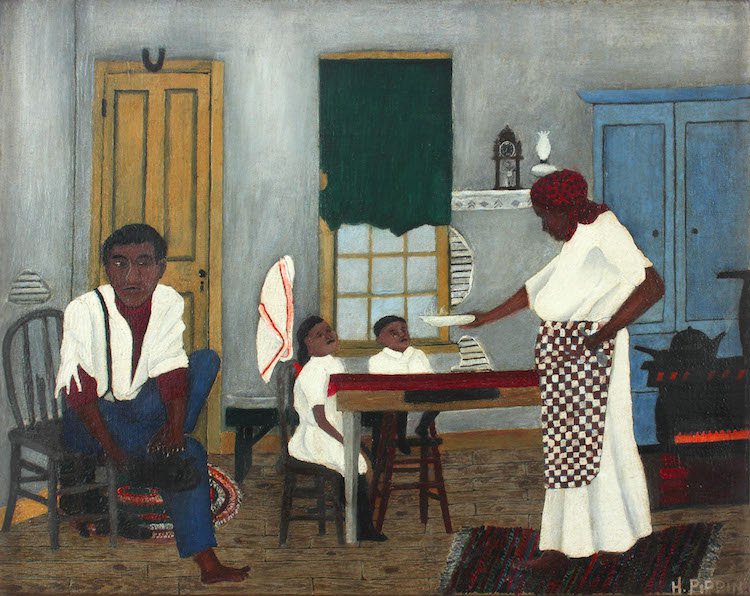
This morning, the Saint Louis Art Museum introduced a new and important addition to its collections: Horace Pippin’s Sunday Morning Breakfast, acquired Monday from from Alexandre Gallery in New York for $1.5 million. That effort was led by curator M. Melissa Wolfe, SLAM’s new Head of the Department of American Art.
In a press briefing, director Brent Benjamin said that the museum was “thrilled,” to add one of Pippin’s works to its collection, a goal SLAM has had for years. (Pippin began painting later in life, and created only about 140 paintings, making them relatively rare.) Sunday Morning Breakfast, Benjamin says, “fills a gap” in the museum’s holdings of significant African-American art, including works by Edward Mitchell Bannister, Henry Ossawa Tanner, Romare Bearden, and more recently, Nick Cave. The painting will also take a central, permanent place in the reinstalled American art galleries when they reopen in fall 2016.
Stay up-to-date with the local arts scene
Subscribe to the weekly St. Louis Arts+Culture newsletter to discover must-attend art exhibits, performances, festivals, and more.
Wolfe, who is spearheading that reinstallation, says the Pippin work will bridge a gap of another sort, and help re-contextualize work already in the collections, exemplified by Thomas Hart Benton’s Cradling Wheat and Ralston Crawford’s Coal Elevators. Pippin, she says, is a bridge between folk and figurative/narrative art and Modernism (he even showed with both Grandma Moses and Jacob Lawrence during his lifetime).
As critics have noted, even when you note Pippin’s liminality or place him in multiple genres, he is so singular and masterful that he’s tough to categorize. Though Sunday Morning Breakfast radiates with human feeling and great warmth, “it’s not fussy,” Wolfe says. “It’s not overdone, not sentimental.” It is filled with beautifully observed human gestures (Wolfe calls attention in particular to how the mother figure holds the spoon in her hand), but it is just as much about composition and color—she points how it is the yellow door, green curtains, and blue cupboard anchor the painting.
Though Pippin drew and painted during his childhood, and heavily illustrated the notebooks he kept during his World War I service with the 369th Infantry (you can see those here), he did not pursue painting as a calling until a war injury sent him back home. Shot in the shoulder by a German sniper, he was left unable to raise his right arm. He began by drawing and creating pyrography pieces with a poker. He then used the poker to support his injured arm, then used his left hand to guide his right hand, which held the paintbrush. Initially he began painting as a way of coming to terms with his war experiences, but as he continued to work, his canvases expanded to include historical, domestic, and nature scenes. For more on this acquisition, check out the coverage in the St. Louis Post-Dispatch, the St. Louis American, the Alton Telegraph, and ARTNews. For an overview of Pippin’s life and career, see arts writer Melissa Aldridge’s comprehensive post, which includes portraits of the artist, some outtakes from his illustrated war notebooks, and several images of his paintings, including Sunday Morning Breakfast,—which you can see in person when it goes on public display Friday, December 18 in Gallery 337.
SLAM director Brent Benjamin also introduced the museum’s upcoming exhibit schedule for 2016:
A Decade of Collecting Prints, Drawings and Photographs (January 29–July 17, Galleries 234 & 235): Includes 62 works from SLAM’s collection of 700 prints, drawing, and photographs, including Maritn Shongauer’s 15th-century engraving, The Nativity; Luis Jiminez’s color lithograph The Good Shepherd (El Buen Pastor); and Dorothea Lange’s iconic Migrant Mother, Nipomo, CA, which became the defining image of the Great Depression.
The Carpet and the Connoisseur: The James F. Ballard Collection of Oriental Rugs (March 6–May 8, Main Exhibition Galleries): You may not know the name James Ballard, but you do know at least one of the patent medicines that made his fortune: Campho-Phenique. Ballard’s passion was traveling the Middle East and collecting rugs, many of them dating back to the 15th and 16th century; he began donating them to the museum in the 1920s. SLAM now has one of the finest collections of this type in the world, and it will finally go on display to the public.
Currents 112: Andréa Stanislav (March 24–June 19): Stanislav is this year’s Freund Fellow; you can read more about her here.
Self-Taught Genius: Treasures from the American Folk Art (June 19–September 11, Main Exhibition Galleries): This show, originated by the American Folk Art Museum (it opened to raves last year by no less than the New York Times) features more than 100 works, including painting, sculpture, and textiles by artists such as Bill Traylor and Achilles Rizzoli.
Goya: The Disasters of War (Summer and Fall, Galleries 234 & 235): At the center of this exhibit, which features 80 etching and aquatints, is another important acquisition—the Goya piece of the title.
Conflicts of Interest: Art and War in Modern Japan (October 16–January 8, Main Exhibition Galleries): This exhibit draws on the 1,357 Japanese prints and objects in the museum’s Lowenhaupt Collection, focusing on depictions of the Sino-Japanese and Russo-Japanese wars. In addition to woodblock prints and lithographs, the exhibit will include folding screens, hanging scrolls, drawings, sketchbooks, stereographs, magazines, books, postcards, trade cards, gameboards, and textiles, including a stunning fireman’s coat emblazoned with the image of capsizing of an enemy vessel at sea—complete with tiny man toppling out of the crow’s nest into the water.