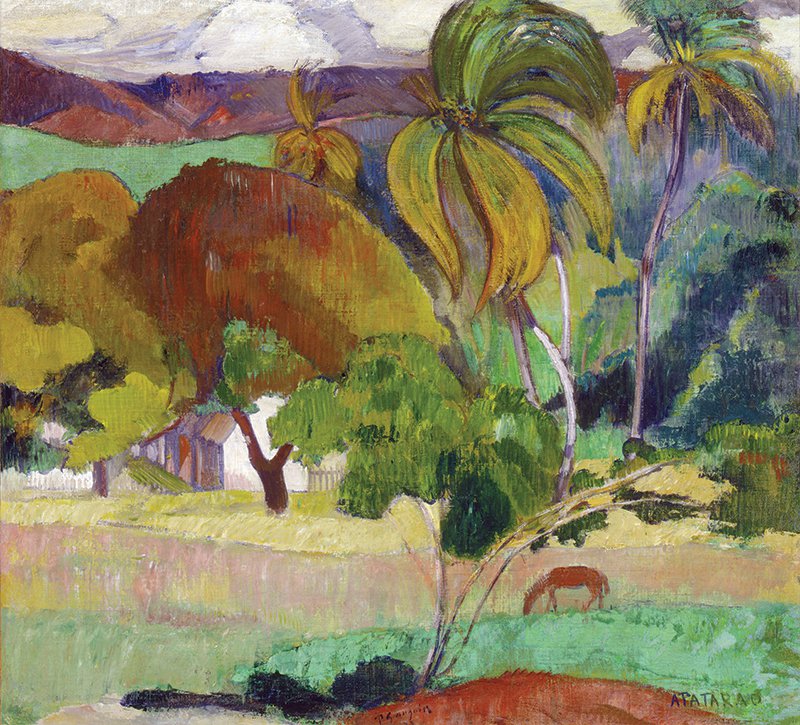
“Man leaves job to pursue other, more meaningful interests” is a theme that’s very of the moment, but rarely does it effect a monumental change. Not so in the 19th century. That’s when—in 1882, to be precise—the French stock market crashed and Paul Gauguin, the not-yet-famous painter, printmaker, and sculptor, lost his job as a broker and decided to make art. It wasn’t as much a snap decision as it might seem: Gauguin, who would go on to influence Picasso, form a creative (if volatile) relationship with van Gogh, and help usher in the era of modern art, was a collector of paintings by Cézanne, Manet, Monet, and Pissarro. Post-employment, he set sail, and from locations including Brittany, Martinique, and Tahiti, the bohemian Gauguin created.
A new exhibit at the Saint Louis Art Museum, “Paul Gauguin: The Art of Invention,” opening July 21, looks at these travels by way of paintings, prints, sculpture, ceramics, and writings by the maverick artist, most on loan from Copenhagen’s Ny Carlsberg Glyptotek.
Stay up-to-date with the local arts scene
Subscribe to the weekly St. Louis Arts+Culture newsletter to discover must-attend art exhibits, performances, festivals, and more.
Sorted into six themes, the exhibit showcases not only Impressionist works including Woman Sewing and Tahitian Woman With a Flower but also the run-up to abstraction. “In terms of the wider narrative of the rise of modern art, Gauguin’s largest contribution is looking forward to abstraction, one of the great narratives of 20th-century art,” says curator Simon Kelly. “Gauguin’s work from the mid-1890s onward really anticipates that.”
“Paul Gauguin: The Art of Invention” opens July 21 at the Saint Louis Art Museum.