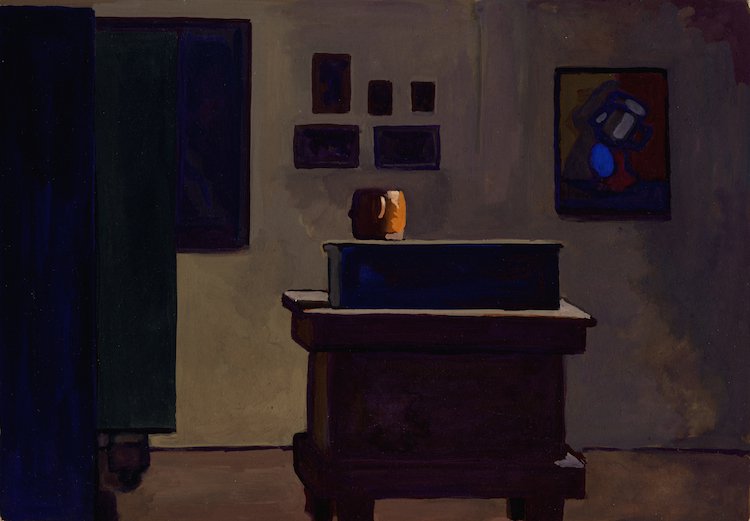
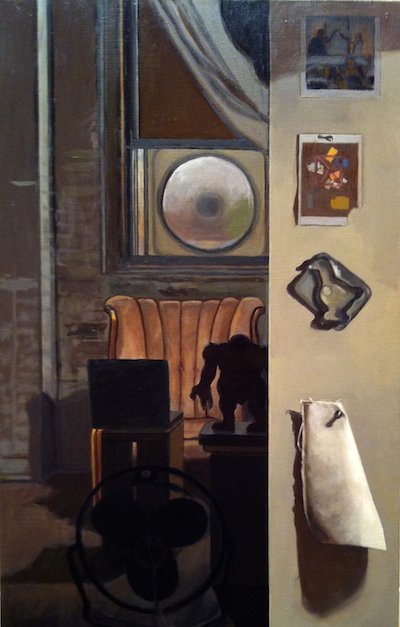
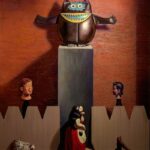
On view at the Sheldon, in the Nancy Spirtas Kranzberg Gallery, Frank Trankina: Superheroes and Night Stories features paintings by the Chicago-based artist. The works in Trankina’s solo exhibition range from large oil paintings of meticulously rendered tableaus to intimate gouache studies of individual objects and the artist’s studio. Throughout the show, commonplace forms and environments are de-familiarized through the transformative act of observational painting. Many of the works depict vintage toys and figurines that are humanized by Trankina’s idiosyncratic juxtapositions, resulting in playful—often darkly humorous—narratives. Others are trompe l’oeil renderings of the artist’s accoutrements and focus on formalism and technique rather than storytelling.
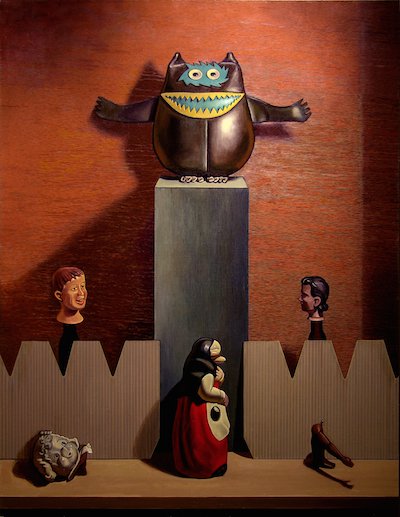
In the large painting, Dream Cabinet (2010), a group of toys and figurines are placed on a wooden shelf and positioned against a rust-colored wall. The painting’s central figure is a Nauga doll—a promotional toy made throughout the 1960s by the American brand of artificial leather, Naugahyde. During this tongue-in-cheek marketing campaign, the company asserted their vinyl coated fabric was the shed skin of squat, horned creatures called Naugas. The surreal creature looks like a coffee bean in its shape and color, and a seam running down its belly—from its wide, toothy grin to its legless-clawed feet—furthers this resemblance. The rotund little monster is pathetically funny, but with a gaping mouthful of yellow, jagged teeth, it also evokes ominous undertones. Perched atop a plinth, with forelimbs spread wide, the kitsch object transcends its pedestrian origins—functioning as a symbolic figure atop a proverbial totem pole overseeing the other vernacular objects within the painting. At the base of the plinth, corrugated panels, probably cardboard, are placed on either side. Behind each one, a dismembered doll head on a support rises above the partitions’ crenelated edges, eliciting a puppet theater. A white-porcelain head lies on its side, face up, in front of the left panel; the head is ambiguous—an anthropomorphized creature, possibly a poodle, with a Shirley Temple bob hairstyle and a black, button nose. Tacked onto the other panel, a Barbie-like, plastic arm is held in place by a push pin. In between these, in front of the plinth, a witch figurine stands in profile, facing stage left.
Stay up-to-date with the local arts scene
Subscribe to the weekly St. Louis Arts+Culture newsletter to discover must-attend art exhibits, performances, festivals, and more.
Other paintings depict sparse groupings of the artist’s tools and materials. These works are more stoic and less theatrical than Trankina’s tableaus of tchotchkes, but like his tableaus, suggest relationships (albeit poetic or formal) through unexpected arrangements of quotidian forms. In Dilemma (2006), two wooden palettes are propped against a slate-blue wall and peek out from behind a vibrant-white cloth tacked above them. The cloth and palettes are pristine—unsoiled by use—and, along with the title, suggest the artist’s dilemma of starting; Trankina has sublimated this problem by painting the objects themselves, continuing a painterly tradition of using the studio as a self-perpetuating laboratory—a means to an end. Another painting, S (2003), is composed of two rectangular scraps of yellowed, paint-stained fabric tacked to a dark-teal wall; a gray zip along the composition’s bottom connotes a floor or shelf. Placed one above the other, the horizontal scraps of fabric are reminiscent of Mark Rothko’s signature blocks of color, while Trankina’s pairing of prosaic forms recalls Giorgio Morandi’s austere iterations of bottles and vases.
The paintings in Frank Trankina: Superheroes and Night Stories—whether playful, staged arrangements or serene compositions of the artist’s materials—allude to other times or places. Toys and figurines found at flea markets and antique stores signify midcentury American culture, and Trankina’s use of trompe l’oeil technique and somber, earthy colors imply the influence of European, Old Master painters. Some of the objects might be collectible, but most feel forgotten or discarded—mildly abject. In this way, there is correlation between them and the trajectory of painting. In May 2009, the poet and art critic Raphael Rubinstein coined the term “Provisional Painting” in his pivotal Art in America article of the same name. In it, he wrote about the growing number of paintings that looked unfinished and casual. Rubinstein suggested that this was due to the perceived impossibility of painting, asserting that artists no longer strived for great painting—feeling instead that simply going on was enough. Like traditional painting, Trankina’s flea market finds may have fallen from their former status, but the artist re-contextualizes them—using an antiquated means to do so. The resulting works are firmly rooted in painterly traditions, depicting subjects that are contradictory to the way in which they are represented.
Frank Trankina: Superheroes and Night Stories runs through May 21. The Sheldon is located at 3648 Washington. The galleries are open Tuesdays, noon–8 p.m., Wednesday–Friday noon–5 p.m., Saturday noon–2 p.m., and one hour before Sheldon performances. For more information, go to thesheldon.org.