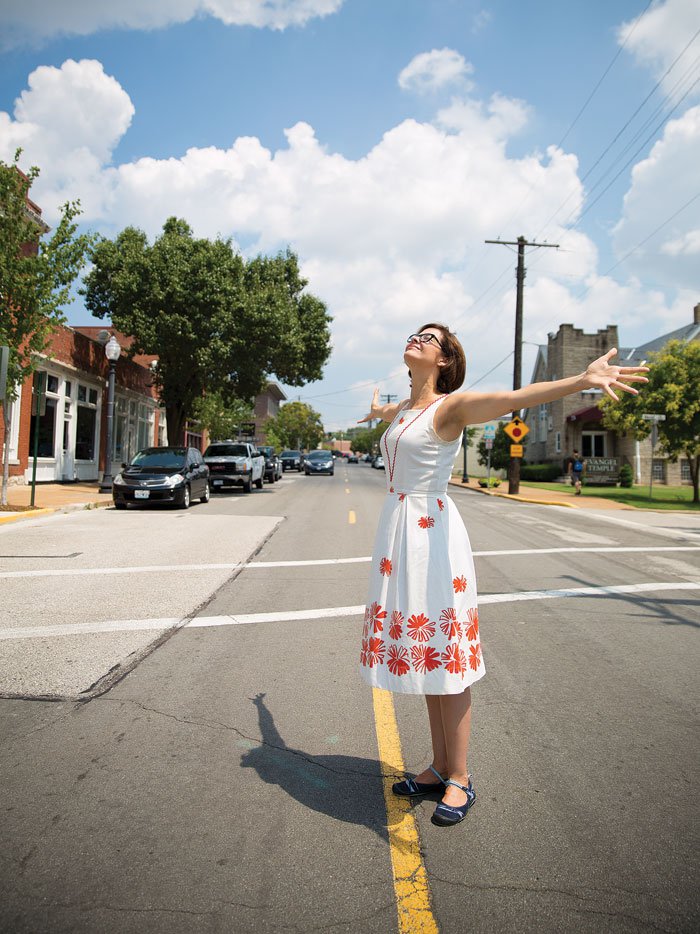
When Nancy Bell, playwright in residence for the St. Louis Shakespeare Festival, starts hanging out in Maplewood to research the next Shakespeare in the Streets, people tell her ghost stories. Shakespeare uses ghosts, she muses. Then she discovers Mystic Valley, owned by three sisters (“So Shakespearean!”) and leads a story circle there with psychics and healers. Next, a Maplewood historian tells her about Clara, one of the famous Clamorgans.
Bell decides to make Clara a ghost.
Stay up-to-date with the local arts scene
Subscribe to the weekly St. Louis Arts+Culture newsletter to discover must-attend art exhibits, performances, festivals, and more.
The next story circle is at Living Arts Studio, which welcomes artists with disabilities. There Bell meets a young woman—call her Jill—who was studying to be a veterinarian when her father suffered a fatal heart attack. Jill flew home to help her mother. A month later, Jill was in Montana when a snowmobile crash damaged her brain and left her paralyzed on one side.
“When I came out of the coma and saw how thin my mother was, I said, ‘Mom, go to the doctor,’” Jill says. “She had ovarian cancer.”
In less than a year, Jill had lost her intellectual prowess, her easy athleticism, and both of her beloved parents.
“I’d so love,” she tells Bell, “to have a conversation with their ghosts.”
In past years, Bell used the shipwreck-marooned Twelfth Night to tell the story of Old North and As You Like It for Clayton. Maplewood is starting to feel a little like Hamlet.
Back at Living Arts, Bell introduces her director, Lucy Cashion, to Jill—whose story will be a monologue in the play—and Dan (also a pseudonym), who, Bell hopes, will perform it.
Neither of them knows this yet. Bell has simply suggested that they bring some of their poems.
“Is this an audition?” Jill asks.
“Kind of,” Cashion admits.
“I thought so.”
They talk first. In five years sleuthing St. Louis communities, Bell has learned to relax and listen. Jill describes the day she surprised her mother by walking, with the help of braces, into the house: “We were all crying, even the bus driver.” Dan talks about the tumor that formed on his pituitary gland when he was a boy, the epileptic seizures he’s suffered, and the scare of temporarily going blind at age 15.
“Do you remember being blind?” Bell asks.
“I remember what it was like being in a coma,” Jill volunteers. “It was dark. That’s why every light in my house is on. I’ll pay the electric bill.”
Bell tilts her head. “You’ve both had more challenges than most people. How did you cope?”
Jill shrugs. “Am I supposed to wither away into nothing? That’s not what life’s about.”
“Do you agree?” Bell asks Dan.
“I do, sort of. I was really, for a long while, angry about everything that happened to me. Then I thought it was God challenging me. Now I think it’s life doing that, and God helping me to get up and go on.”
He says that when children ask what’s “wrong” with him, he tells them that “a disability can happen to anybody at any moment.”
“I have thought about that a lot since I met you guys,” Bell says fervently. She asks what they think the best thing about life is.
“Opening up to others,” Dan says.
“That you can do new things,” Jill says. “I mean, you only live once.”
“What change would you like to see in the world?” Bell asks.
“More art,” Jill says. “Like the ’70s. Not the drugs, but more creativity.”
“I agree,” Dan says. “Our world has become angry. It’s become more judgmental.”
“Do you think people judge you?” Bell asks.
“A little bit. Like, when people learn I don’t work, they think, ‘He’s lazy,’ or ‘He’s spoiled.’ It used to hurt a lot. But if somebody is working really hard, they have got to be so angry that they have to work 40 hours a week.”
Bell’s silent, letting his kindness make its point. She asks if they have questions.
“Just…eager,” Jill says. “I hear you’re going to do some kind of masks?”
“Puppets.”
“I have a really big goldfish. I don’t think Call-a-Ride would put it in the van.”
We move to a quiet studio so they can read their poetry aloud. Jill reads an elegant short poem about a robin waiting to care for her babies. Dan reads a poem about a father “whose love withstood my fists,” and about waiting almost too long to open his heart to his dad’s love.
“When do you guys write your poems?” Bell asks.
“Early in the morning,” Dan says, “usually after I have been praying.”
“When it hits,” Jill says.
“We have been talking a lot about parents,” Cashion says. “Close your eyes, think of a gesture you remember one of your parents making, and then see if you can repeat it.”
Dan raises his arm and tenderly strokes someone’s hair.
“Do you mind being touched?” Jill asks Cashion, and puts a hand on her cheek. “Oh, sweet child, you are so beautiful.”