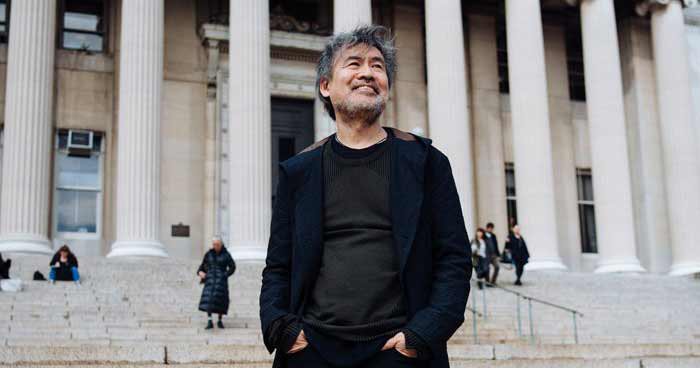
Opera Theatre of St. Louis’ “Bold Works, New Voices” series has given us all kinds of wondrous things: a jazz opera about boxing, an adaptation of a Salman Rushdie novel, a romp through Gertrude Stein’s Paris. This year, the series premieres An American Soldier, by librettist David Henry Hwang and composer Huang Ro. The original hour-long version debuted in Washington, D.C., in 2014; Hwang describes it as a “docu-opera” that laid out how Chinese-American solider Danny Chen was driven to suicide by his fellows in arms in Afghanistan in 2011. The opera’s new two-hour version, he says, allowed the pair to explore Chen’s life and death on a larger canvas.
You passed on writing Chen’s story as a play. Why as an opera? A lot of the things that I’m doing at the moment in terms of my playwriting work tend to be more comic or meta or ironic, and I didn’t feel like this story really lived in any of those wheelhouses. Because Huang Ro and I had been looking for a subject to do an opera about, I thought, this seems like it could make a very good operatic story. Opera is really well suited for big epic stories that have very strong and pure emotional lines that often deal with tragedy, death, and love.
Stay up-to-date with the local arts scene
Subscribe to the weekly St. Louis Arts+Culture newsletter to discover must-attend art exhibits, performances, festivals, and more.
How did the opera come together? Generally, all the operas I’ve worked on, including this one, the words come first. Which is of course easiest for the librettist [laughs]. It’s harder when the music already exists, and you need to fit the words in. That said, once the music is written, there’s still rewriting and adjustments to do. And that of course then the words need to be adjusted to fit the music. Then in this case, it’s a very specific situation, because we had already done the one-hour version. We wanted to expand it into a full-length version, and that involved working with the musical themes that had already been composed for the first version.
You worked mostly from court documents, right? For me, the primary materials were the court transcripts, and the journalistic record. In particular, there was a local newspaper in North Carolina that did some pretty granular reporting on the court marital as it was going on. I didn’t do any direct interviews—it was Huang Ro who spoke with Danny’s parents. I have no capacity in Chinese, and as it turns out, Huang Ro, though he speaks five dialects, didn’t happen to speak the same dialect as Danny’s parents, so he needed an interpreter, too. That was one of the first things that happened, because we didn’t want to do it if we were going to just exacerbate the tragedy of these parents having lost their child. I feel like Huang Ro’s conversation with Mother Chen ended up being the emotional through line of the opera. Opera is very well-suited to love stories, and in some sense, the primary love story in this piece is a mother-son relationship, which is I think doesn’t exist that much in opera. But it ends up being the emotional engine of our piece.
The original, shorter opera debuted in Washington, D.C. in 2014 in a very different political climate. How does it feel to be on the cusp of premiering a longer version in 2017? I think we were creating a piece anyway which affirmed the importance of the pluralistic model of American society and culture. If anything, we have leaned into that for this version. It’s not just a story about a Chinese-American soldier who essentially gets hazed to death. But it is also what we hope is an affirmation of E Pluribus Unum, from the many, one, the notion that the country is stronger for the many different types of people and cultural backgrounds that contribute to it. To be making that statement in a political moment when immigration is under attack, when white nationalism is on the rise, and when the tone from the White House, in particular, feels oftentimes disparaging of Americans of color, to be making this statement at our moment in American history, we didn’t plan for it. But it certainly feels more powerful and important now than it was in 2014.
Of course, the racism was always there, but events like Charlottesville seem to suggest that the need to address nationalism and white supremacism has become more urgent. I think a lot of white supremacists or racist points of view, as you say, were here in 2014, but they were still a bit more under wraps. It was less acceptable to express these sentiments, whereas now I feel like the white supremacists and the neo-Nazis, and that whole point of view, feels much more empowered and validated. That’s the climate into which the latest version of the opera is now premiering.
And it’s now twice as long—what kinds of artistic choices did you and Huang Ro make as you expanded it? I would say there are two major areas in which we sought to expand the opera. First of all, I should mention that some of the stuff that’s in the opera now were ideas or even music that had been written for the earlier version, but because we had a one-hour limit, we had to cut them. So there are some things we always wanted to do, even in the first version. I would say that, number one, we’re trying to deepen the emotional exploration of the story. The Washington version was, in some sense, something like a docu-opera. I worked from the transcripts, I worked from the newspaper reports, so it had more of a documentary feel to it. In this version, we are able to breathe more, and therefore explore the emotional impact of the moments more deeply. An example being, there’s the moment right before Danny dies, and it is right around this episode which actually happened, where the sergeant who was Danny’s primary persecutor, ordered the rest of his unit to stone him, to throw rocks at him. In the original version, that happens and then Danny goes to a guard tower and you hear a gunshot. Huang Ro had the idea that we really want to understand Danny’s point of view. What is his mental state in the moment before he dies? That makes a lot of sense emotionally and dramatically. Now, one of my favorite arias in the show is that moment where Danny expresses himself. It was a difficult thing to write, to get into his head. It’s a painful state of mind to enter, to create that aria. But I think it’s a very powerful moment. The second thing we tried to do was just expand the sociopolitical canvas to look at not just the story of one Chinese-American, but also the larger role that pluralism has played in American society. We see examples of other types of harassment, including gender harassment and assault, to try to paint the larger picture. Towards the end, there is an E Pluribus Unum chorus which is sung by what I think is going to be a very diverse group of soldiers, espousing our national motto. Those are the two general areas that we utilized to try to expand the show.
And you added a character named Josephine—who’s just Danny’s friend, right, not a love interest? Yes, Josephine is just a dear friend, and there was a male character who sort of served that function in the one-hour version, but we made him have a female friend, which essentially again I would say the first priority to try to deepen the emotional story and understanding of our main character. And it had the additional benefit of adding another female voice to the ensemble. We’re not looking at the ingénue female as the love object, the primary love is maternal.
What was it like working with Opera Theatre? This is actually my second time doing a show at Opera Theatre. I also had written the libretto for the Unsuk Chin Alice in Wonderland that was five or six years ago. This was a deeper dive, because withAlice in Wonderland, we were basically taking an opera which we had premiered in Munich, and bought it and did its American premiere, as opposed to this was something that existed in the hour form, and James Robinson had the idea to expand it into a full-length, and they provided the workshops, they provided all the resources that we needed in order to do our work creating it. Then they held workshops created to hear it,, they got audio made—it was a very hands-on experience. Not to mention bringing Huang Ro and I up to St. Louis a month or two ago to begin talking about this work in the community, with various St. Louis communities. So I think that the care and hospitality and artistic commitment of OTSTL is quite extraordinary and the fact that opera theater has done as many world and American premieres as it has during its history – that’s a risky proposition for an opera company. Generally, the conventional wisdom is that opera patrons just want to see the classics over and over again. Being willing to take a risk on new work in general, and in this case a new work which centers around an American character of color, and has a sociopolitical point of view, I think speaks to their dedication and willingness to take risks for artistic gain.
An American Soldier runs June 3–22; visit opera-stl.org for performance times and tickets.