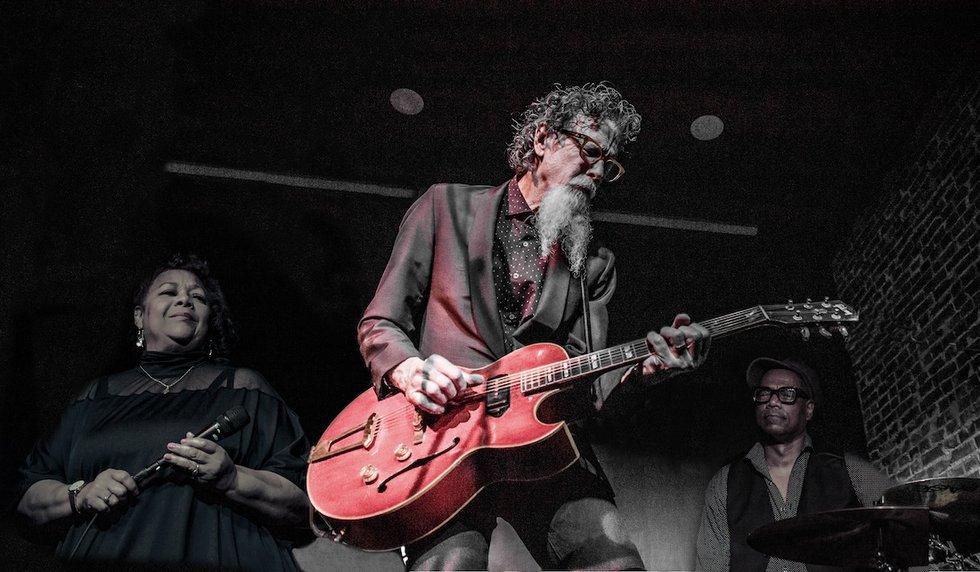
St. Louis–based singer/guitarist Walter Parks doesn’t blame singer Ada Dye for not always having time for him. Not long after Dye joined his band, Walter Parks and the Unlawful Assembly, she got tapped to join Bruce Springsteen on his tour, and she’s been traveling the world with the Boss ever since.
But she’ll be in St. Louis this Friday for Parks’ band’s show at The Blue Strawberry, and Parks insists that her limited availability actually suits him just fine. “Right now, I can only do so much as a band leader,” Parks explains. “It works out well.”
Get a guide to the region’s booming music scene
Subscribe to the St. Louis Music newsletter to discover upcoming concerts, local artists to watch, and more across an eclectic playlist of genres.
Parks also understands the life of a traveling musician more than most; he spent 10 years as a sideman to Woodstock legend Richie Havens. But he’s now rooted in St. Louis. He moved to Webster Groves just before the onset of the pandemic (his wife is a native), and he says it has helped facilitate a creative renaissance.
That involves far more than performing (along with Dye, Parks’ touring band includes drummer/producer Steven Williams). A native of Jacksonville, Florida, Parks has thrown himself into researching the music of the Okefenokee Swamp and translating old spirituals into rock ‘n’ roll, a process that involves both intense research and deep respect for the Black Americans who originated the songs.
He references his band’s version of “Early in the Mornin’,” which draws on the famous recording that ethnomusicologist Alan Lomax made at the Mississippi State Penitentiary in 1947. “What I’ve done is put a more R&B meets rock ‘n’ roll edge to it, but the groove is still the same,” Parks says.
To him, the history is as important as the licks. “These guys were forced into the convict labor system,” he says of the men in Lomax’s recording. “They were forced to sing. So that’s an awful situation, but if we fast forward the timeline to the present day, that groove has been the basis for so many rock ‘n’ roll songs.”
Parks’ research has involved multiple trips to African Methodist Episcoplian churches in Alabama and Mississippi. He says, “When I go into these churches, I don’t go into these churches to do a concert. I go to these churches to learn.” That education, he says, “infuses you with this responsibility to do this music justice and to not hack your way through it.”
Expect Parks to share not just songs but the stories behind them, and notes from his research, when his band takes the stage at The Blue Strawberry this Friday. He’s looking forward to sharing his music with the city he has gotten to know in the past four years.
Being in St. Louis, he says, has “humbled me, in a sense, because there’s so much blues here, and so much blues history, and there’s so many good players.”
He’s careful to stay in his lane.
“St. Louis has reminded me that I need to stay with what I’m good at,” Parks says. “I don’t try to play the Chicago blues stuff. I don’t try to play the St. Louis blues stuff. I try to play my kind of blues. And so, when I do it, I do it with a feel that’s different from the way folks do here.”
One St. Louis inspiration has come from Scott Joplin, the noted ragtime composer who wrote his best-known pieces during his time in the city just after the turn of the 20th century. “When I translate his style and feel to the guitar, it’s perfect,” he says.