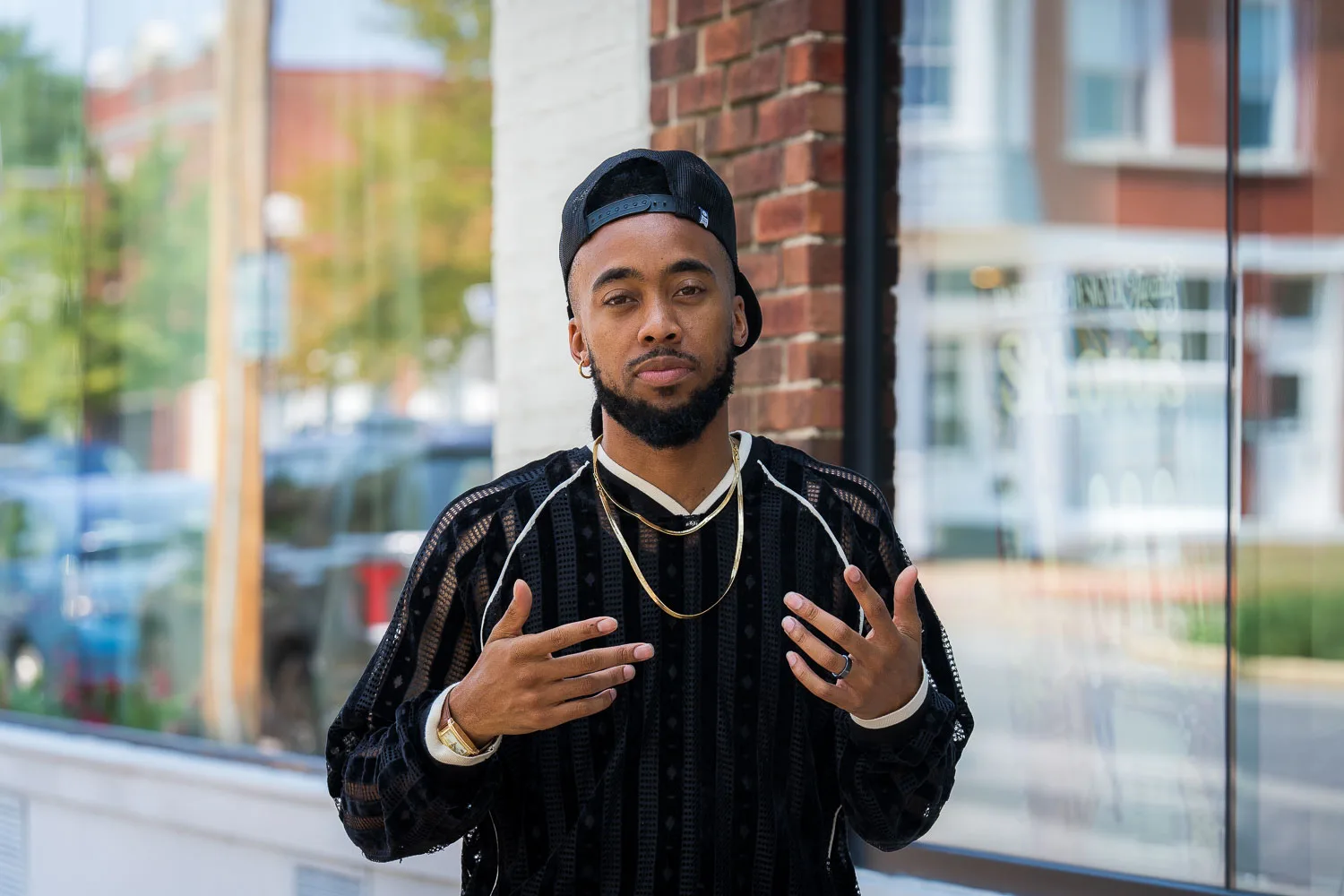
It’s been quite a summer for the artist known as Mvstermind, whose real name is Muhammad Austin. He has no fewer than five tracks in the new HBO soccer documentary U.S. Against the World, including its thrilling title track. He performed at the World Cup in Los Angeles, helping hype up the U.S. Men’s National Team for its victory over Australia. He’s also serving as a fellow at WashU’s Engaged City program.
But Austin shrugs off the idea that it’s been a bit too much.
Get a guide to the region’s booming music scene
Subscribe to the St. Louis Music newsletter to discover upcoming concerts, local artists to watch, and more across an eclectic playlist of genres.
“I do great under pressure,” he explains in a new episode of The 314 Podcast. “I think that’s kind of my zone.”
Austin wrote all five tracks specifically for the documentary, working with co-writer and producer Hannah Parrott. By the end, deadlines were coming fast—and Austin says he and his wife, Savvis, rejiggered their household schedule so he could move into his South City studio for some all-nighters away from the kids (they have two sons, ages 7 and 1) to get things done.
“You’ve got to design your world in order to go into that deep, special, sacred zone,” Austin says. “When everybody’s sleeping, everybody’s taking care of everything, I can go into a place where I don’t have to think about the rest of the world.”
That kind of intense focus is now yielding fruit. Austin says he’s heard from friends all over the world as his voice kicks off not just the HBO documentary, but the previews that promote it—and he sees doors opening thanks to the attention paid to the team and his songs. “It’s been life-changing, in so many ways,” he says.
And these are doors, he believes, he won’t have to move to L.A. to walk through. “You just hop on a flight and go get to it,” he says.
Both Austin’s new EP, I Heard They Doubted, which drops August 18, and that catchy HBO title track are about confronting other people’s dismissiveness and doubt head-on, something Austin says is new for him. “That’s the speed that I’m in right now—unapologetically taking on that journey of being OK with not just brushing it off, [saying], ‘No, I’m gonna use that. I’m going to turn it into gold,’” he says.
Ironically, he says, the challenge of building a music career from the Midwest isn’t the doubt or the dismissiveness, but rather not being surrounded by other examples of how to make it happen.
“You don’t see other people doing that,” he says. In L.A., he adds. “It’s like, ‘Oh, well, in front of me are 25 examples of how to do it and how not to do it.’” In St. Louis, you have to find your own way.
That’s something Austin, 34, has been doing for awhile. He grew up in North City and was bused to Clayton as part of the region’s Voluntary Interdistrict Choice Corporation desegregation program, commonly known as VICC. He remembers being 6 years old, waiting for the bus at 6 a.m., and arriving in a different world—and in a school district where very, very few other students were Black. It was not easy.
But it also gave him the ability to understand St. Louis in a way many people cannot—from the wealthiest parts of Clayton to the streets near Fairground Park.
During his time in Clayton, some district leaders began to question the costs of participation in VICC and considered pulling out (the district ultimately did not pull out, although the entire program is now being phased out across the region). For Austin, seeing classmates walk out in protest helped him understand not just the dark forces that shaped segregation—but the people who were willing to fight it.
“I got a chance to see some real ones who actually care,” he says. “And so in some shape or form, that really did shape my experience, because I was actually able to see the heart in the midst of some crazy, wild, systemic things.”
As a WashU fellow this year, Austin has gotten excited about cultural asset mapping, which he sees as helping other people get other people out of their silos. You can only understand how rich the cultural scene of a city is when you’re not locked into areas where everyone looks like you.
“We all are dependent upon one another,” he says. “It’s a whole system. And if one was existing without the other, it would not be functioning properly.”
Watch the full interview on The 314 Podcast.