Lenny Jewell moved to St. Louis from England in 1986. Sitting at a rickety iron table outside Pop’s Blue Moon on The Hill, he talks about coming to the U.S. as a fan of rockabilly and blues music—two genres he couldn’t find on the radio back home. When he arrived, he found that American radio wasn’t faring much better.
According to Billboard, the most popular singles of 1986 included Survivor’s schmaltzy “Burning Heart,” Mr. Mister’s mawkish “Broken Wings,” and Dionne Warwick’s ultra-corny “That’s What Friends Are For.” The ‘80s were a time of heightened corporatization for the music industry. On the airwaves—where the suave, the synthetic, and the saccharine reigned supreme—this certainly showed.
Get a guide to the region’s booming music scene
Subscribe to the St. Louis Music newsletter to discover upcoming concerts, local artists to watch, and more across an eclectic playlist of genres.
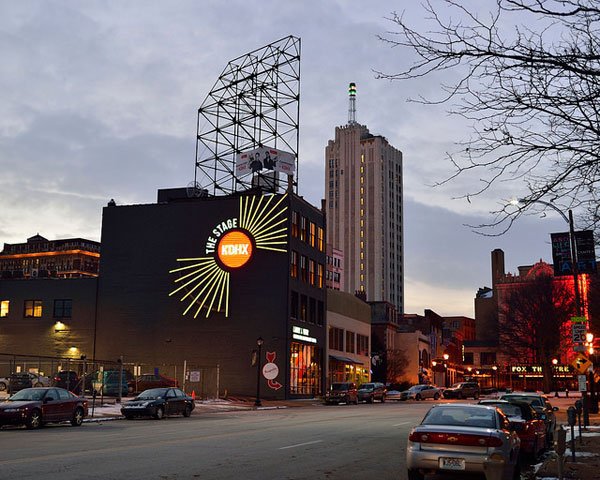
By 1987, KDHX 88.1 FM became officially recognized as a community radio station in St. Louis. Registered as a 501(c)(3) nonprofit under the Double Helix Corporation, KDHX was founded with the goal of building community through independent, commercial-free, volunteer-produced music programming. And, much to Jewell’s liking, it played rockabilly and blues.
“It’s one of a kind,” he says of the station. “It’s St. Louis. It’s informative. It gives you something different from everything else on the dial.”
Jewell has been a loyal KDHX listener since its launch 36 years ago. When he learned about the station’s dismissal of longtime DJ Tom “Papa” Ray in February, he felt the need to speak out. First, he and others held a protest outside the station. Afterward, he suggested everyone regroup at a bar to vent their frustrations.
“Being St. Louis, the protests got thrown out the window, and the venting at the local bar took over,” he says.
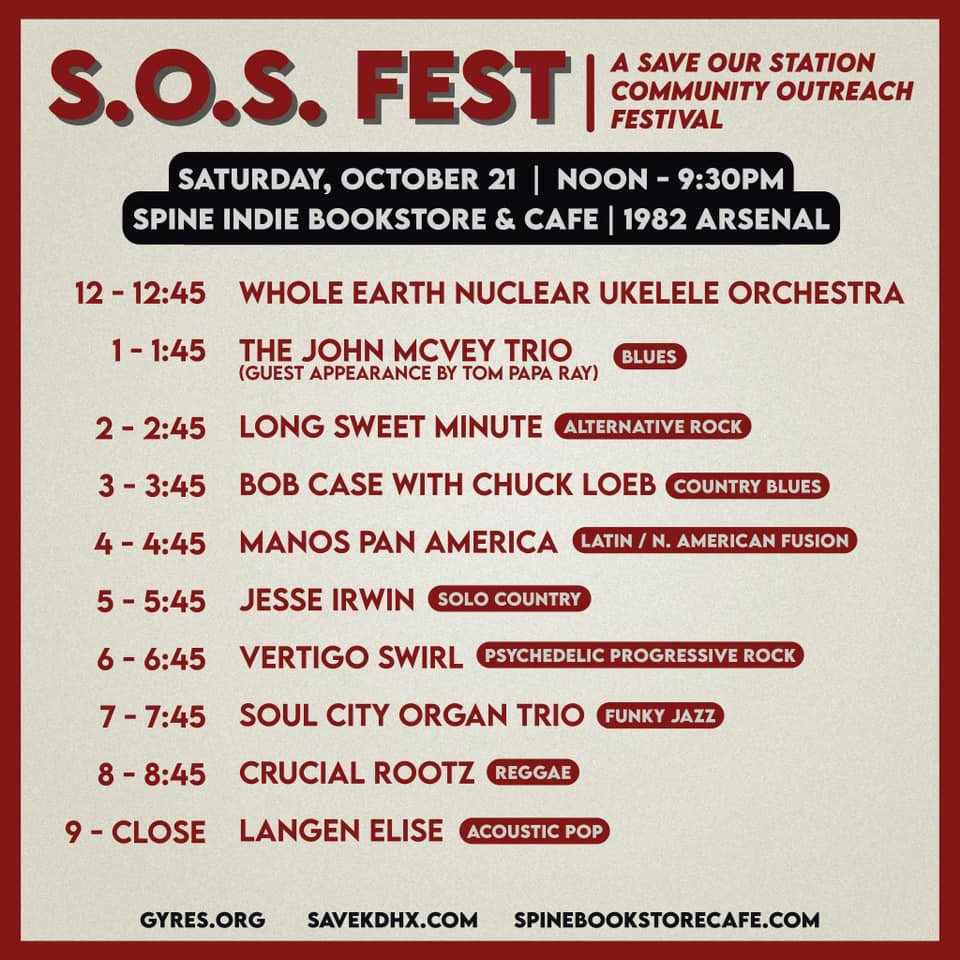
Eight months later, at least 12 more DJs have been dismissed from KDHX, prompting many others to go “on strike” or resign in protest. Fellow KDHX fans and former volunteers still meet at Pop’s each week to retain a sense of community and determine how they can enact change at the station. To show station leadership the breadth of community support backing the DJs, Jewell came up with the Save Our Station (S.O.S.) Festival, organized by his own nonprofit group, the Gyres Society.
A full day of live music and vendors, the festival will be held on October 21 from noon to 9:30 p.m. outside Spine Indie Bookstore & Cafe. The festival will channel the syncretic spirit of KDHX by featuring artists from a variety of genres, including blues, reggae, and Latin music.
Jewell says the S.O.S. Festival isn’t meant to thwart the station or perpetuate conflict. Rather, his goal is to inspire change.
“I want to show them that there is a path, that they can come back if they would just open their ears, start a dialogue, and start being what they say they are,” Jewell says. “Be a community radio station.”
For outsiders, it can be difficult to keep track of the decisions that caused Jewell and his cohorts to feel like KDHX lost sight of its original vision. While the station normally has about 80 volunteer DJs, it’s currently down to 54. This means 37.5 percent of them are no longer on the air, whether they were dismissed by management or voluntarily resigned.
The turmoil began on February 28, when Ray was dismissed from his show, Soul Selector. In an open letter, station leaders said he was dismissed due to a “long history of bullying, aggression, and harassment.” Ray has denied these accusations, and instead attributes his firing to disagreements with executive director Kelly Wells that occurred via email.
In May, a group of DJs issued a letter of no confidence in Wells, citing several perceived missteps, including Ray’s firing. The letter ends by calling for the removal of Wells by the board of directors.
Later in August, DJs Drea Stein and Andy Coco were released due to “their use of their platform to encourage listeners to defund [the] station.” Stein and Coco both deny this. Ten more DJs were fired on September 22. Gary Pierson, president of the KDHX Community Media Board of Directors, implied these volunteers were dismissed for resisting the station’s DEI initiatives, which followed accusations of racism and sexual harassment on the part of station leadership in 2019. Pierson subsequently backtracked and clarified that the DJs were released for being disruptive in their support of Ray.
According to a press release from the League of Volunteer Enthusiasts of KDHX—a recently formed group that hopes to represent volunteers and “work with management and the Board of Directors in a variety of functions”—these DJs participated in an effort to organize a negotiating body prior to their dismissals.
Some KDHX veterans, such as Coco, believe these dismissals, and the board of directors’ reduced size—six of the possible 15 seats are currently filled, according to a group of associate members—have been a way for station leadership to consolidate power.
“There are lots of ways [Wells] could have gotten what she’s trying to get done,” Coco says. “And instead of doing it the hard way, she took the shortcut of flexing absolute power.”
Jenn DeRose is a professional organizer and former KDHX DJ. As a social justice advocate, she says she is concerned that the station’s recent messaging will cause community members to associate DEI efforts with autocratic decision-making and the stifling of open conversation.
“Generally speaking, DEI efforts aren’t used to squash any dissent in an organization,” DeRose says. “[KDHX leadership] is using something beautiful and important as a weapon, and it devalues the work of DEI efforts.”
As DJs continue to seek more representation in the station’s decision-making, several local artists and vendors hope to raise awareness for their cause at the S.O.S. Festival.
Langen Elise, guitarist and vocalist for St. Louis–based indie rock band The Defeated County, will close the festival with a solo acoustic set. Elise has a long history with KDHX, having volunteered and performed at its events in the past. Her music has also made it on the station’s airwaves, which she finds indispensable even in the age of streaming.
“Community radio play actually still matters a lot more than people think it does when it comes to making it to any kind of ‘next level’ of your career,” Elise says. “One of the great things about St. Louis is that we have KDHX.”
Elise’s set will feature protest songs and acoustic renditions of tracks by The Defeated County. She says she’s excited for the opportunity to bring further attention to the actions of station leadership, which she feels are unjust. This is something she wishes she did in 2019, when accusations of discrimination and harassment first came to light.
“Now, KDHX is saying they’re firing all these DJs as part of their anti-racist, super-inclusive strategic plan, but it doesn’t make sense, because it’s the same leadership from 2019,” she says. “We should have been using our voices sooner, but we’re doing a really good job now.”
Ray will also appear at the festival, playing harmonica with the John McVey Band. He says the group will perform “St. Louis–centric” blues songs, including a song by the Missouri-born blues musician Billy Gayles.
Ray believes KDHX is valuable because it’s one of the city’s few stations that plays local music. He hopes the S.O.S. Festival will remind community members of this.
“KDHX was at one time the best community radio station in the United States,” he says. “Hopefully one day, with different management and with a different board, it can reach that point again.”
In his most recent statement, Pierson referred to a “small group who are determined to derail the station’s future.” Ray and Jewell both disagree with this notion—a Facebook group called “SAVE KDHX 88.1” currently has 3,000 members, and a Change.org petition calling for a new board of directors has garnered more than 3,000 signatures so far.
Furthermore, Jewell emphasizes he and the DJs want to preserve the station—not derail it—and reconnect it with the people of St. Louis. He hopes the S.O.S. Festival will help this happen.
“We can’t let hope die,” he says. “We’re the community. They’re community radio. They can’t survive without the community.”