“There’s no jumpin’ around in the blues,” Reverend Gary Davis once said. But Art Dwyer, a bassist who’s the only remaining founder of the Soulard Blues Band, shakes his head. “That definition’s too confining. Somebody close to you just broke your heart, and your only living brother just stole your wife, and you went to talk to him about it and she stabbed you, and you went outside and your car had been stolen…well, that’s at least half of it. But that ain’t even all of it. Blues can be celebratory.”
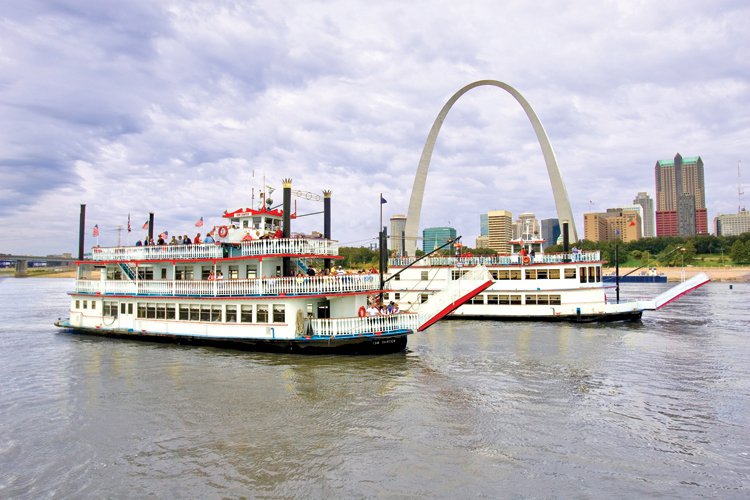
Take the St. Louis Blues Cruise. “The people who come, it’s a real cross-section,” says Dwyer, whose band’s been playing those summer cruises from the start. “Some are from out of town, and there are as many older people as younger. Some people come dressed to the nines, some really loud—you can see their shorts or dresses a mile away. There’s some preparation.” He chuckles, thinking of past trips. “Everybody knows how to behave, but there are no rules. And the intensity kind of grows all night, all the way until the boat pulls into the harbor and they shut the engines off, and everybody’s still laughing and telling jokes as they leave. There’s not a long face in the crowd.”
Get a guide to the region’s booming music scene
Subscribe to the St. Louis Music newsletter to discover upcoming concerts, local artists to watch, and more across an eclectic playlist of genres.
Blindfolded, Dwyer would know he was on the Mississippi. “There’s no mistaking the moisture in the air, the hot musky smell of the river. You can feel when you are turning. And the Tom Sawyer’s got these giant engines, and I can feel them under my feet. We put Styrofoam pads down so it doesn’t get picked up through our sound system!
“The river’s mostly commerce now,” he says with a sigh. “The peak of romance, on some goofy level, was probably Andy Williams singing ‘Moon River.’ But at one point, there was a whole existence out there. People who were born, lived, and died on the water. There were haberdashers, knife sharpeners, commissary boats that floated up and down the river selling stuff to people on other boats. They’d trade stories, eat and drink a bit, play the fiddle, and dance all night. So entertainment was a big, big part of it all.
“Now we go out and there’s bridges, lights. But the magic is still there, and we are just tappin’ into it.”
Dwyer has trouble even defining the blues. “Right now, there are probably 10 and in another minute there will be 20 definitions running around in my head,” he says. “So rather than nail down with any one interpretation…” Dwyer, it’s fast becoming obvious, does not want to define the blues, doesn’t think it needs to be defined.
“Musically, the structure is usually three chords,” he offers, handing me this crumb on a silver plate. “Whole songs being played in one key, that’s what defines the blues’ power. It’s got flatted thirds, fifths, and sevenths—” the blue notes, also called “worried” notes—“and some people call that the funeral staircase.” The syncopation of the blues shuffle takes the music further off center by making the emphasis ragged and uneven.
Bottom line, these technical traits let the blues bypass logic and cut straight to the heart.
“Blues is an expression that touches everybody,” Dwyer says. “No matter who they are or where they’re from, they can get the blues”—no definition needed. “As far and wide as it can reach, that’s how deep it can get. There are musicians that can strike a chord or hit one note, and it’s all there. It can be summed up in one note. They can play that note and never let you forget it.”
On the cruise, they play the blues greats—B.B. King, Wynonie Harris, Elmore James—and some R&B—Marvin Gaye, James Brown, the Isley Brothers. “But if we get to a certain point, it doesn’t matter what we play,” Dwyer says. “What counts is that the band is playin’ and playin’ good. All this interaction begins. We can see that from the bandstand. People walking across the floor and grabbing somebody and pulling her onto the dance floor.”
The cruises sail only once a month, June through September, and pretty regularly sell out a month ahead. “Tom Dunn runs the boats,” Dwyer says, “and when it floods you’ll see him down there in his starched white shirt, cigar in his mouth, nice trousers, and he’s got hip boots on and he’s in mud up to his knees, cleaning debris. He’s a river boy.”
A slow grin crooks Dwyer’s narrow, deep-lined face. “We don’t want them to know we would do it for nothing. It’s that much fun.”
For this summer’s schedule, check gatewayarch.com.