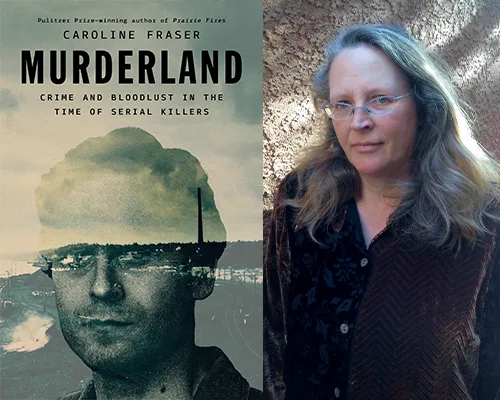
Named one of the most anticipated books of 2025 by LitHub, Caroline Fraser’s new nonfiction offering, Murderland: Crime and Bloodlust in the Time of Serial Killers, is out June 10 from Penguin Press. The book dives into the messy and murderous Pacific Northwest of the 1970s and ’80s, where Fraser grew up and questions flew about why the region seemed to produce more than its fair share of killers. According to Fraser, one piece of the answer to those questions could lay with the region’s poisonous smelters and their toxic effect on the communities around them. It’s only a hypothesis, but the question alone has brought forth a twisting narrative that true-crime readers, environmental advocates, and history buffs can all enjoy. Ahead of Fraser’s visit to Clark Family Branch on June 17 as part of the St. Louis County Library’s Favorite Author Series, SLM spoke with the Pulitzer Prize-winning author about Murderland, crime, and the questions these stories bring to light.
You have clear connections to the Pacific Northwest, having grown up around Seattle. But when did the idea of Murderland and weaving together these stories come to you?
Stay up-to-date with the local arts scene
Subscribe to the weekly St. Louis Arts+Culture newsletter to discover must-attend art exhibits, performances, festivals, and more.
I wasn’t aware of the whole smelter piece of it until more recently. The serial killer thing I had been thinking about for a long time just because there always was that question hanging out there. There seemed to be more serial killers in the Northwest than maybe there should have been. That question has always been sort of a sensational one, and you didn’t really know whether it was urban myth or whether there was something to it. But I was always curious about it because, of course, I remembered all the stuff around the Ted Bundy period because I lived there, then, somewhat later, the material about Gary Ridgway, the Green River Killer. So that had been in my mind, and I had written some little pieces of things about that time period, like the thing about my neighbor down the street who blew up his house when I was 8. I mean, that had always stuck in my mind as particularly mysterious—like what was that all about? Those were things I was thinking about off and on for a long time, and then during COVID, I actually had some time to go back to that material. Around then I had also become aware of the whole history of the smelter and Tacoma and started doing some research on that and planning out various things about lead exposure and what it can do to kids—how it can cause juvenile delinquency and violence later on in life—and that to me was just a fascinating link that I decided to explore.
You’re no stranger to nonfiction research or weaving your own experiences into a narrative. How was the research and writing process for Murderland different from previous projects?
Everything is so different. With Prairie Fires and Laura Ingalls Wilder, I was going to archives and doing research directly, traveling to the places where she lived and seeing what they were like and talking to people in those towns. So that was very different from what I started doing with Murderland because, again, it was COVID, so everything was closed. I was sort of thrown back on my own devices of researching stuff on the Internet, but it actually was an interesting exercise to discover where these various murderers grew up. That became a major question—Where did they grow up, and how much lead exposure might they have had early on in their life?—because we know that that’s perhaps tied to what their behavior might be later. I started looking at documents online, at ancestry.com, at various websites that are devoted to doing research on individual killers. There’s a lot out there in terms of what people have discovered from documents from police departments and the FBI. Tracking all that down and then looking at that against the legacy pollution documents, which are—or at least were, until recently—available online from the EPA and looking at superfund histories…it was an interesting exercise in comparing those types of documents.
I imagine that it would be very easy to quickly fill up your own sort of pin wall with all of the information that was out there and the connections being made.
Yes exactly. And then, ultimately, I was able to go to Tacoma and do some actual archival research into the history of the smelter there and look at what their corporate culture was like.
Murderland really braids together three major arcs—your own, that of the businesses who transformed the area with toxic industries, and that the killers they may have helped create, most notably Ted Bundy—talk to me about the structure of this book and binding those things together.
It was a tricky thing to negotiate these different threads because, on the one hand, I did not want to write an academic history of lead exposure or the businesses that did that in the U.S. I mean, for one thing, that already exists. There are some excellent histories of of that issue. I was wanting to do something that was a little more nuanced and also avoided making too obvious a connection between these serial killers and lead. I wanted to show how they may have been exposed, how that may have affected their behavior. I think there is a lot of evidence that goes to that question, but we still can’t really prove it. So I didn’t want to be too definitive on that. I was also really trying to create a biography of an era, a sort of picture of what it was like to grow up in that time. There’s a whole thread about my childhood and what I remember of that time. I also think inevitably, as the book goes along, you start to see a similarity between the behavior of the serial killers on the one hand and the behavior of the corporations on the other. They’re so dedicated to their own survival that almost anything goes, and there’s a lot of lying going on both sides. The behavior of the corporations is itself quite lethal. They just don’t seem to care about what effect they have on the communities where they exist or on their workers.
It’s a story of intense impact in both cases—with these businesses that come into an area and strip it and pollute it and create toxic spaces and with these individuals, who may have been affected, who create their own ripples of death and destruction in these areas.
Yeah, and I just hope people think about some of these legacy pollution events that were out there because they’re still there to some extent. I mean, yes, many of the Superfun sites of that era have been cleaned up partially, but the problem with these things is that there’s never enough money. There’s always, inevitably, neighborhoods that don’t get cleaned up. I know that in Washington State, they tried their best to make sure that all the really important playgrounds and schoolyards and any place where children might frequent were cleaned up, but there’s still outlying areas. One of the other weird things that has now happened is that they might reopen some of these mines and start this stuff up again. In a town called Kellogg, they’re actively planning to restart mining in Bunker Hill, although they have just spent hundreds of millions of dollars to try to clean up the waste and pollution that is still being caused by the old mines. I just don’t even know how to express the insanity of that.
In Murderland, you’re exploring this hypothesis of environmental effects playing a part in how serial killers come to be. Some could extrapolate that and ask if one crime—being negatively impacted by the area’s industries—could in some way excuse the others. Where do you fall on that question of blame and responsibility?
I don’t have any desire to let them off the hook. I think whatever was going on with these guys—and they’re pretty much all men—is undoubtedly really complicated. It’s not just a question of what exposure there’s been. There’s probably lots of other factors that go into it. There’s clearly physical abuse, sexual abuse, and head trauma is another thing I think everybody’s looking at now. That clearly also has an effect on violence and and aggression. So it’s not like I’m trying to create sympathy. I have no real ambition to do that, and I don’t think that’s what I’m really after here. I just want people to understand that this could be a really complicated picture. Somebody doesn’t just wake up when they’re 20 years old and suddenly start killing people. This happens to you when you’re a kid, and there are a lot of things that can happen to you as a kid that can create this really abhorrent behavior. I think we should be talking about that. One of the things I find so extraordinary about telling the history of the 1970s and this rising curve of both violent crime and the number of serial killers that peaked in the ‘80s and early ‘90s, and then fell off, is that during this era, these these terrifying things were happening and people were not coping with it in a rational way. There was a lot of hysteria, a lot of newspaper headlines. There were a lot of reactions in the moment, but there wasn’t an effort to understand the sources of this, which I find extraordinary. I quote a member of the FBI saying, essentially, “we don’t have any ideas,” and like shrugging their shoulders or throwing their hands up in the air. I would have thought that was part of their job not just to figure out ways to find these guys and track them down, but to have a larger conversation about what could be causing this.
True crime readers are a particularly voracious breed. I think it’s rare that somebody reads one book in this genre without consuming many more. What do you hope that readers take from Murderland as they continue to consume these stories?
I hope that they might start thinking about true crime a little bit more broadly and looking for more from the genre. There’s nothing wrong with telling stories the way traditional true crime has done it, in terms of looking at one person and the crimes they committed and looking at the investigation into those crimes. That makes a great deal of sense and it certainly makes a good story. But I think one of the things that leaves out is a sense of history. If you take a big step back and look at the history of the time, what does that tell you? What questions does that open up? And I think the true-crime genre is evolving in that direction. I think the number of writers who are using the genre to explore bigger questions is growing. So I think true crime can really expand and look at history and where these crimes fall in history. Crime is actually an important part of our culture and our history because it tells us a lot about who we are as people. Crime is really important in all kinds of ways as a human health issue and and a quality of life issue, and when you look at the history of violence in the U.S., you can see that we’re, in some cases, a pretty violent country. But you can also now see that crime has gone down considerably since the period that I’m talking about whereas you can turn on certain TV stations and they’re talking as if crime is the worst that it’s ever been. That’s not true. That’s misinformation. And I wish people had a better historical sense of what has happened with crime over the past 50 to 60 years.
You’re headed to St. Louis soon as part of the St. Louis County Library’s Favorite Author Series, where you’ll be in conversation with Vicki Erwin, one of our local authors and a true crime historian. What can audiences expect from your talk?
I’m sure that we’ll cover some of this ground in terms of talking about the genre of true crime and how it’s changing, as well as what questions people are curious about in terms of the book, how it was written, the research, and what I think it offers to people in terms of learning about the 1970s and how to think about some of these broader questions about corporate responsibility and environmental pollution.
What is one thing that you really want people to understand about Murderland?
I hope it’s an absorbing reading experience. I think that it’s a topic that continues to fascinate me and I hope it’s as fascinating for readers to delve into that era. I hope that it gives you a very real experience of what it was like to be alive then, how it was different for women and girls growing up then, and what the experience was like of being around when all this was happening. I hope that it is a suspenseful read and that people really enjoy it.