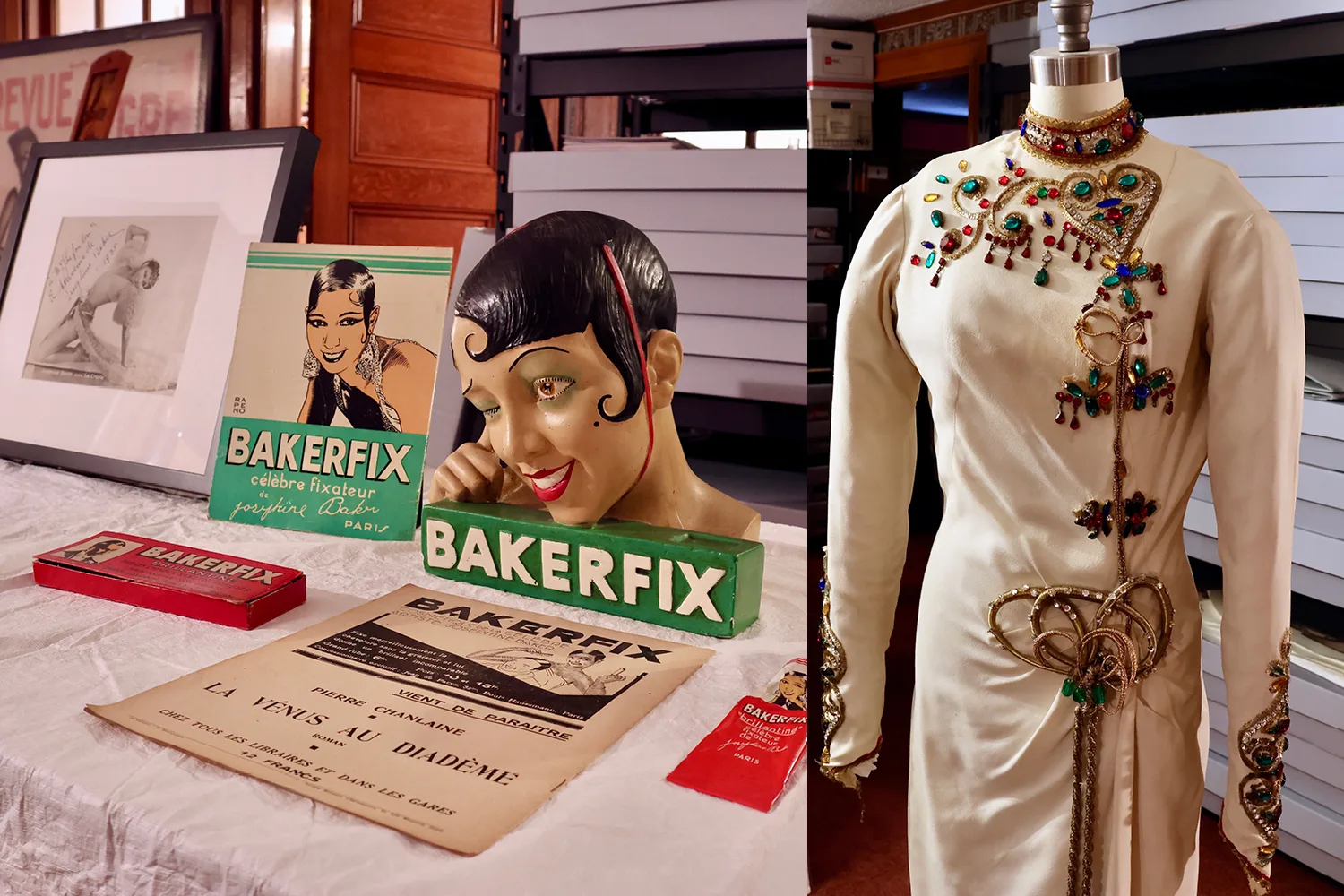
For 40 years, Mary Strauss has painstakingly acquired items related to one of the most famous St. Louisans of all time. She’s purchased Josephine Baker’s former playbills, costumes, and posters. She has a Josephine Baker cookie jar and a Josephine Baker ceramic figurine. She even has a jar of Baker’s signature hair care product, Bakerfix. “It still had Bakerfix in it,” Strauss reports. “It smelled terrible!”
Now she’s giving it all away. A longtime St. Louis-based philanthropist, Strauss was drawn to Baker’s remarkable story, from the banana-festooned skirt that launched her dance career to her role as a passionate humanitarian. “She was her own person,” she says.
Stay up-to-date with the local arts scene
Subscribe to the weekly St. Louis Arts+Culture newsletter to discover must-attend art exhibits, performances, festivals, and more.
Strauss deliberated about what to do with the collection, which has grown to more than 450 items. “It’s so large,” she says. “And I thought about selling it, and I thought about giving certain pieces to certain places. And then I thought, ‘No, it belongs in St. Louis. Because she is from St. Louis.”
But Baker—a dancer who went from the city’s Mill Creek Valley neighborhood to become the toast of Paris, an Allied spy, a civil rights activist, and both the first Black woman and first American to be inducted into the French Panthéon—doesn’t just belong to St. Louis. Strauss settled on the Missouri History Museum as a place that will both keep the collection local and be able to preserve it for, and share it with, the world.
This morning, the museum is announcing its receipt of Strauss’ collection. CEO Jody Sowell says he’s been aware of Strauss’ growing collection of Baker memorabilia for years and is excited that the museum will be able to give it a permanent home, even as it plans to lend out various items to other institutions. He says the collection will be woven through the Missouri History Museum’s collections, not cordoned off in their own separate area—which is appropriate in light of the long sweep of Baker’s fame and the many roles she played in 20th century history.
As Sowell notes, Baker’s 2021 induction into the Panthéon set off a wave of attention that has yet to abate “The fascination about Baker just continues to grow,” he says. But that’s not anything new. Says Sowell, “I bet if you go through just about any decade of the 1900s, you will find these moments where Josephine Baker pops up.” Phylicia Rashad, of The Cosby Show fame, even released a disco tribute album in 1978.
What has often been overlooked in all the attention is Baker’s St. Louis story, something Sowell is eager to make sure his museum rectifies. Baker’s time here is given short shrift in her quasi-memoir, which was just released in English for the first time, and in many narratives seems to be reduced to a few sentences about her impoverished childhood. Sowell says her relationship with St. Louis is much more than that. “The fact that this world icon was born in St. Louis, got her start in St. Louis, and made one of our most important civil rights speeches in St. Louis shows that this really is a St. Louis story.”
Baker’s feelings about St. Louis were mixed. She spoke of being proud to be from here (when Lindbergh landed in Paris, people made the connection to her background). But she was also an outspoken advocate for civil rights at a time when St. Louis had much to answer for. That was all the focus of her 1952 speech in the Kiel Auditorium, which was a benefit sponsored by the Citizens Protest Committee On Overcrowding in Negro Public Schools. Baker also vividly recalled witnessing the 1917 East St. Louis race riot, which saw white residents turn on Black ones, and challenged civic leaders on the segregation still endemic in many theaters and large venues.
“I had it put in my contract that I would not appear in any city where my people could not come to see me, and at each time that there has been an approach to my coming to St. Louis, I have always refused,” Baker told the audience at Kiel (now Stifel Theatre). “Oh, I have had several fantastic offers in the first-class theaters and nightclubs, but when the question arrived about my people coming to see me, immediately there was a silence.”
Baker said she ended up booking the Kiel gig because of the importance of the cause, and went on to describe the “beautiful audience tonight, salt and pepper,” with “colored and white brothers mingling.”
Baker continued, “This brings tears to my eyes and I … I want to get on my knees to thank God for letting me see this sight today. Friends and brothers, God is good … powerful … understanding. And now I have hope that St. Louis will not be the last city to join in with the other American cities that are so strongly fighting against discrimination for all Americans.”
Says Sowell, “I think she had a passion for St. Louis, but I also think she was willing to turn a microscope on St. Louis and talk openly about its issues. And I think the opposite was probably also true: St. Louis was very excited that she would come back, but I’m sure a little chastened by that speech.” He says Baker’s story challenges St. Louis to turn its attention to its own complicated and difficult history. “Josephine Baker has many lessons for St. Louis, and it starts by telling them that she does have this St. Louis story,” he says.
Ironically, of all the many items Strauss has collected, with posters from Paris and products from New York, she has never been able to find a program for the Kiel Auditorium speech. “So I’ve got everything but the program, and I’m in St. Louis!” she says, with some surprise. “You would think somebody in St. Louis would have it.” She remains hopeful—and now, should someone come forward with one, she knows just the place to donate it.