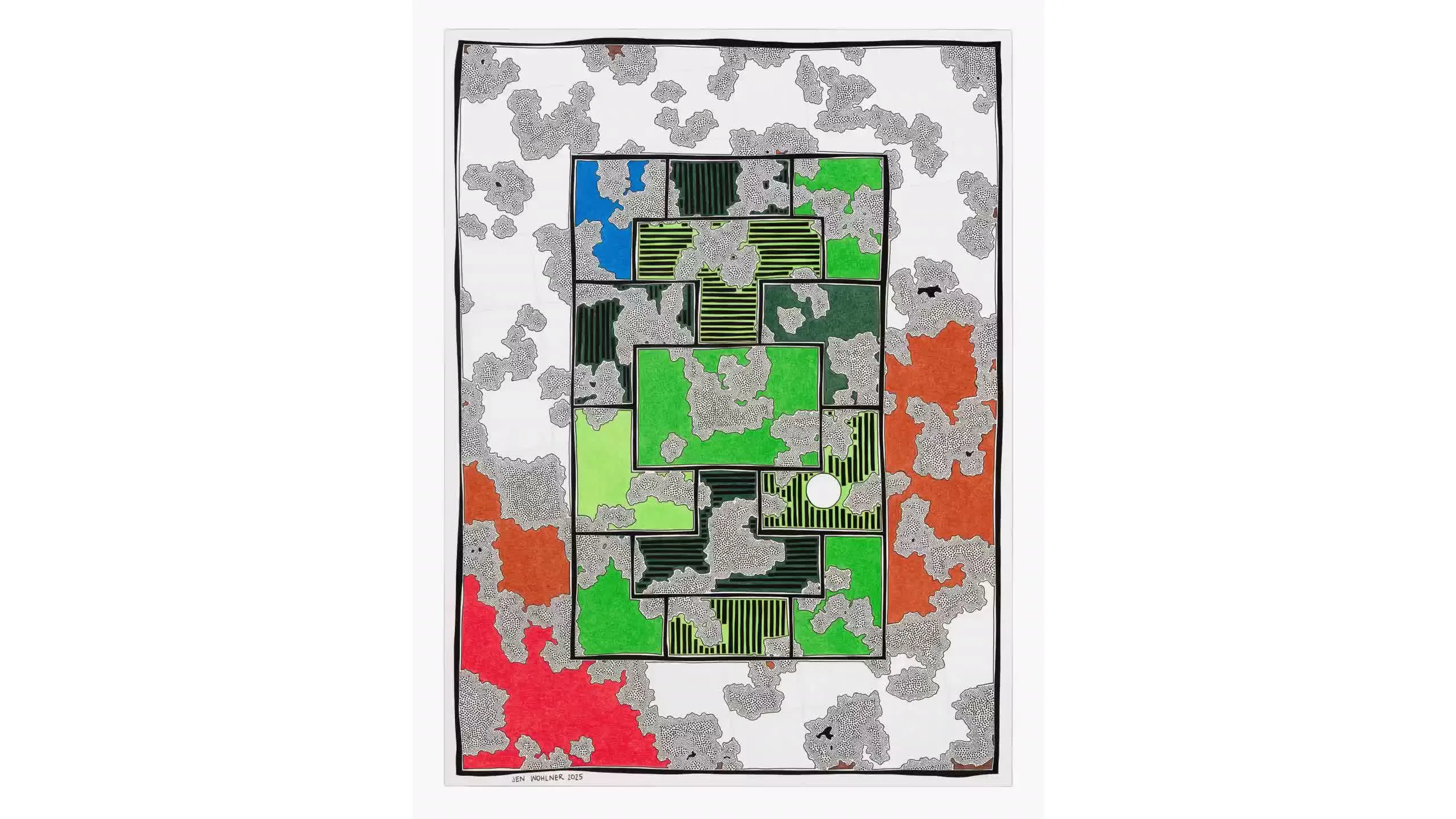
St. Louis–based artist Jen Wohlner is showcasing her new solo exhibition, BINGO!, in The Sheldon’s Neidorf Family Gallery through August 8. Wohner’s work, intensely focused on abstraction, is a dizzying collage of seemingly random colors, geometric shapes, and above all else—dots.
Drawn to St. Louis in 2019 by her wife, St. Louis native Jill Wohlner, Jen Wohlner has participated in nearly 20 exhibitions across five years. Her involvement with The Sheldon began when curator and gallery director Paula Lincoln saw her January 2025 solo show at Wildfruit Projects and reached out with an offer a year later.
Stay up-to-date with the local arts scene
Subscribe to the weekly St. Louis Arts+Culture newsletter to discover must-attend art exhibits, performances, festivals, and more.
“This is my first time showing in an institution like The Sheldon,” Wohlner says. “Working with them has been really wonderful.”
Drawn using everyday materials such as pen, colored pencil, and ink, the artworks, exclusively on paper, range from the size of a sheet of printer paper to breathtakingly massive large-scale works that immediately draw and hold a viewer’s eye. Wohlner says that The Sheldon’s gallery space allowed her to keep the works unframed, highlighting the ordinary nature of the materials.
“You’re really aware that this is a drawing on paper,” she says. “And that is cool. There’s something exciting about these being unframed…viewers have some time to stare at those details.”
Wohlner’s use of ordinary tools also keeps her inherently abstract art practice accessible to viewers. “Maybe they see the familiar materials: just pen, ink, and colored pencil, and they know how those work,” she says. “Even if they’re not understanding the specifics of my lived experience with all the nuances, they’re still able to enter the drawing in a way that’s relatable to them.”
Working as a software engineer for more than a decade allowed Wohlner the freedom to develop her style without dependence on sales, allowing her to experiment with art. Her experience in software development, she says, has a heavy influence on the way that she constructs the systems at work in her art.
“In software engineering, when you’re making a big system [and] a couple hundred people are working on the software, not everyone knows how each part of it works,” Wohlner says. “We might be working on one layer of the software system, and it just needs to work. Then, people are going to build atop that layer, but they don’t need to know all the ins and outs, they just need to know it works.”
Wohlner integrates this experience into her art by creating systems that only she may know exist, but that her audience will understand, albeit at a shallower level. “The viewer gets just a hint of it, and that’s enough,” she says. Her audience, then, is free to layer their own interpretations upon the pieces.
Wohlner’s work invites collaboration with a willing audience, which she says is true even throughout her artistic process. “Partway through, I’ll ask my neighbor…or I’ll call my wife on WhatsApp and ask ‘What’s this a drawing of? How does this work?’” she says. “It’s not like writing a journal that only I’m going to read. This is something that has an audience, and I know that.”
Queer identity is another major aspect of Wohlner’s work. Drawing from the theoretical work of Johanna Drucker and Ferdinand de Saussure, Wohlner’s art is a form of “queering memoir” making it deeply personal and based upon lived experience, while simultaneously challenging the notion of what memoir can be.
“For me particularly, it’s thinking a lot about what queer family is,” she says. “And maybe deconstructing some of those norms or binaries that we might not associate with family.”
Color is used sparingly in Wohlner’s work, while dotted clouds of gray, random and unsettling on first glance, give a sense of cohesion to the pieces. The dizzying clouds, filled with hundreds of miniscule dots, appear unbound, weaving into the bold shapes that Wohlner has chosen to bring to the foreground. She compares her process of creating such a staggering level of depth to endurance sport.
“It’s the same feeling. I’m okay with having a day in the studio where all I’m doing is coloring with the same purple,” she says. “It’s exciting to me what results from being committed to filling in an area with a single type of mark. Something special comes from it.”
The name for her exhibition, BINGO!, comes from the feeling of elation that she has observed in her audience whenever they have made a breakthrough with the pieces.
“There are these times when you’re looking at the drawings,” she says. “Where you have these ‘a-ha!’ moments of ‘oh my gosh, that’s how it’s made’ or ‘wait, this is negative space but it’s at the forefront of the drawing.’”
Ultimately, Wohlner’s work is a testament to her own lived experience, in which hyperspecific detail and ordinary means combine to create an exhibition that will likely puzzle, but will create a uniquely lasting impression upon every viewer.
The free exhibition is open to the public Wednesdays–Fridays from 12–5 p.m. and Saturdays from 11 a.m.–3 p.m. at The Sheldon Galleries. An artist talk will be held on July 25, at 1 p.m.