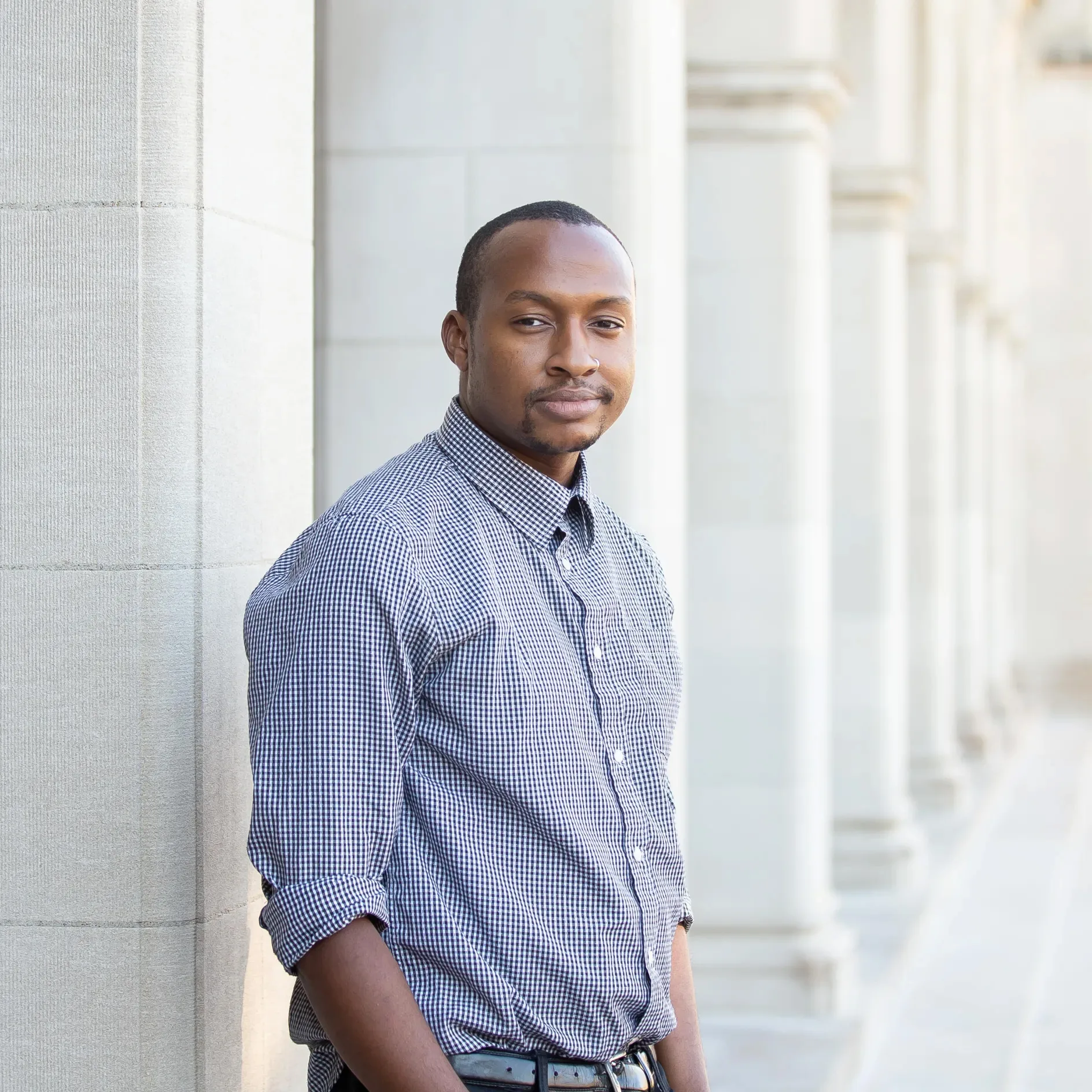
Jay-Z said he had 99 problems, but a (rather choice word for a) woman wasn’t one. St. Louis–born Washington University professor and musician G’Ra Asim has 99 problems as well—but his problems revolve around exactly what Jay’s didn’t.
99 Problems Finding the 1: a love story (sort of), out August 4 from Beacon Press, details his adventures in romance while offering a detailed look into his mind as he considers music, race, gender, and culture at large.
Stay up-to-date with the local arts scene
Subscribe to the weekly St. Louis Arts+Culture newsletter to discover must-attend art exhibits, performances, festivals, and more.
Launching with a presentation, musical performance, and book signing at the High Low Literary Arts Café (3301 Washington) on September 16, 99 Problems is Asim’s second book, after his acclaimed 2021 book Boyz n the Void: a mixtape to my brother.
Born in St. Louis and raised primarily on the East Coast, Asim was drawn back home by a desire to contribute to the flourishing arts scene. Asim vividly recalls both his parents’ involvement in the local cultural community; his mother was involved with The Black Rep while his father would frequent reading events.
“St. Louis is a city that punches above its weight, culturally speaking,” Asim says. “That arts community that I took for granted as a child has been really cool to reconnect with as an adult.”
While Asim chose to showcase his experiences with love in 99 Problems, the threads of his thinking expand outward, whether that be in his thoughts on race relations in the United States, dating culture itself, or his other artistic outlet, music.
Asim says music is interwoven with his creative process. “A song doesn’t offer as much space in terms of word count, but you can often capture the sense of what you’re interested in in an essay,” he says. “When I wrote myself into a corner with prose, I would often wander to another room of my apartment and pick up the guitar.” Songwriting helps him to distill down the complex ideas that he wrestles with in his essay composition process. His passion for music is evident throughout the book, as he writes about his band, Baby Got Back Talk, and his experiences on tour.
Asim found the humorous, casual narrative tone for his book during a trip to Laumeier Sculpture Park with WashU’s Center for the Study of Race, Ethnicity and Equity to see sculptor Hugh Hayden’s American Vernacular exhibit. As music influenced his composition, the visual artwork informed his voicing for the book.
99 Problems opens with an examination of race, which Asim uses to socially contextualize himself to his audience.
“I felt like I needed to perform a significant analysis on race’s influence on my social experience to even begin to account for my experiences with romance,” he says. “I say this descriptively, with no joy: I do think that blackness is the lens through which everything that I ever do is going to be understood by others.”
Asim covers Afropessimism, consults W.E.B. DuBois, and explores the tensions in both interracial and intraracial relationships. Otherness, he says, is central to one’s formation of identity, which bleeds into the dating scene.
“Straight people are very often invoking queerness as the boundary to help them stake out their own territory, so to speak,” Asim says. “Queer people are often doing the inverse. By the same token, the racial binary as it operates in the U.S. is something that seems to influence how people think of themselves and who they’re attracted to.”
Through his sprawling thoughts, Asim offers readers a deeper understanding of life and love in the post-COVID world, inviting them into his mind while holding up a mirror through which they can see themselves clearer, as well.