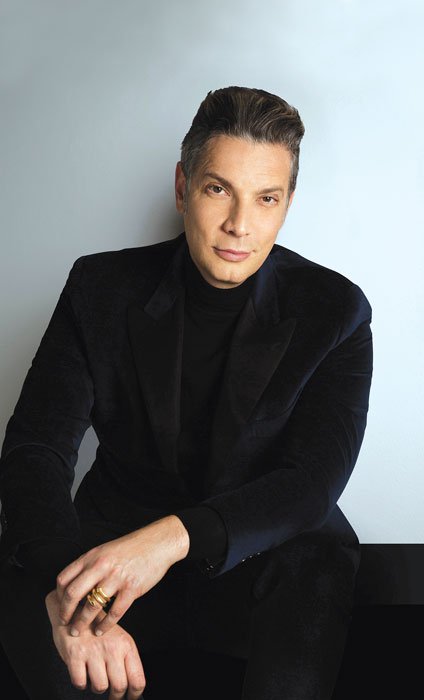
Vintage-couture king Cameron Silver—the founder of L.A.’s renowned Decades boutique, fashion director for H by Halston and H Halston, and dresser of celebs everywhere—isn’t originally from St. Louis, though he certainly has an affinity for our city. He was an honorary chair for the Dada Ball in 2010, and he’s returned nearly every since, lecturing at Wash. U. with Derek Blasberg and hosting a trunk show to support Opera Theatre. On April 4, he returns for “Four Seasons of Fashion,” a Vivaldi-inspired fashion show and gala for the St. Louis Symphony.
You seem to have a soft spot for St. Louis. [Laughs.] Everyone asks me if I have family here, and I swear I have no connection to St. Louis. It impresses me because it’s so creatively and philanthropically responsible. The performing and visual arts are really supported there; it’s not taken for granted. That’s what I always find so appealing about cities between the coasts: The community is much more hands-on with providing outlets for the arts.
Stay up-to-date with the local arts scene
Subscribe to the weekly St. Louis Arts+Culture newsletter to discover must-attend art exhibits, performances, festivals, and more.
What appealed to you about the concept of “Four Seasons of Fashion”? My background is originally in music; I did an album [Berlin to Babylon] in the mid-’90s. So when I heard about using Vivaldi’s “Four Seasons” and fashion, I thought that was so beautiful. The idea of blending the sound with this visual of beautiful, vintage gowns and colors will be a very intense, ultimately sensual experience. I look at fashion as an art, and I think this is a lovely example of that.
Do you know what you’ll bring for the fashion show and trunk show? We’ll definitely have a big selection of Oscar de la Renta from Oscar’s last few collections; since he passed, it’s nice to celebrate what he has designed. And there will be a mix of the great Europeans—Dior and Chanel—and some vintage Halston. It will be eclectic, but glamorous. I hope we take you through not only the seasons, but the decades of fashion.
What are you looking forward to doing in St. Louis? Walking the private streets in the Central West End. It’s so beautiful, and the architecture is stunning, with those grand homes and groovy mid-century modern houses… And I still haven’t been up the little trolley thing in the Arch, so I need to do that!
Last September, you began representing Halston on QVC. How’s the new role? I’m primarily living between New York and Pennsylvania, because QVC shoots in Westchester. I have this weird and eclectic life. Two weeks ago, I was in Milan for Dolce and Gabbana, and then I’m QVC’s new it boy! It’s what I’ve always believed in: the high and low, the mass with class, the democracy of style… It all ties back to my love of fashion history. What I’m doing is bringing Halston back to the forefront of fashion. He’s the man who established America as a fashion capital in the ’70s. It’s an honor to share that legacy with both a younger audience and an older audience who knew Halston in his lifetime.
He was the first to champion fashion for the masses, so in a way you’re continuing his legacy on QVC. Absolutely! He was an amazingly progressive thinker: He used plus-size models in the ’70s and believed in easy care, which is basically the fundamental language of QVC. Most people want clothes that are easy to care for. I like that his genius and the DNA of his design is so contemporary and timeless.
Speaking of fashion and time, what do you think about the idea of the buying cycle changing, so consumers can immediately purchase clothes shown at fashion shows, rather than having a months-long lag time? Everyone thought Instagram was going to save fashion, but it’s hijacked it. In an effort to make the process so democratic, it’s alienated the customer because she’s so tired of it. You’re looking at clothes that get an absurd amount of exposure over six months, and when they finally deliver it to the store, the consumer is sick of it. I think there are two strategies: 1) Make it an industry-only experience, and don’t overexpose everything, or 2) If you’re going to do a fashion show, have it be consumer-interfaced; take advantage of the social-media moment, have it in stores, and let the buyers buy privately.
I look at QVC and think, “QVC has been doing consumer-interfaced fashion shows since Day 1.” QVC invented e-commerce before the Internet, because it’s always been about buying with the television or computer screen. It’s always been about social media before social media because people shared reviews. It’s interactive, live, and you get what you want immediately. I think luxury fashion is learning from H&M, Zara, and QVC that six months of courting your customer has exhausted her.
Retail is so broken. Things need to be in-season. I don’t think men or women have the desire to preselect their wardrobes six months in advance. And for anyone who buys six months ahead, by the time it’s time to wear it, you’ve paid full price and it’s already on sale.
I admire that Tom Ford and Tommy Hilfiger and Karl Lagerfeld are taking it back. It’s all going to have to go that way; there’s no way to sustain it at this level. Everything is going to be fast fashion—and by fast fashion, just the delivery has to be fast, not necessarily the production—but it can still be done artistically.