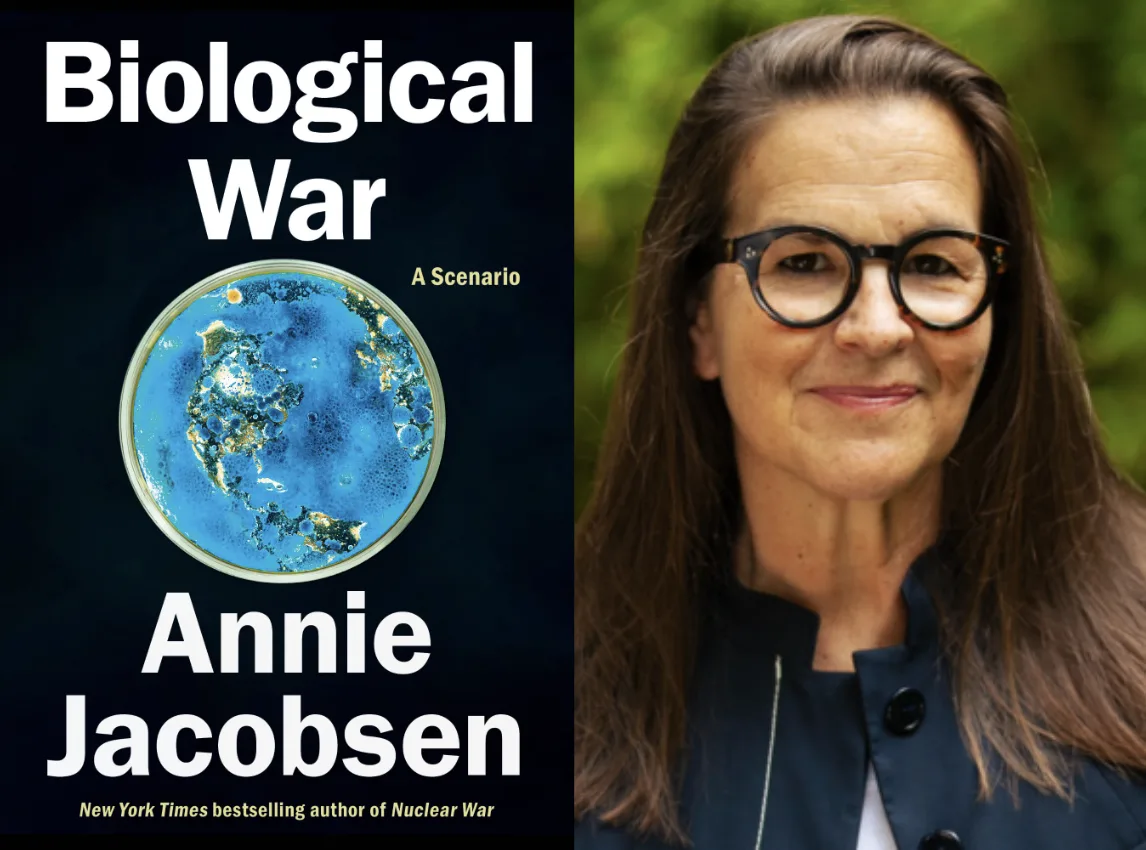
In her bestselling 2024 book, Nuclear War: A Scenario, Pulitzer Prize–nominated author Annie Jacobsen gave readers a highly detailed, heavily researched, minute-by-minute account of how the world might descend into nuclear winter. Now, Jacobsen is back with a new scenario inspired by information first encountered during her research for Nuclear War.
Biological War: A Scenario sees the self-described nonfiction dramatist use expert interviews, historical precedent, war games, and other research to construct a series of events in which a deadly pathogen is released into the world—to catastrophic effect. Interesting, informative, and surprisingly digestible despite its scientific and technical subject matter, Biological War is out July 28 from Dutton. Ahead of the release, Jacobsen took some time to share her process, discoveries, and hopes for the book with SLM before her visit to the St. Louis County Library’s Clark Family Branch on August 3.
Stay up-to-date with the local arts scene
Subscribe to the weekly St. Louis Arts+Culture newsletter to discover must-attend art exhibits, performances, festivals, and more.
Biological War: A Scenario officially releases this week. How are you feeling as the book officially goes out to the general public?
It’s always exciting to write a book and to watch it release into the world. It’s just a huge privilege.
Early on in the book, you say that biological war is a topic that has orbited your work for some time now. At what point did you know that this needed to be its own book?
It was writing my previous book, Nuclear War: A Scenario, which was intended as a standalone book. But many of the subject-matter experts I spoke with—including presidential advisers, former secretaries of defense, stratcom commanders—many of these people said to me, “You should look at bio next,” with a kind of undertone that felt a little bit like a shark in the water. So I did look into it, and the result is Biological War: A Scenario. I was shocked at what I found because in Nuclear War, I take the readers from nuclear launch to nuclear winter in 72 minutes. That’s how fast it would happen. In Biological War, I take readers from outbreak to anarchy in six days. And then what happens after anarchy is even more alarming, certainly from someone who has written about national security for decades, because I was not aware that the government has a plan for itself in the event of a biological incident or attack.
The timing worked out so that I was able to read Nuclear War and Biological War almost back to back, and it really is striking how, in both cases, even with the amount of preparation that exists, it still can never be enough in the end.
That’s right. There’s a really spooky quote from retired colonel Dr. Tom Ehrhard in the very beginning of the book. Ehrhard ran catastrophic nuclear and biological war games at the Pentagon out of the office of the Secretary of Defense, and what he said to me was that there’s really nothing you can do to prevent a biological attack. There are only things you can do to mitigate extermination. Those are his words.
This book was a massive research undertaking, and you’ve managed to get access to so many people with really deeply specialized expertise. I’d love to hear more about making those connections and the research process.
I am a journalist who has been writing about national security for more than 20 years now. I write about the Pentagon, about the CIA, about war and weapons and national security and secrets. And I have developed sources—and trust from sources—over the course of writing now eight books. If you put in the footwork, I think, ultimately, you do garner trust. People understand that I work from what I would have to say is the Eisenhower principle. In the beginning of Eisenhower’s farewell speech, he talks about the military industrial complex and how the public needs to really be aware of that so it doesn’t take over. But he also says something really important after that, which is that an alert and knowledgeable citizenry is the counterbalance. So that is how I see my job, and it’s always how I present my work to sources. I am here for the alert and knowledgeable citizenry. That has really gotten me far, because I do believe that many of our public servants, people who work for the military, the intelligence community, the public-health system…they are dedicated servants. They do want to learn from mistakes and help the public understand where we can do better, too.
These books, while they are extremely technical, extremely detailed, do feel manageable for an average reader. It feels like something that somebody could pick up and very quickly say, Okay, I now understand these systems more completely than I did before.
That is actually intentional. You know, my husband said to me, “You have to be able to read it on the beach.” And I really took that to heart, because so much of the world in which I work is sort of owned by or perceived to be owned by very highbrow individuals with fancy degrees and titles. I am old-school journalist trained—you write for the people. That means the story has to be compelling and easy to follow. So that is always my greatest challenge. How do I take this and talk to the smartest subject-matter experts, people who win Nobel prizes for their work and advise the president, and make it accessible to the rest of us?
You say in the epilogue of this book that this is a scenario, not the only scenario. How did you settle on the way in which events would unfold?
As a nonfiction dramatist, I often think about the most impactful facts I have learned, and then they become plot points for me. Then one figures out how to reverse engineer from the end. So certainly when I learned about the government’s Devolution plan from President Obama’s former FEMA director, Craig Fugate, I was like, Oh my God, that is the third act. I don’t even want to say the climax—it’s just the third act horror. And then, likewise, I knew that the first act, the inciting incident, would have to pull from the really diabolical biological weapons program—illegal biological weapons program—that the Soviets had. They pursued it for decades during the Cold War and immediately after signing the Biological Weapons Convention treaty in 1972 promising that they would destroy their arsenal. Biological weapons once upon a time were legal, during the Cold War. The treaty in 1972 made them illegal. The Soviet Union actually signed the treaty and then built their program even further. When I learned about that in some of my other books, and then the nefarious details of precisely what it was they were building and how they were trying to genetically modify pathogens to be more transmissible, more virulent to defeat medical countermeasures…it just seems so dark and nefarious that I had to include it. It’s also an extremely cautionary tale, because what the Soviets were doing—and we know this on the record from Soviet detectors—what they were doing 40 years ago could cause a near-extinction-level event. So to think about what can be done now with the science and technology available at the fingertips of people through AI, this is something I knew I had to consider the major inciting incident of all of it.
Those passages describing the different chimera pathogens and things that we either know do exist or may exist—it’s terrifying stuff to think about.
I’m glad you mentioned the chimera virus because it’s such a great example of me searching for metaphors, sort of poetic images that we can all relate to. The chimera is, of course, that beast from Greek mythology that if you close your eyes, you can kind of envision. You’ve seen it on a Greek vase or in an art history class. It’s the head of a lion, the body of a serpent, the wings of an eagle—this is the idea of mixing species to come up with an even deadlier organism, and that’s precisely what gene editing is in the dangerous pathogen research department.
Researching one world-ending scenario would be enough to plunge some people into a rough place, much less two of them back to back. How do you care for yourself in working on these books? How do you keep a level head when you are looking at the worst possible cases?
I am an eternal optimist. Really, anyone who knows me personally knows that about me. There are things I can’t write about. I cannot write about children being hurt, for example. We all have a threshold of what it is we can stare at directly. Mine is certainly more weapons. It’s probably because I am an armchair journalist, meaning I have never been in the war theater, but I have interviewed hundreds of people—a hundred or so for each of my books—who have been in every war from World War II to the present day, and they have been there and they have described me what they saw and what they did and what happened to them. I have built a knowledge base about war and weapons as an objective journalist. So looking at this new model that I am working in now, writing a scenario, first with Nuclear War and now with Biological War, is taking all of that knowledge and looking at it in a war gaming scenario, a hypothetical future situation. It actually has a degree of hopefulness embedded in it, however strange that may seem to others, because I believe my books serve as a cautionary tale. I know with Nuclear War I was really amazed. I wanted people to feel like, This is a cautionary tale. I want to know what could happen, what I can do. But I also saw the results of that book go up to a real policymaking component. I was invited to the Senate to talk to senators about nuclear war. I was invited to the United Nations to talk to the diplomats about it. I was invited to the Vatican to talk to the cardinals. And I would hope that the same concept would unfold with Biological War. If my books bring to the public an awareness that something can be done before we all die in a dystopian near-extinction-level event, then I’ve done my job.
Despite how dark some portions of these books are, I do feel oddly comforted in knowing the different processes that are in place and knowing how things may unfold. Having an expectation of events does somehow make them less scary than they were before.
I couldn’t agree with you more. I mean, the point is not panic. The point is pressure. And when you are equipped with knowledge, you can certainly make better decisions for yourself and your family. I remember during COVID, because I had no experience with a pandemic that was not weapons-related, I didn’t have the knowledge about what was happening and what might happen. You want to be the strong point for your family when everyone else is saying, “What the hell is going on?”
You’ll be presenting Biological War: A Scenario to St. Louis next week. What are you hoping for from that conversation?
I love the Q&A format because I find, having been at this a while, that audiences really love to ask questions. I’m not sure if people will have a chance to read the book by the time of the event, but either way, it kind of fills in the groundwork when you have a Q&A. People can ask questions about things that they’re thinking about.
What do you hope that people take away from this book?
As I said earlier, the point is not panic, the point is pressure, and there is a lot to learn about what we didn’t learn from COVID, even though that sounds like a double negative. COVID was a pathogen with a case fatality rate of 1 percent. The common flu has a case fatality rate of 0.1 percent. The pathogen I describe in my book has a case fatality rate of 100 percent. There are lots of germs in between. So you get the idea of the degree of lethality of mother nature’s germs and of genetic modifications that are done to mother nature’s germs. What we learned from COVID was that, despite billions of dollars spent in the biodefense industry, we were woefully unprepared. So that money is going to the wrong places. The second thing we learned was that the public’s trust was absolutely fractured because of the bad delivery of information and, in many cases, the delivery of wrong information. Biology is inherently uncertain. I think that’s a big takeaway from the book. Each of our physiologies is different. Our immune systems are different. Germs are different. All of this in the mix reminds us that public health officials probably really need to look at how they convey information. The uncertainty component means that you’re going to be wrong. And when public health officials pretend that they’re never wrong, we get into a real problem. The best example I can think of is after month three of the pandemic, this is in late March 2020, the WHO and the CDC tweeted out repeatedly. “FACT: #COVID 19 is NOT airborne.” I reprint a copy of his tweet in the book because people find this hard to believe. COVID was airborne. Airborne means its respiratory disease that lingers in the air, meaning somebody else walks into the room they can catch it. The CDC and the WHO at the time, and continuing for months, were telling people that COVID was fomite transmissible, or you could catch it off of surfaces. Everybody remembers spraying things down with Lysol. But their information was so wrong. It couldn’t have been more wrong. As it turns out, fomite transmission of COVID happens in 1 in 10,000 cases. Being wrong is one thing, but not admitting you’re wrong is another thing. The CDC and the WHO have never, ever publicly said, “Hey, we were wrong about this, and we’re really sorry.” They just kind of hope that goes away. And that is a less incendiary example than the debates that are occurring over the origin story of the virus itself.
I think it’s illustrated so well in the book. One of the scenes that stands out so clearly in my mind is the press conference where public health officials are surprised by the questions about what’s happening in L.A. because there’s a lack of communication and people just don’t know what they’re dealing with.
I came across those kinds of bureaucratic mishaps time and again, and they’re all tied to real events. In the back of my book, in the notes, readers can always go see the references if they wonder, Wait a minute, is this Annie Jacobson’s imagination or is she referring to something that has a precedent?
Annie Jacobsen will discuss Biological War: A Scenario with attendees of St. Louis County Library Foundation’s Westfall Politics and History Series on August 3 at 7 p.m. She will be joined in conversation by Mark Sundlov, managing director of Soldiers Memorial Military Museum. Books will be available to purchase on site via The Novel Neighbor, and a signing line will follow the presentation.