Midway through the new film Effie Gray is a hauntingly beautiful image of the movie’s namesake character, played by Dakota Fanning, at a Venetian costume ball. Dressed in a white silk gown adorned with black streamers, she spins on a cobbled piazza, the streamers flying around her as if on a maypole. For this fleeting moment, Gray seems free. But once back home in England, she must face her oppressive husband, during a time in Victorian Europe when women were typically seen as subservient. Over time, though, Gray comes to see herself as something more, becoming an early feminist.
St. Louis native Donald Rosenfeld was so inspired by Gray, he decided to produce a film based on her life story. He teamed up with director, screenwriter, and actress Emma Thompson, with whom he had worked on Howards End and The Remains of the Day. It was Rosenfeld who introduced Thompson to the late writer Ruth Prawer Jhabvala while Thompson was working on her first-ever screenplay, for Sense and Sensibility, in the mid-’90s. “One day, Don, I will write an original script for you to produce,” Thompson told him.
Stay up-to-date with the local arts scene
Subscribe to the weekly St. Louis Arts+Culture newsletter to discover must-attend art exhibits, performances, festivals, and more.
Two decades later, we have Effie Gray.
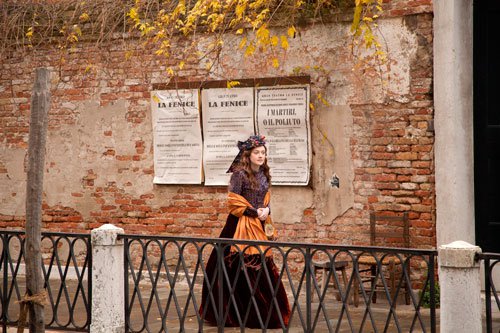
The film’s rich costumes play a supporting role in the film. To that end, Rosenfeld contacted Oscar-winning costume designer Ruth Myers.
“After a couple of weeks, I saw the first six sketches of 37 costumes she had done for Dakota and thought, ‘She’s a maestra!’” Rosenfeld recalls. Thompson, who’s worn her share of beautiful clothes in period films, concurs: “These are by far the most beautiful I have ever worn.”
For Myers, it goes beyond beauty. “It’s not enough to just do pretty clothes anymore,” she says. “It has to grab my heart.”
That’s what attracted her to Effie Gray. She was already familiar with Gray’s story, having read a book about her years earlier. “It is, in a way, very much an early feminist period,” she says. “And because I love this era so much, it was also a way to show Victoriana in a slightly different light.”
One literally sees Gray transform in the film. When she arrives in Italy, her clothing changes from somber tones to a jewel-toned palette. “She’d been in a cage—which is what I wanted the earlier clothes to feel like—and then she gets to Italy and finds out life isn’t like that. That’s what I wanted the clothes to say.”
Effie Gray trailer: https://vimeo.com/123630093
Emma Thompson interview: https://vimeo.com/122682100
Hometown Inspiration
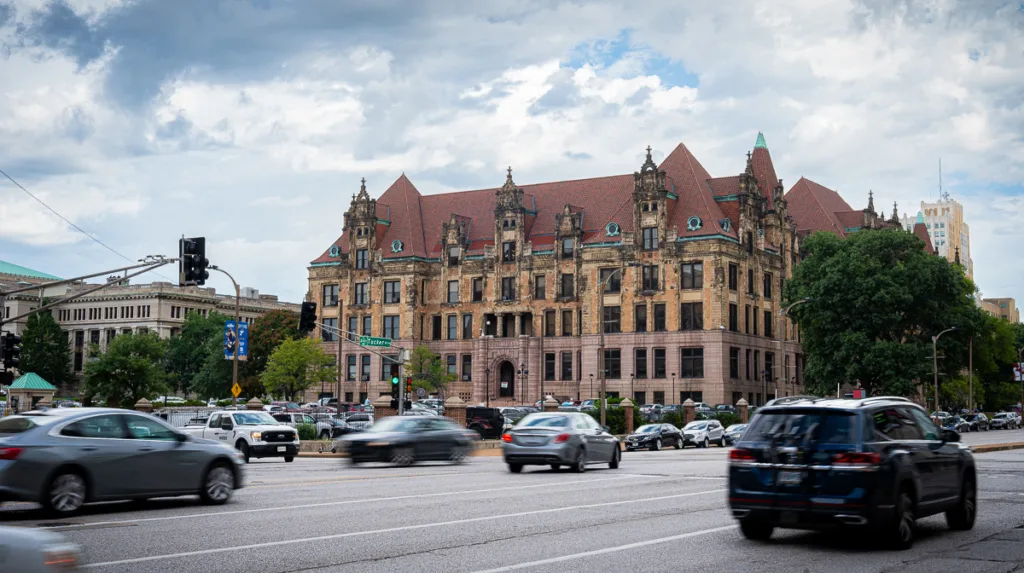
In many ways, Effie Gray is both a travelogue and a snapshot of society during the Victorian era. For producer Donald Rosenfeld, the 1904 World’s Fair, held in St. Louis, was an important point of reference. In fact, his hometown influenced him in other ways as well. Growing up, he and his older sister often took in double features at the Tivoli Theatre and the Varsity Theater, where they watched the works of Fellini, Godard, and Bergman.
“St. Louis was a paradise for me in the 1970s—record stores and rock concerts and happiness,” Rosenfeld recalls. “I would not trade those years growing up in St. Louis for anything.”
He quotes another famous St. Louisan, T.S. Eliot: “It is self-evident that St. Louis affected me more deeply than any other environment has ever done. I feel that there is something in having passed one’s childhood beside the big river, which is incommunicable to those people who have not. I consider myself fortunate to have been born here, rather than in Boston or New York or London.”