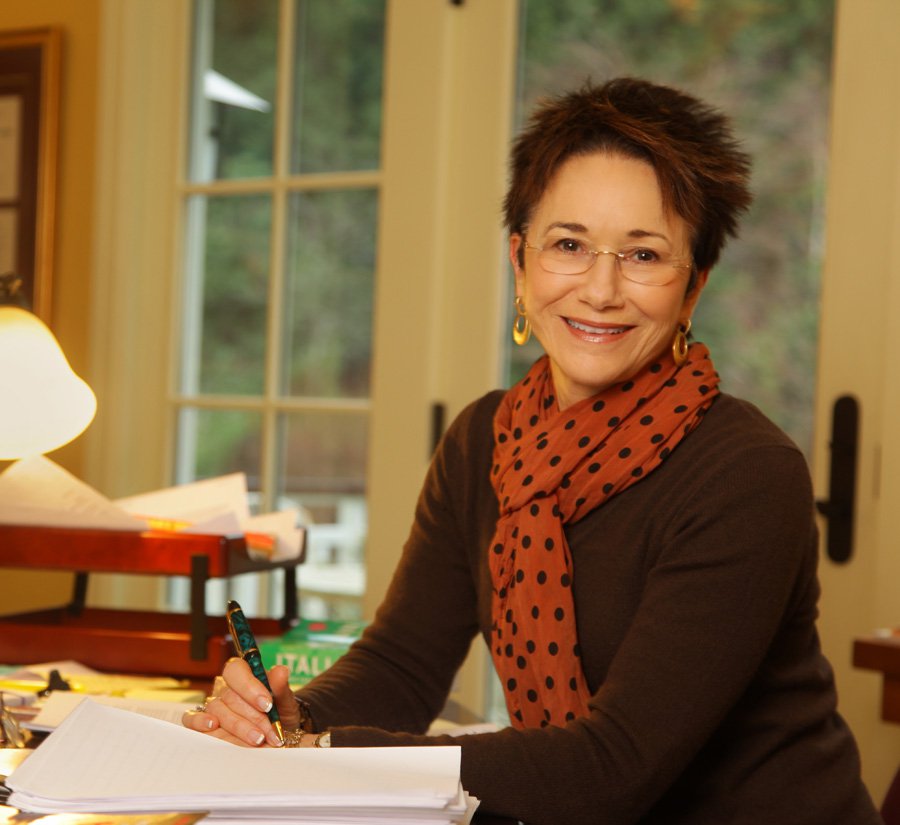
Just say “Havers” to somebody who’s read Elizabeth George and you’ll see a slow grin. Sgt. Barbara Havers eats junk food, dresses badly, and blurts out the wrong thing regularly. She’s also bright, fiercely loyal, and great fun, the perfect counterpoint to Chief Inspector Thomas Lynley, Lord of Asherton.
Their creator, novelist Elizabeth George, lives on an island in the Pacific Northwest but sets her crime novels in England, and her close observations of class differences and social mores add depth to their intricately plotted puzzles.
Stay up-to-date with the local arts scene
Subscribe to the weekly St. Louis Arts+Culture newsletter to discover must-attend art exhibits, performances, festivals, and more.
George started her work life teaching high school English and got fired from her first job for union organizing. Thirteen years later, she sold her first novel, A Great Deliverance, won a clutch of mystery awards, and turned to writing full time. She’s since hit the top of the New York Times bestseller list, and most of the books in her Lynley series have been filmed for television in the BBC’s The Inspector Lynley Mysteries. (She’s polite about the result, although none of the actors bear much resemblance to her vision of the characters.)
George just published her nineteenth Lynley novel, A Banquet of Consequences, and is finishing up the research for her twentieth. She will speak at the St. Louis County Library headquarters on November 4 at 7 p.m.
What have you learned by writing from the point of view of people of different genders, races, classes…?
Most of my learning has to do with technique and craft. Writing from another character’s point of view is really about knowing what is required from a point-of-view character. By the time I start writing, I have a pretty good idea of what that character’s voice should sound like, what that character’s past reflections should be… But I wouldn’t say I’ve learned a great deal about the human condition from writing in different characters’ points of view. I think I’ve learned from the research I’ve done into the experiences the characters might have had. Writing about the black experience in Great Britain on a housing estate requires me to go and observe and interview. That’s where my learning takes place.
You have huge casts of characters, yet they stick in the mind in the way other authors’ characters don’t. How do you pull that off?
What I attempt to do is illustrate what William Faulkner said all literature should illustrate: the human heart in conflict. What I ask readers to do is to feel a common humanity with the characters I create. And that, I think, attaches them more to the characters that in some books are merely created to serve the interests of the plot. In my books, the characters are created in advance of the plot, and they inform the plot.
How has your genre changed since Hercules Poirot?
What I write is crime fiction. What Agatha Christie wrote were mystery novels. Both provide a puzzle and challenge the reader to reach the resolution before the writer reveals it. But in the mystery novel, the writer does not reveal everything to the reader. A crime novel holds nothing back. The reader knows all the clues and frequently knows more than the detective knows. The tricky thing is to have the correct interpretation of the clues buried within additional interpretations of the clues. It’s all designed to confuse the reader while at the same time giving the reader all the necessary information, if they can only interpret it correctly. So crime novels are a bit more realistic.
Why did they evolve that way, do you suppose?
As things went on, writers perhaps became less willing to write a lighthearted romp through murder. In Agatha Christie, the reader is never asked to care about the murdered person or anybody else. But in a crime novel, the reader is really asked to have some special feelings for the detective, the victim, the people who remain behind, or even the killer.
What makes us care?
If you allow the reader to know what’s going on in the character’s head as well as what’s going on in the character’s heart, you have a far better chance of making a connection. In my books, the characters are not involved in action all the time. Sgt. Havers has habits, and she wears clothes that distinguish her and frequently get her into trouble, and she has attitude. She doesn’t just play one note. I think that’s the important thing. She comes into contact with people who are nothing like her, with people she doesn’t understand or can’t stand. There’s this intimacy that’s created.
And how did you research her?
I know no one who’s like her. There was no research! Occasionally I will actually see a t-shirt that she ends up wearing. Everything else is purely my imagination, and the type of character I felt would be a good contrast to Lynley. She is his polar opposite, and there is between them far more than the class difference. My purpose in creating those two characters was to illustrate that a man and a woman could come to love each other very dearly but never have that love become sexual or even be considered something that could become sexual.
Does that ever disappoint your readers?
People who’ve read the books know there could never be a sexual relationship between them; they wouldn’t want it. People who have only seen the TV show always ask, “Will Lynley and Havers ever ‘get together’?” A dry chuckle. I love that term. “Get together.” I tell them to read the books, and they’ll see.
How did Lynley’s elegant character evolve?
Simply out of my interest in writing about somebody who wasn’t the typical down-at-the-heel detective, broke or alcoholic. It let me write about a character that would allow me to have fun with some aspects of English life that have nothing to do with my own life. So I gave him a title, and then I just began to people his world.
How could you bear to kill off his charming wife? Or were you ready to do her in?
No, I wasn’t eager to kill off Helen. But in a series, you have to keep opening up the characters’ stories, if you want them to change in time, place, and circumstance. I don’t like books where the characters never change. Once Lynley married Helen, and once they resolved the critical issue of Helen’s lack of self-worth—she chose the easy route, and she knows it. She’s bright; she could have gone to university! And Lynley was able to deal with his reluctance about having this child. Their story’s closing out. So to open it up, you either have to add new characteristics or remove one and have an explosion of the story that way. And when I got to the serial-killer book, I at last had my means of doing it. But then I thought, well, that’s what everybody does. So instead of having the serial killer murder her, it was a senseless street killing that for a while Lynley thinks is connected to the serial killings. And then I ask the reader to take part in that death and experience to at least some degree what Lynley experienced. A lot of readers got very, very upset, because I was asking them to feel something. Readers today aren’t often asked to feel something. But when people hear my explanation they completely get it.
What’s most unusual about your books?
That I have a large class of continuing characters, and no one is safe.
How is the shrinking and condensing of the publishing world affecting what we read?
Oh, well, that’s very sad. First of all, it’s really hurt midlist authors. A lot of people have trouble even getting published now, and 20 years ago they would have had no trouble at all. I also think, to be honest with you, that the fact that people can publish their own work on the Internet or have on-demand publishing has created a glut of really bad books. It’s really important, especially for writers, to read up. No one has become a better writer by reading Fifty Shades of Grey, and nobody will.
Do you notice readers’ tastes changing? I keep hearing about “domestic noir,” for example.
I don’t think it’s a matter of where people’s tastes are going. It’s somebody coming up with a great idea, like Gone Girl, and people saying, “Whoa. Cool book.” And then Girl on a Train came right on its heels.
And now everybody’s writing dark, twisty books about relationships.
And I think that has nothing to do with readers’ tastes and everything to do with people copying other people.
Has writing about crime and death affected your worldview?
No, I’ve always looked at the world the same way. As my first husband said after he read Well-Schooled in Murder, “Well, this pretty much depicts your grim view of the human race!”
Which might have answered this question already, but is it tough to get inside the mind of a killer?
No, because I design my characters in advance, and the killer is designed from the beginning as the killer. Everybody else is created just to exist in the world in which this killing occurs, but the killer is created to kill, and so different requirements are placed on that character from the start. Unless you do some fancy dancing—which I’ve done, twice—you are not in the mind of the killer once the killing has taken place.
Right, because that would give it away.
As P.D. James says, once the killing occurs, you can’t be in the mind of the killer, because the killer would be thinking about the killing. So I took that as a challenge and decided, I will write a book in which you are in the mind of the killer after the killing takes place, and the killer is thinking about the killing, but you think he’s thinking about something else. That was great fun, especially because I was able to fool my editor. She said, “Wait a minute”
—because she knew the rules—and then she went back and said, “Oh, my God, it was there all along.”
Is there an essential loneliness to being a detective? So many seem so solitary…
No, I don’t think there’s an essential loneliness. Deborah Crombie’s detectives are happily married, and now they have kids. But I do think it helps to have your detective have some kind of personal pit that he climbs out of and slithers down into again. It makes the detective less of a godhead. That’s out of fashion now.
Do any of your characters remind you of yourself?
I think I have aspects of St. James and Barbara Havers most of all. St. James in his reserve and his intent upon going at everything intellectually rather than emotionally, and Havers in her attitude.
Couched in reserve, though?
Not always!