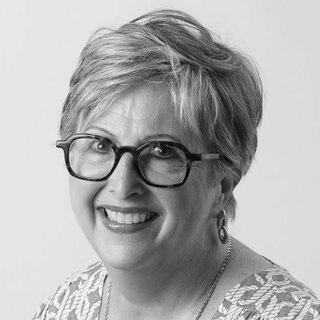
Wry, whimsical, and generous, St. Louis’ new poet laureate isn’t big on ponderous, pompous readings or self-congratulation. She’d rather take people who’ve shied away from poetry their whole lives and open them up to its magic. Jane Ellen Ibur founded the Community Arts Training Institute, focusing on art’s power to change the world, and Poets and Writers Ink, to pull talent from young writers. Her own work has appeared in 60-plus anthologies and her two books, Both Wings Flappin’, Still Not Flyin’ and The Little Mrs./Misses, in which we hear from Mrs. Noah, taking inventory on the ark two weeks out, and Mrs. Adam, who has a Cheerio in one hand and a watermelon tucked under her arm: “I’m supposed to pass this fruit/ through that hole? For taking/ a bite from an apple? Jesus Christ,/ you call that Justice?”
You learned that you had breast cancer the day after you were named poet laureate. Do you mind talking about it? I actually feel like women don’t talk about it enough. I was diagnosed in October 2018, the day after my 50-year high school reunion, and I had found out the last day of the reunion that I was going to be poet laureate. Both other poet laureates had been ill and died—I thought, “Do I even want to do this?!” and then I just plowed right ahead.
Stay up-to-date with the local arts scene
Subscribe to the weekly St. Louis Arts+Culture newsletter to discover must-attend art exhibits, performances, festivals, and more.
And here you are. How do you see your new role? To be an ambassador of poetry. To take poetry to some unexpected places. St. Louis is a divided city, but it’s not only black and white. I have a list of people I think have been ignored: East Indian people in St. Louis. Latino people. Bosnians. I want to work with elder black women in Old North, another invisible community, and with the LGBT communities. Can poetry heal the divisions? I don’t know. When veterans read, veterans come to hear it. I want to break out of that. I want everybody to hear each other’s poetry. I want people to cross lines they hadn’t crossed before.
You’ve taught poetry to people in prison—and to people imprisoned by poverty, homelessness, advanced age, horrific memories. What’s the trick to teaching so nontraditionally? I’m working at the VA right now. I teach a creative writing class to people with depression and PTSD, and it’s mostly poetry—formal poetry—because I found, when I was teaching at the jail, that those guys needed something to absorb their minds. All they were doing was obsessing about their cases. Writing took them out of that place. And formal poetry had them focus on the rules, so the unconscious stuff could come up.
So you use those structures most of us can’t even pronounce? Yeah. With the villanelle, I can carry people through an exercise where they’re writing a formal poem out of order and it comes out right. The reason to juggle it around is so people will stop thinking. Write as fast as you can, without thinking. I want people surprised by what they can do, because that’s what makes them come back. And I want them back, because the other total joy is writing in a group. It makes you better. At the VA, I saw people change really quickly, because they saw other people relax. I’m working on someone right now who’s tense, who’s sitting far away from everybody, but soon she’s going to change her seat. She’s going to move close.
What’s your own work about lately? My mother has dementia, but she’s robust. I just published my first piece about her in The American Journal of Poetry, and it’s in her voice. It’s hard. There are titles I’ve written down and I have not written the words. One is “Waiting for Godot.” Before we moved her, she would get up and get all dressed, put on her lipstick, get her purse, and sit on the couch, waiting. It just killed me. At first she did say she’d grown crazy from being alone. She had six kids and they all left, and she claimed that was what made her crazy. I write about it when I have to.
Is it true that you write a poem a day? I’m on day 2,748. [She flashes a wicked grin.] I’ll say at a reading, “I’m on day X, and I’m going to read them to you.” The shock and the horror that runs through that group… Obviously, I don’t believe in writer’s block. Look around. Write about it.
Did you write early? I had a magazine that I started at 5. There were no words. It was all scribble. And I lined up my dancing doll—one of the big ones you could strap on your feet—and my stuffed collie and taught. The poetry hit me more in high school. Then I took a class, and the professor was so cruel, I ended up never doing it. I’ve told all my students, “Do not ever give one person that much power.”
You’ve paid a lot of attention to African-American art and literature. When is that appreciation, and when is it cultural appropriation? I used Ntozake Shange when I taught at jail. All my students were black. Am I the right person to do that? Not necessarily, but there was no one else. I think we should each teach each other’s stuff, learn it, share what we know. If we know something that is positive and it makes us step over the line, then I think we have to step over the line. At the jail, 99 percent of my guys were African-American. I thought it was the greatest gift, that they let me into their lives, and for that gift, I tried to give them everything I had—so that even this wild drug dealer could write great villanelles.
Mary Woodard, who worked for your family for years, had a profound influence on you. Mary was an extraordinary ordinary person who kind of picked me up off the floor and told me I was a good person when I was a kid and things weren’t going so well. She took me in when I was lost. I made a commitment to her that I was going to take care of her when she was older, and it was 11 years of intense medical stuff, some really gory stuff, but we laughed every single day. We probably cried every single day, too. I’d say, “How are you?” and she’d say, “Kickin’ but not high” or “Both wings flappin’, still not flyin’.” She never stopped wanting to live.
What did you learn from taking care of her? How love can fill one, me, with strength and courage I never suspected I had. I became great at debriding wounds and putting on dressings. I’m not good with gore, but I learned to face it every day, because it was for Mary.
What did she love about you, all the way back to when you were little? Nobody’s ever asked me that. Jeez. I don’t know. Maybe she loved my intensity; I don’t know. I do have some magic. Maybe she saw that.
You’re funny, too. We do laugh a lot in my classes. Even when we’re writing devastating stuff, we’re laughing, because we are sculpting it outside ourselves for once. And when I do a reading, I try to include some humor, for the healing effect of it. I just got the greatest compliment: My friend read two of my poems to this group of people, and he said, “They all laughed and laughed.” One he read was “Miss Kitty and Miss Piggy”—it’s about an altercation between Miss Kitty from Gunsmoke and Miss Piggy. Hey, I’m doing this every day. I have to have some amusement.
What’s the downside of sensitivity? Getting hurt.
What’s the upside? Getting to see magic.
What about empathy? No downside. The upside is connection.