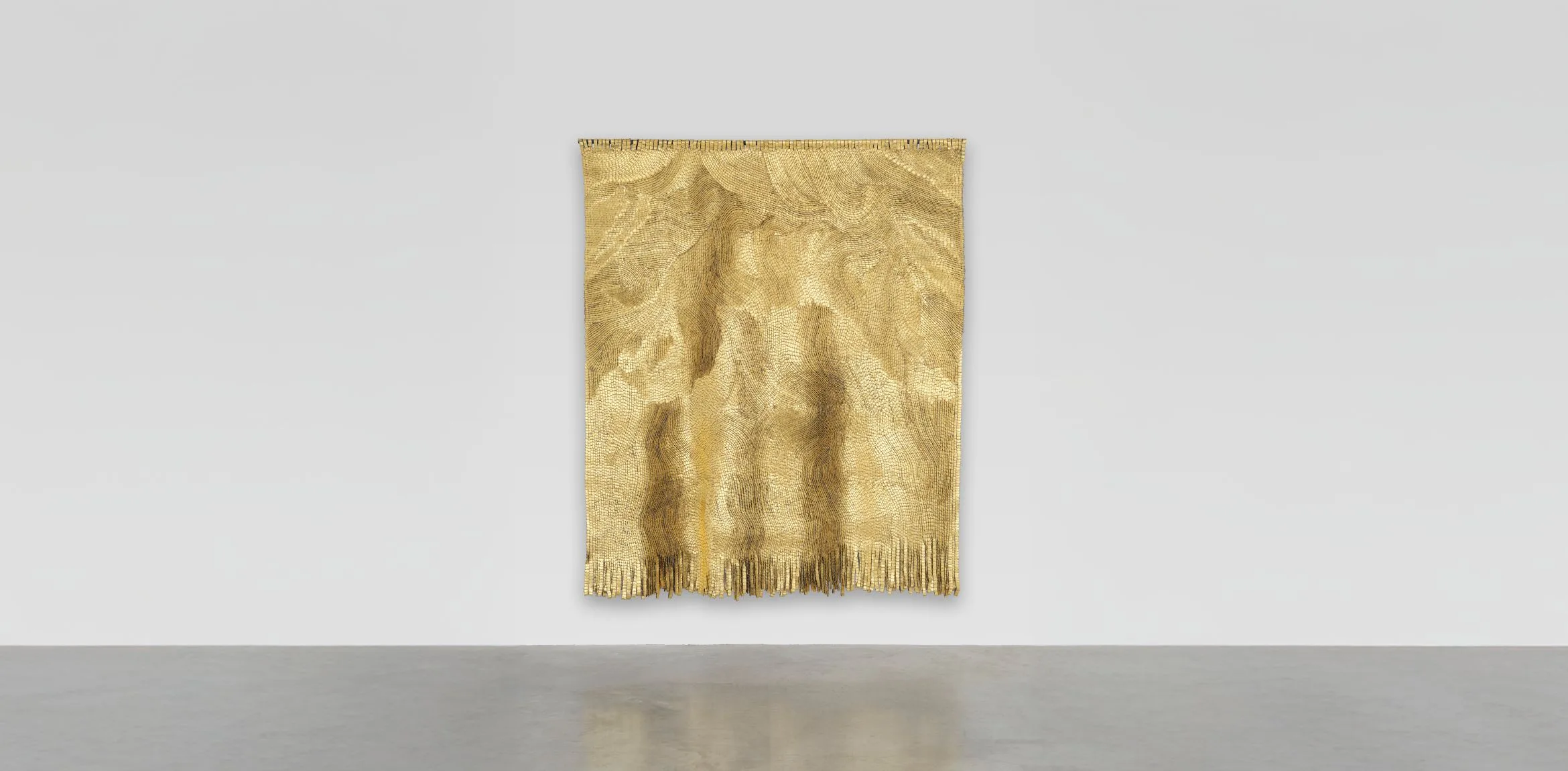
The unbridled beauty of Olga de Amaral’s textile work will be on display at the Pulitzer Arts Foundation’s upcoming exhibition, Weaving the Infinite, running from September 10—January 31, 2027. Produced in collaboration with Cooper Hewitt and the Smithsonian Design Museum, the exhibition will tell the story of Amaral’s technical evolution over nearly 70 years.
The 94-year-old artist, who is originally from Bogotá, Columbia, studied at the Cranbrook Academy of the Arts in Bloomfield Hills, Michigan, before returning home and opening Telas Amaral, a commercial design studio with her husband, fellow Cranbrook Academy student Jim Amaral. Olga’s work defies the typical limitations of what form a textile can take—her work is built into the three-dimensional form of sculpture rather than existing in the usual two-dimensional space of a textile, setting her work apart from the masses.
Stay up-to-date with the local arts scene
Subscribe to the weekly St. Louis Arts+Culture newsletter to discover must-attend art exhibits, performances, festivals, and more.
“Her work is so stunning and materially inventive,” says Molly Moog, curatorial assistant for the Pulitzer Arts Foundation. The title of the show, Moog says, comes from Amaral’s free-flowing approach to weaving, which creates truly unique pieces.
“All the choices she makes leads to this very free approach,” she says. “They enable her to move beyond limitations. When you work on a loom, it restricts the scale you can make, but if you work with your hands, anything is possible.”
Pieces on display include selections from Amaral’s decades-spanning career, including two panels from a multi-panel weaving that once stretched to 93 feet tall. To provide context for Amaral’s artistic evolution, including her fascination with coarser materials that allow her to form free-standing structures and reflective materials (most notably gold, but also palladium, silver, and plastic), the exhibition will include Amaral’s drawings, notes, and personal collectables.
Another key aspect of Amaral’s art is her wide range of cultural influences. Much of Amaral’s work is inspired by Andean weaving and South American culture, though it also calls to mind influences from across the globe, including Scandinavian and Finnish techniques (taught to her at Cranbrook) and Japanese kintsugi, in which gold is used to repair the broken shards of a piece of pottery.
“Olga is a lifelong student of weaving techniques,” Moog says. “She is a person who has learned by studying from different sources…she pulls in different technical aspects that are in service of expression and creative freedom in her work.”
Ultimately, Moog hopes that audiences will be able to see the interlacing methods underlying each of de Amaral’s artworks.
“This crossover between design, craft, and art is an understudied element of her work,” she says. “It felt like there was space for an exhibition to explore this wonderful side of her work that hadn’t been looked at as much.”
Weaving the Infinite will be on display from September 10—January 31, 2027 and will open with a reception from 6–9 p.m. on September 10.