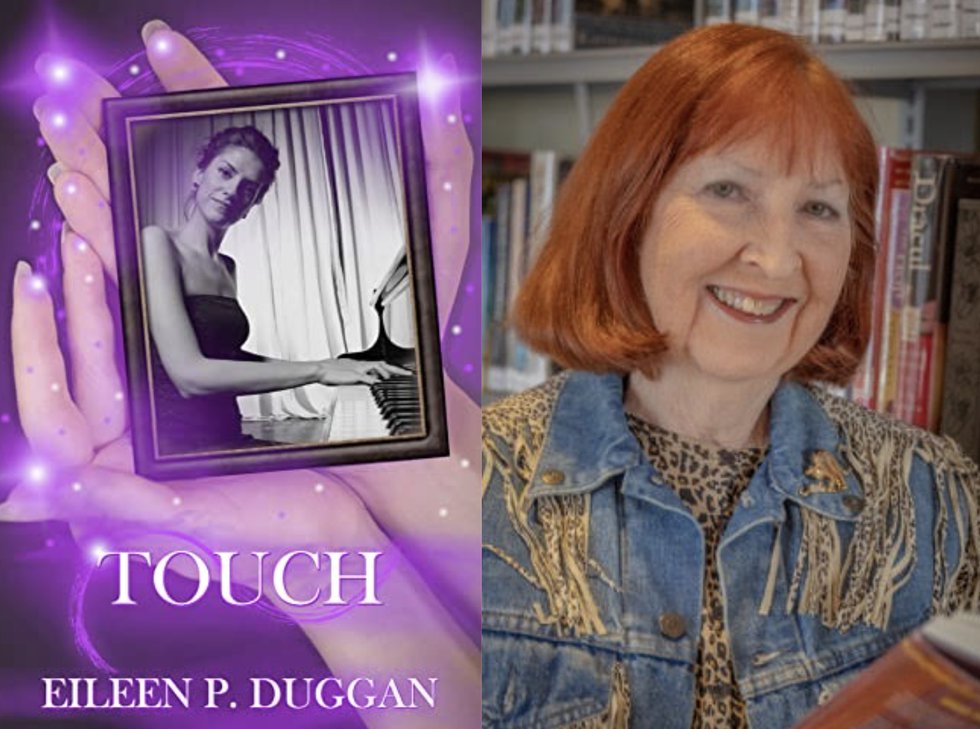
You might recognize Eileen P. Duggan’s byline. She was the editor of the West End Word, and before that the publication’s reporter, for a total of 18 years. She reported for the South County Times as well. Or you may have enjoyed Duggan’s two earlier novels, The Not-Ready-For-Julliard Players and April Fools Daily.
Like those books, Duggan’s new novel, Touch, centers on music. Touch just took first place in YA fiction for the Missouri Professional Communicators Annual Contest. The award in the National Federation of Press Women Contest will be announced May 17.
Stay up-to-date with the local arts scene
Subscribe to the weekly St. Louis Arts+Culture newsletter to discover must-attend art exhibits, performances, festivals, and more.
Touch tells the story of a 15-year-old schoolgirl named Ginny who acquires talents—musical, mathematical, and athletic—by touch. The themes of familial relationships, bullying by mean girls, and becoming overwhelmed are relatable to preteens, teens, and adults. And the deep, dark family secret requires sleuthing on Ginny’s part. It’s a fun read whether you’re a kid, a teen, a young adult, or a Boomer.
While it’s common for journalists to write fiction, like Geraldine Brooks and Colson Whitehead, Duggan’s background is rare. The native St. Louisan has a degree in piano pedagogy from what was then Fontbonne College. We recently caught up with Duggan over the phone to discuss her new book and unique path to producing fiction.
Tell us more about piano pedagogy.
My mother was my first piano teacher. I had various jobs, and I realized I did not want to be a secretary, so I went to college in my mid 20s to study music. You really need the degree to teach piano. I went for a career, but I loved Fontbonne, the critical thinking they taught, and then the sense of accomplishment in earning a degree. I don’t regret my long job journey because I think it’s helpful to learn about different people and walks of life to write fiction. I retired from piano teaching last September after 21 years, with the journalism career in between.
How did music pedagogy lead to reporting?
My piano teacher at the time was John Philips, and his good friend was the co-founder and editor of the West End Word, Suzanne Goell, a piano prodigy. He suggested she hire me to do music reviews. My reporting went on from there.
Touch is magical realism. Not exactly rooted in reporting. How did that happen?
My roommate for many years was a fabulous soprano who died young in 2005 with no kids. Her talent didn’t get passed on. I always thought, Wow, I wish I could inherit her voice. My beloved piano teacher, John Philip, who died before his time—I wished he could transfer his talent. One day, I was struggling at the piano and I looked up and saw his photograph on the wall and thought, If only I could touch his hands as he played and absorb his talent directly. That was in 2013, and it became an ongoing thought, the transfer of talent through touch. My book club read Garden Spells by Sarah Addison Allen. One of the two sisters has a decidedly magical touch with food.
And those inspirations developed into Touch?
The main character just sort of happened—a teenage girl with a boy for best friend, and it flowed from there. I started NaNoWriMo [National Novel Writing Month] that November, in which you’re to write 50,000 words in a month. I did it, and I began editing it in December of that year. A member of the Maplewood Writers Write-In Group suggested I use an object in an estate sale, and my novel went from there.
A few years ago, I met Margie Lawson, a psychologist, at a Missouri Writers Guild conference, and she lectured on using power words and psychological cues. I took her Make Your Openings Pop class online from her Lawson Writing Academy. I changed a few more things in 2019.
Your theme of teenage girls being overwhelmed resonates.
I had a piano student who was doing too much—school, dance, piano, a lot. It’s a continuous problem for girls and grown women. You hear about kids doing so much that they can no longer fit in their piano practice. I heard that a lot in recent years from other piano teachers.
How did you add the element of bullying?
There are a lot of mean people out there. I watch a lot of TV and believe that it’s true that bullies have feelings of inferiority and are cowards, [like the] cheerleader who picks on Ginny through Facebook. Bullying is so much worse today from social media. In our day, it was just rude and mean remarks.
Did you unearth your own family secret the way Ginny did?
No mysteries in my family. People love intrigue and personal relationships. Look at soap operas. It’s a fun mystery to pursue if you think there’s something going on. The best source on digging for a journalist is the late Post-Dispatch investigative reporter Louis J. Rose’s How to Investigate Your Friends and Enemies. It’s a journalism textbook.
Touch is available now in paperback and e-reader editions.