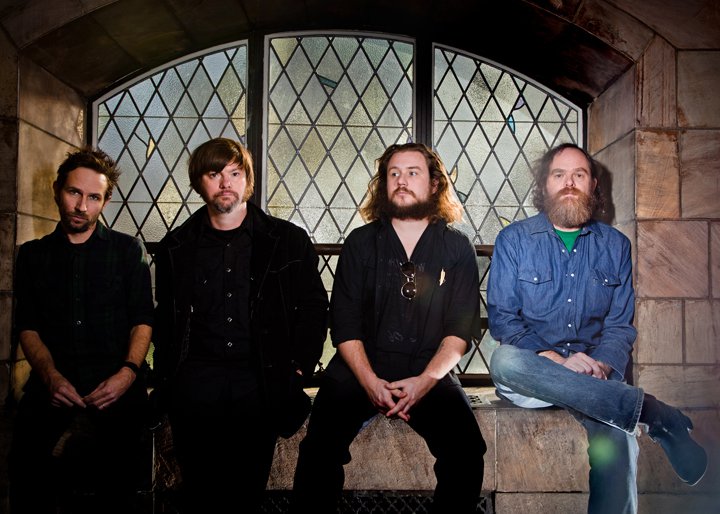
Last week, Jay Farrar released an album that was half a dozen years—or more than a decade and a half, depending on how you look at it—in the making. The Woody Guthrie tribute album New Multitudes is collaboration with Yim Yames (aka Jim James of My Morning Jacket and Monsters of Folk), Will Johnson (Centro-matic, South San Gabriel) and Anders Parker (Varnaline, Gob Iron—the latter being another collaboration with Farrar). But most importantly, it’s collaboration with Woody Guthrie himself. At the invitation of Nora Guthrie, the legendary folksinger’s daughter and curator of his artistic legacy, Farrar and his friends combed through a treasure trove of lyrics that Guthrie had penned, but for which no music existed. Over the course of the next few years, the quartet supplied the music for a number of songs and recorded them.
The album is the latest of a handful of such projects that connect Guthrie’s lyrics of protest, as well as those of a more personal nature, with contemporary music. Prior visitors to the archive include Billy Bragg and Wilco (whose frontman, Jeff Tweedy, of course, is Farrar’s former partner in Uncle Tupelo.) Their Guthrie tribute, Mermaid Avenue, was released in 1998 with a second volume in 2000. Others include the Klezmatics’ Happy Joyous Hanukkah, and the Dropkick Murphys’ song “I’m Shipping Up to Boston.”
Stay up-to-date with the local arts scene
Subscribe to the weekly St. Louis Arts+Culture newsletter to discover must-attend art exhibits, performances, festivals, and more.
New Multitudes is the first salvo of a yearlong celebration of the centennial of Guthrie’s birth that will include tribute concerts and other projects. Farrar, Yames, Johnson and Parker are headed out on a brief tour—commitments to their own bands are keeping it from being longer—and unfortunately, no St. Louis date has been scheduled. After that, Farrar finish a new Son Volt album that he hopes to release later this year on Rounder Records, and will tour with the band, starting in May.
Look/Listen spoke at length with Farrar about New Multitudes, his partners in the project, and his deep connection to Guthrie’s music.
Look/Listen: So, this record has been some years in the making. Take me through the process.
Jay Farrar: The idea took root back in 1995, 1996, when a request came through Warner Bros. [Farrar’s record label at the time] for Son Volt to work with Woody Guthrie lyrics and to work with Billy Bragg. That didn’t happen, but the idea stuck with me. Fast forward to 2006. That’s when I approached Nora Guthrie and Anders Parker, and I started visiting the archives. At that point, we sort of thought it might be an extension of the side project that we had already put one record out as, as Gob Iron.
Wait, let me understand—was this before or after Jeff [Tweedy and Wilco] did this?
I don’t know all the chronology, or all the machinations behind the scenes. All I remember is being asked to participate and then, shortly thereafter it was announced that it was Billy Bragg and Wilco.
So this really has taken some time. Where is the archive, and what is it like?
It was in a place, a relatively small space in upper Manhattan. I forget which floor it was on. It was a couple of rooms. But it’s an inspiring repository of all things Woody, from a large amount of unused lyrics and journals and paintings, sketches. That’s one thing that struck me when I was there: In addition to the breadth and scope of what Woody was writing about, what a talented artist he was.
So these are lyrics that he wrote, but never was able to put music to. What do they physically look like? Are they handwritten on scraps of paper, cocktail napkins?
His lyrics took a variety of forms. It could be on a napkin. He seemed to do a lot of lyric books, where sometimes the lyrics would be typed and sometimes handwritten. Sometimes within those books, there would be a little leaf or twig or something that he felt was important to include. It took all different forms.
It is a heady experience to be standing there with the actual documents that he created?
It definitely felt like an honor that they allowed us into the archives. Woody was the archetype, the first guy that put across the idea that music can change the world. There’s a passage in his autobiography, Bound for Glory, about how he noticed that people started paying more attention when he started singing about current events and writing topical songs. I guess that’s something, as a writer, that I turn to for inspiration—that idea.
Even if he was dealing with topical material—if there was element of timeliness to it, there was also a timelessness. That’s why his songs still resonate today.
Yeah, that’s something…good point. Even though Woody is known for being a topical songwriter, ultimately, the majority of his stuff is more timeless. Stuff about social and economic injustice is always gonna be relevant.
You and Anders worked together in Gob Iron. And I know you’ve known Will Johnson for a long time as well. But how do he and Jim James fit into the picture?
I knew Will from when he helped out when Son Volt drummer Dave Bryson broke his collarbone before a tour, so Will filled in on drums. But Jim James and I met back in, I think it was 2004, when we were both at a Gram Parsons tribute concert in California. And then subsequently, Son Volt and My Morning Jacket shared bills over the years.
Anders and I started writing music and working on these songs and recording them, sometimes separately, sometimes together, in Brooklyn, New York. So we started the process in 2006, and then I think it was about 2009 when Jim James visited the archives, and Nora Guthrie played him some of the music that Anders and I had been working on. Later, Jim and I spoke about joining forces and bringing Will Johnson on board.
Does James make you call him Yim?
I call him “Fella” (laughs).
Is there a particular time frame of Woody Guthrie’s work that the album focuses on?
When I went into the archives, I was kind of gravitating and focusing more on the period of the 1940s. That was when Woody was briefly stationed at Scott Air Base. I did come across some writings in his journals where he talked about having a day off and hanging out on the riverfront in St. Louis. That was of particular interest to me. Also, the song “Hoping Machine,” those words were pulled from one of Woody’s journals, which was also from the 1940s. His journals were more free-form, and sometimes stream-of-consciousness style, which appealed to me. It was also an interesting juxtaposition at times, where there would be very routine comments, like, “Get up, make coffee, eat breakfast” and then he would launch into something philosophical or profound, like some of the words that wound up in “Hoping Machine.” Like, “Music is the language of the mind that travels/That carries the key to the laws of time and space.”
But later, Nora Guthrie pointed out that the majority of the songs that we had chosen were from a sort of renaissance period that Woody had in the 1950s in California.
Was it in any way overwhelming to approach this project? Like, ‘There’s so much to see here, so much left undone. How do I know that this is the right lyric to pursue?’
I just tried to find lyrics that I had some connection to or some frame of reference that I could draw from. Or in other cases, where there was just compelling subject matter. I guess a case where I had a frame of reference was one of the songs that Will Johnson wound up doing, “Chorine.” I pulled those lyrics just based on the expression “Sheeba Queen.” My dad used to use that expression. But I later passed those lyrics on to Will and he did a great job writing the song.
Is it transformative in any way—do you feel like a different guy looking in the mirror now that there are songs out in the world that are credited to Woody Guthrie/Jay Farrar?
It’s kind of surreal. I guess that’s also something that you feel when you’re at the archives. It’s kind of surreal that someone’s music that you grew up with, someone that was an icon and an archetype, and there you are, looking through some of his most intimate musings. But ultimately, I found it to be more about inspiration than intimidation. It was based on a degree of familiarity with Woody’s work and his music.
Everybody learns “This Land Is Your Land” in grade school. But your early experience of his music sounds like it went deeper than that.
Yeah, as far back as I can remember, both of my parents played his music and sang his songs. Woody Guthrie was one of the few musical artists that they both agreed on. And as you mentioned, “This Land Is Your Land” is kind of an unofficial national anthem. Both my parents were drawn to Woody’s music and they drew me in in the process. Woody possesses a poetic sensibility that stands alone. His use of alliteration in songs like “Pastures of Plenty”… “Green pastures of plenty from dry desert ground…” I think his use of alliteration is great, and really still kind of stands alone.
I know your dad has passed on. Is your mom still with us?
She is, yeah.
And what did she think when you told her you were going to do this?
She was supportive. She’s the one that got me into this (laughs) whether she wants to admit it or not.
And what do you think Pops would have said?
He would have wanted to join in, I think. And maybe in some way, wherever he is right now, he is joining in.
As we talked about, Billy Bragg and Jeff and other people have dipped into the archives—the Dropkick Murphys, the Klezmatics…
There’s a record out more recently [Note of Hope, released last year] that includes Lou Reed and Jackson Brown…Ani DiFranco.
Did any of those earlier efforts have an impact on you one way or the other?
I didn’t seek out Mermaid Avenue when it came out. I probably heard some of it in passing. But I knew that I was eventually going to get around to doing this project on, hopefully, my own terms. And that’s the way it turned out. But I wanted to be sure that the canvas was open and clean. I didn’t want to be influenced into doing anything or to not doing anything based on what I had heard other folks do. One of my favorite Woody Guthrie songs of all time is “Deportee.” And I found out recently that it was an early instance of someone putting Woody’s lyrics to music. Nora said it was done in the 1950s. A guy named Martin Hoffman wrote the music.
In terms of album credits on New Multitudes, I think you, James, Johnson and Parker each get three on the main album. Is the bonus CD of the deluxe version more of what you and Anders had done originally?
Exactly. The bonus disc is comprised of songs Anders and I had done, because we had a head start.
When and where did you record the album?
I guess the main recording session was done in Brooklyn, when we all got together. And we later got together in St. Louis for a couple days. Prior to that, Anders and I had been recording, sometimes separately, sometimes together, just whenever we could in breaks in our schedule. It’s probably also important to note that there was no record company involvement when we started the recording process. Consequently, there was no budget (laughs). I was trading guitars—almost like the barter system. I was trading guitars for engineering services, just to get it done.
I’m glad you had enough guitars to carry it through.
I have a few left (laughs).
We were talking about the song “Hoping Machine” earlier. I love that concept, like it’s something we have sitting around the house. Woody uses the word “machine” in interesting ways. How he wrote on his guitar, “This machine kills fascists,” etc.
Exactly. That, conceptually is what struck me as well: that there could be such a thing as a hoping machine. Of course, he hit the nail on the head.
Another song you co-wrote, “New Multitudes” is the title track. Tell me about that one.
“New Multitudes” appealed to me for several reasons, but initially, just the repetition of phrase, “Gotta have new multitudes,” sort of reminded me of Walt Whitman, or something like that. And then it became apparent that “New Multitudes” was emblematic of the project itself. In a small way, we were carrying on, or perhaps carrying on the vision of Woody Guthrie. So that’s what we called it.
For more information about New Multitudes, visit newmultitudes.com, rounder.com, and jayfarrar.net.