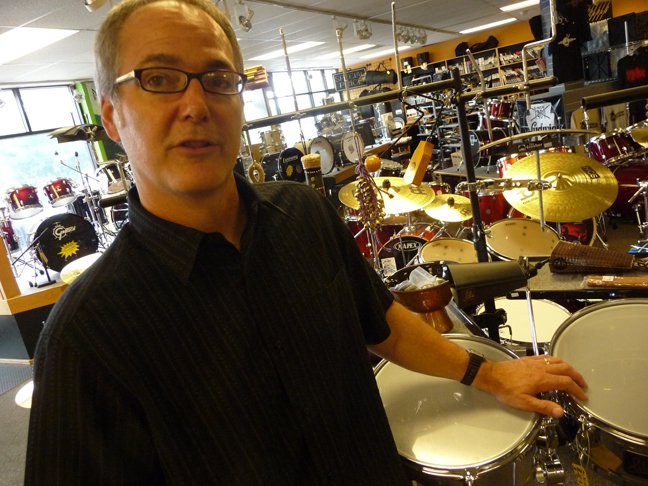
All retail stores are not created equally, this we know. Drum Headquarters had that special feel to it, a “pop” that hit you as you walked through the narrow pathways between kits and hardware. There was the shine of cymbals in the right, front corner. The brilliant colors of full drum sets through the center of the store. The exotic hand percussion along the back wall. If the sticks and heads along the left side of DHQ didn’t have the same visual punch, they were the “daily needs” items that kept drummers from all over the region visiting the store since 1981. And you always knew you were in a drum shop when catching the beats of young drummers, tucked away in the muffled rehearsal rooms.
Three decades on, second-generation owner Jim Uding says that “a perfect storm” of economic factors have conspired against the long-running, popular shop. Located on Manchester and Southwest in downtown Maplewood, the store closed its doors on Thursday, July 7. Though private lessons will continue through the remainder of the month, Uding says that there’ll be no immediate liquidation sale and that the equipment and brand will remain frozen for the next 10 days, or so, at which point he’ll have a determination on the final outcome of the business name and inventory.
Stay up-to-date with the local arts scene
Subscribe to the weekly St. Louis Arts+Culture newsletter to discover must-attend art exhibits, performances, festivals, and more.
“I did everything I could to save the business,” he says, pointing to a litany of reasons that the store wasn’t able to push through. “The closure has definitely hit our customer base, which I considered a community. And not just drummers, but musicians here, generally.”
Pinches on the viability of indie drum shops have come in different forms; Drum HQ was touched by most, if not all, of them. On a macro level, there’s the little matter of the entire economy struggling since 2008. On a local level, Highway 40 was closed for two years soon after Uding’s purchase of the shop from store founder Rob Birenbaum in 2005. On the front of changing retail habits, some customers checked out gear at Drum Headquarters, then ordered the same products online, or bought from chain competitors. And lastly, a combination factor: when the economy was cooking, many folks used easy credit to buy their high-end dream kits; when their fortunes changed, they used Craigslist to sell their gear directly to a new buyer.
“We did thin out our inventory, though never to a degree that customers would notice,” he says. “At one point, we had stores here and in St. Peters, with 11 employees. This year, we had a staff of three, and in February, we went to a staff of two, including myself, along with a part-time employee. I didn’t really have to tell them about the direction we were heading.”
Uding joined Birenbaum’s experienced staff as an 18-year-old in 1983 and has watched countless players-slash-customers come through the shop over the years. Some of them became famous, others just played for fun. Trends (electronic drums during New Wave, anyone?) came and went, some driven by radio, some by changing cultural norms. For example, Uding says that female customers became more prevalent in recent years, breaking into what had long been a male-dominated corner of the musical playing field.
“Female drummers loved coming here, because they knew we’d treat them as equals,” he says. “We weren’t up at the counter nudging one another, saying ‘look who’s coming in now.’” But he adds that all players were accorded a certain respect when entering the shop, as all staffers were avid drummers and “we knew their passion and their art.”
Since news of the store’s closure, many customers have driven up to the shop, looked at the sign in the window and driven away, disconsolately. Others have shared their stories with Uding, who says he’s gotten “a hundred e-mails and phone calls from people, sharing their memories.”
Danny Kathriner, a veteran local drummer with a fine pedigree of band credits to his name, says that he was a fan of the shop well before becoming a known commodity among his peers.
“My very first visit to DHQ was memorable,” he says. “When I was about 15 years old, my dad took me to the original location, which was nothing more than an unassuming, two-story house right off Big Bend in Maplewood. It was around the Christmas season and I was looking through pawn shops (down Manchester Road) for spare drums and drum parts. I was young and simply wanted to collect as many drums as possible. My dad and I just stumbled across Drum Headquarters. We went inside and were greeted by Rob, the original owner. He sold us a maple, 16-inch, Gretsch floor tom. I still use it today.
“What I remember about that day was Rob being a very personable person. He took me very seriously even as a young customer. He treated me like a professional even before I was. I felt so cool. I was hooked and became a loyal customer. Going inside DHQ was always a cool experience, as a drummer anyway. As a kid, seeing drum kits all around was like being in drummer heaven. As I grew older there were other reasons to stay loyal. Unlike many music stores, there was never an air of pretension with the sales people.”
A. Michael Collins, though now living away from St. Louis, was both a client of the shop as a customer and a salesman on the DHQ floor.
“That place was an institution,” he says. “I still can’t believe it’s gone. Drum Headquarters was the hub of the drumming community, and working there was a real joy… one of those jobs that really was as fun and cool as you thought it would be. When a place as enduring and well-respected as DHQ goes by the wayside, I have to believe that we’re seeing the end of local music stores.”
While Uding pulls just short of saying the same, he will grant that independent retailers of all stripes need to remind their immediate communities that they’re around, open for business and a key part of every neighborhood’s health and vitality. And there’s the always the unique nature of niche stores to pitch. Sure, you can buy an SD card, a refrigerator and the latest Jerry Bruckheimer movie at Best Buy, but the experience of buying a drum set there is a very different one than browsing at (and playing your way through) a store like Drum Headquarters.
Sounding like a drummer as much as an erstwhile drum shop owner, Uding says, “I realize there’s a convenience of being able to click on an order form at 3 in the morning. But there’s a tactile thing with drumming. When you go into the percussion section and play beats on a djembe, it’s how the instrument feels in your hands that counts. At that point, it’s not the price that matters, it’s how that piece felt in your hands.”
For updates on the immediate future of Drum Headqarters, Uding suggests eyeballing drumheadquarters.com, where news will be posted as it becomes available.