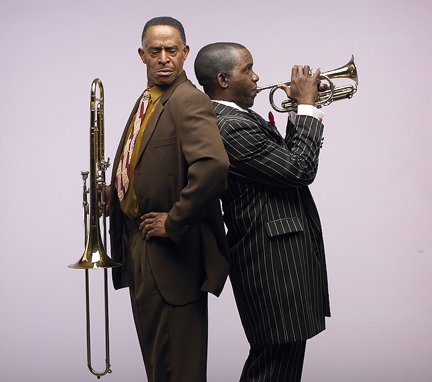
Though audiences still identify Antonio Fargas with Huggy Bear, his Starsky and Hutch character, he’s had a long, eclectic career that’s included everything from Broadway theater to independent film to TV comedy. His breakthrough role was in Shirley Clarke’s 1964 film, The Cool World—when he was all of 14 years old. More recently, he played the character “Doc” on Chris Rock’s series, Everybody Hates Chris. Though he considers himself “semi-retired,” Fargas is busier than actors half his age; he continues to appear on the theater stage, and is a partner in Granada Entertainment, which has a series in development for British TV. He’s also working with a group of other artists on a 12-city tour of a gospel musical stage play, Calling All Saints, and serves on the boards of the Langston Hughes Center for the Arts, the Martin Luther King Center of Newport, the Mount Vernon Open Case Theater and the Progressive Symphony’s Academy of the Arts. This month, he is on stage at The Black Rep for its production of August Wilson’s Ma Rainey’s Black Bottom, the first play in Wilson’s epic, poetic Pittsburgh Cycle, which describes the African-American experience through every decade of the 20th century. We sat down to chat with Fargas at the Black Rep offices last week after rehearsals to talk about the play, his hometown of Las Vegas, his love of the Black Rep, and, of course, the role of Huggy Bear, which still gets him stopped on the street.
Look/Listen: You’ve been in Black Rep productions previously, if I remember right?
Stay up-to-date with the local arts scene
Subscribe to the weekly St. Louis Arts+Culture newsletter to discover must-attend art exhibits, performances, festivals, and more.
AF: There was a performance of The Gospel at Colonus at Wash. U., but last year was my debut on the Main Stage in The Real McCoy. It was a special piece about a man who was a part of history, and it was enlightening to me to find out he was a real guy, and that he was a black man who did something with the steam engine. I think it was also enlightening for young people to find out about a man of color—he was from Canada—who impacted the lives of a lot of people around the world. I played the father. I heard it won some kind of theater award around here. I felt good about that, and felt good for the theater.Ma Rainey is my second time working on the Main Stage at The Rep, and I’m very excited about it.
L/L: And you were in a revival of Ma Rainey in another city, previously, but you played a different character.
AF: Right. I played Toledo, at the Royal Exchange Theatre in Manchester [England]. We did Ma Rainey about six years ago. So it’s nice to revisit the play, and keep it fresh by doing another character. The story’s about an actual blues singer, Ma Rainey. August Wilson places her in Chicago, and the story centers around the life of the band, who are waiting for Ma Rainey to arrive and take center stage.
L/L: So, there’s a younger character, Levee, and he’s kind of peppery, and then the older, grounded characters…
AF: There’s three of us—there’s Slow Drag, Toledo and Cutler, the role that I play. We’re the older musicians who are fairly set in our ways and resigned to just love the music and are grateful for the opportunity to play. And Levee is more edgy. We each bring a different flavor to August’s recipe. There’s a lot of African myth and metaphor about the soup that all these ingredients have made, which nourishes our people, and replenishes our people. August delves deep into the African folklore and the history, and it comes out in all his plays, including Ma Rainey.
L/L: Yes, he’s always struck me as much a poet as a playwright.
AF: Because he loved jazz, there’s a lot of jazz music in the prose.
L/L: What are the differences between the two characters, Cutler and Toldeo?
AF: It’s very, very subtle. For an actor to explore each character, each character is an individual. I’ve played the same type of characters before, and the through-line is maybe only their occupation, or their ethnic background. So with the specifics on these musicians, most of it goes back to the fact that they have the same kinds of parallel histories and experiences, be it religious, through the church, or the learnings of the road and of the street, the parlance or the machinations of the musician’s life. They’re not too dissimilar. I see more similarities than I see differences.
L/L: So, The Black Rep is one of the few companies in the U.S. that’s produced all of Wilson’s plays, in his Pittsburgh cycle.
AF: And now, they’ve completed the cycle. This is the first play that Ron [Himes] did when he started doing Wilson’s plays.
L/L: Now, he’s acting as well?
AF: Right, he’s playing the Toledo character. A lot of times when you do a play, and you play either the same character or another character, you have a sense of history you can use in terms of relationships. And then knowing Ron over the years, and knowing Erik Kilpatrick [Slow Drag], and having parallel careers with Ed Smith, the director…it’s really a family affair, which is what an ensemble, a repertory company provides.
L/L: Yes, it seems like it’s a very bittersweet thing, this bonding and then splitting apart that actors do, production after production.
AF: When we get together, it’s like a birth, or a marriage. And when we finish, it’s a death or a divorce. If the experience has been a good one, it’s a celebrated divorce, and a celebrated death. Then you look to be reborn again in another project….or just going back to being you. [Laughs.] Going back to being a husband, or a father. And the greatest role I’ll ever play is just being Antonio Fargas. That’s a work-in-progress, for sure.
L/L: So you’re in Las Vegas, right? It’s an interesting city. It seems like it’s changed a lot over the past few years, too.
AF: It is, and it’s morphing into this budding cultural center, and I’m very excited about that. They’re opening up a new theater complex called the Smith Center. It’s a marvelous, marvelous couple of theaters, and a showroom. It’s going to revitalize the downtown area, because it’s near downtown, it’s not near the strip. Its main thrust is to entertain, and to have alternatives for the locals as well as the visitors who want to come and see legitimate theater. It’s like Lincoln Center, though of course not as grand. Alvin Ailey is coming there, and of course touring Broadway plays. And I’m looking forward to possibly doing a production of Driving Miss Daisy there at some point in the future.
I’m so excited to be there during this point of my career, where I consider myself semi-retired, and working with people who want to work with me, and having more opportunities to work in theater, now that I’m not pursuing television and film the way I used to. It’s nice to be able to step off the stage a little, and enjoy giving back. I’ve been able to stay on the planet for 65 years, and 52 of them have been involved with theater. And theater is the well where it all starts. Before there was television and film, there was theater. So I have a special love for theater. And I have a special place in my heart for black theater, and black writers who preserve our history, and tell about our history today. I think the black church, and black theater are certainly preservers of history, and the preservers of a culture as it evolves.
L/L: And the Black Rep is such a jewel.
AF: The Black Rep is a mecca. I’ve been around to see a lot of black theaters, institutions that no longer exist. And for the Black Rep to be around 35 years, that’s quite a spiritual accomplishment. I started getting involved with the Black Rep back when the Woody Awards were happening. So I came, and they gave me a lifetime achievement award, and I helped present and support the theater back then, and that was my exposure to the Rep. And then I said, this is a place that I want to work. And trying to work out a schedule when you’re beholden to being in L.A.—there were a few times when projects came up, and I had to beg out because of the choice I had to make at the time. But now I’m semi-retired; I’m available.
L/L: Are there roles you want to play on stage at the Black Rep?
AF: I just try to keep it open, and stay open to the endless possibilities, and still be a dreamer. At this point in my life I think it’s reallly good for me. Cause that’s what I try to do, and support young artists’ dreams, but also to advise them to get spiritually connected, and spiritually based within their art and their dreams so that you can handle and accept what comes your way.
L/L: Right, because ego is a particular pitfall in this line of work.
AF: Yes, that’s the attraction. You see somebody, when I did my first role, in film, at 14 years old, I was like, man, I’m going to be in the movies. That’s like Cary Grant and all these people. And that was quite an attraction. And then I found a home in theater, where people felt the way I feilt, and I realized that this is something that I had a burning desire to do. But it developed slowly. A passion for this life, and for the arts, and for living.
L/L: Yes, I guess it’s those human connections that ground you.
AF: Sure. It’s about developing this family, this team. My son played football, and what we miss when we play or we leave the stage, is the camaraderie. I miss the rehearsals. I don’t particularly miss the performances. I miss the preparation, the things we talk about backstage, the laughter, just as football players miss the smell of grass and the smell of ointment and the locker room.
L/L: It seems like your presence in this showmight bring down people who don’t go to the theater regularly, you know, because they know you from TV.
AF: Yes. I am a great supporter of Huggy Bear. [Laughs.]
L/L: I was a little reticent to bring up Huggy Bear, because it seemed like you might sick to death of talking about it!
AF: The marvelous thing about it, the magic of television and film, is that something that I did almost 40 years ago now, people still talk to me about him. Then, I was also able to do four years, which we finished about three years ago now, Everybody Hates Chris. And so it’s just an evolution. And now, through my travels, to come to St. Louis for two years in a row, and work with my friend, Ron Himes, who is such a pioneer, it’s really special for me.
What I love today is going places, and meeting people who have been affected by, or experienced me through television or film, because I get to say thank you. And it’s everywhere I go. Even the other day, I was getting some food, and a lady said, I want to thank you because eight years ago, you met my son in Los Angeles, and you gave him some advice. Many years ago in L.A., a guy came up to me in a barber shop and said I want to thank you for what you did. My sister came through L.A. in the early 80s or late 70s, and was all starry-eyed and full of wonderment, and I knew that things not go well for someone…so I gave her some advice to go home and pursue something else, and she did, and she’s very happy, and he wanted to thank me. That’s the payoff. When I was doing a play in England, I had to take a taxi to the theater every day. And almost every taxi driver I met for that short ride said, you don’t have to pay me, Antonio. I just want to thank you for what you did for me growing up, because we loved Starsky and Hutch, we watched it every Friday night after we took our bath and did our homework. And even coming here, if people I meet are around 45 years old, they were like 11 years old then, and they had an impression of Starsky and Hutch…it’s that give and take that happens. And of course in the theater, it’s live, and there is an aliveness to it, it’s an exchange between the audience and the actors. It’s just really nice to, here at the Rep, to experience the audience after the show, and get those exit poll kinds of reactions about their impression of the show.
L/L: Are there any other projects you’re working on that you’re excited about?
AF: One of the most gratifying things at home is working with a company called the Las Vegas Arts Center. It’s just a small company on the west side of Las Vegas, and they have a summer program where we teach dance, theater, and music and we give young people life skills through the arts. That is very near and dear to my heart. Ron came to Las Vegas and worked at the Arts Center when I first moved there, and he brought me over to a place in my own city, and had me talk to the kids. And I was just hooked. So I’ve been there for the past five years. I’m an elder mentor at the Las Vegas Arts Center, helping kids who don’t have a chance to experience the art, and fulfill their dreams, even if it’s only for a little while, before they go out into the tough world get these skills they get from learning theater and dance.
L/L: Are there shows you’d like to direct?
As you get older, theater gets to be really physically demanding. I can see the day where I would just want to direct. You have to be not just physically fit, but mentally tough, and sensitive and all these things to run the range of emotion that these characters and stories demand. So, it’s not for the faint of heart. This nomadic life is definitely for the young. The old…I need a little more room in my seat, it’s hard for me to travel coach. Not because of snobbery, but i just need room! You know what I mean? It’s just like when you get older, it’s not about having a fast car, it’s about having a safe car. All those things. To be a retired person, and to be collecting social security, I never thought I would be 65 years old, much less doing something I started doing when I was 14! It’s pretty much a miracle as far as I’m concerned. I love the theater, but I also love film. I was very happy that a silent film [The Artist] won an Academy Award. But the greatest production is life. And the power which I choose to call God could only direct this movie called life. It’s an improvisation. Or really, I call life a rehearsal. Life is a big rehearsal! [Laughs.]
L/L: What do you hope people will take away from the show?
AF: Well, you know, its like any art piece…it’s very subjective. People will take away different things. I can’t prescribe. I’m sure Mr. Wilson had a sense of love and history that’s embedded in the stories and in the work. I’ll just be happy if I am fulfilling Mr. Wilson’s words, and Mr. Smith’s direction.
Ma Rainey’s Black Bottom opens April 13 (after two previews) and runs through May 13. Performances are on Wednesdays at 7pm, Thursdays at 7pm, Fridays at 8pm, Saturdays at 3 & 8pm and Sundays at 3pm at the Grandel Theater, 634 N Grand. Tickets are $20-$47. On April 16 at 7pm, the Black Rep presents August Wilson: Language and Dialogue, a forum discussing Wilson’s work, language and impact on contemporary dialogue. Panelists include Dr. John Baugh of Washington University, Dr. Jonathan C. Smith of St. Louis University and Reverend Traci de Von Blackmom; the event is free. For more information, call 314-534-3810 or visit metrotix.com or theblackrep.org.