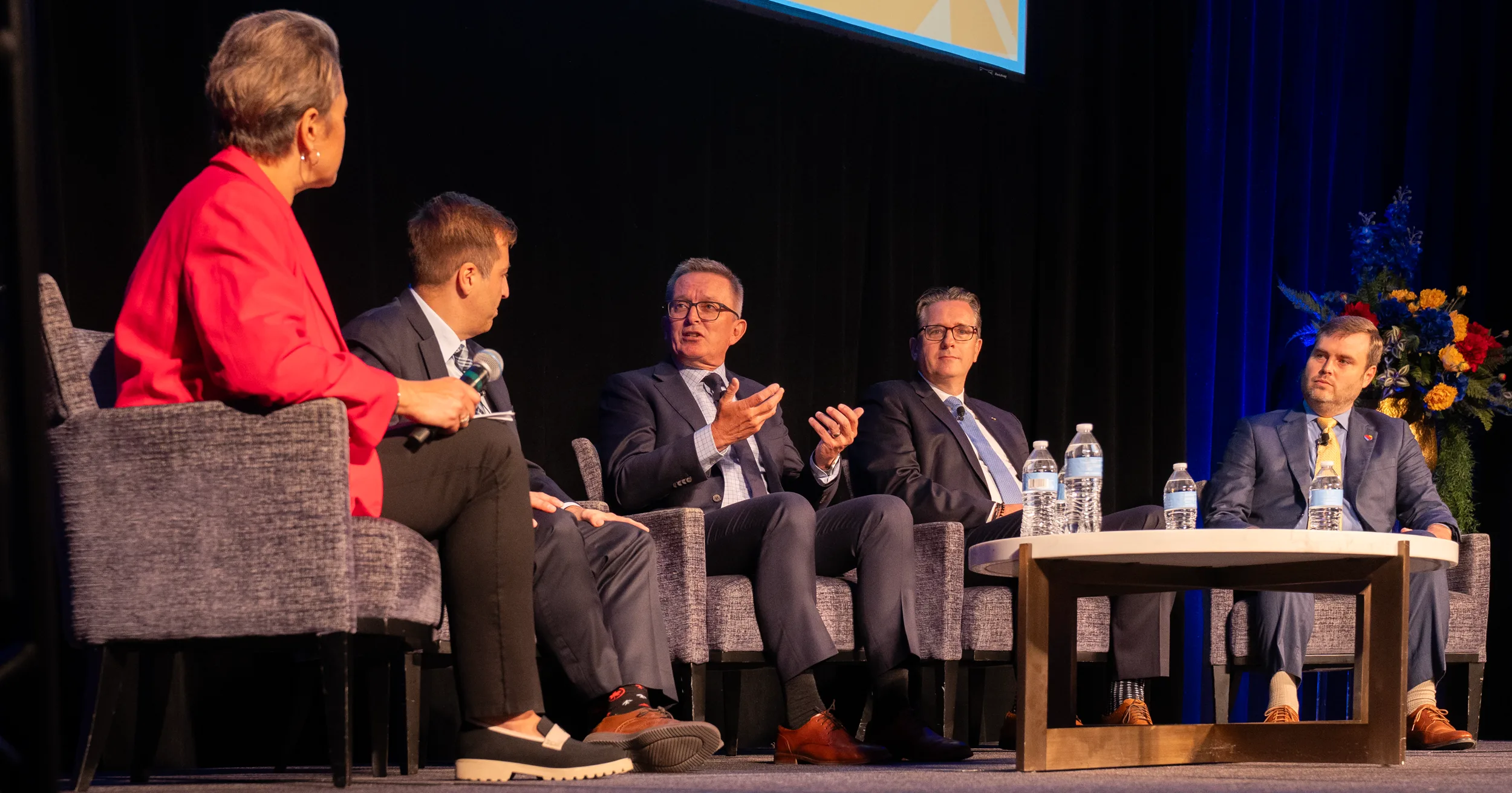
One of the organizations working to grow St. Louis’ tech ecosystem is making a major pivot to focus intently on the needs of mid-market firms across the region.
The shift announced Monday by TechSTL, a nonprofit membership-based tech council, is billed as a response to shifting conditions in the local tech space and an effort to fill a gap within the regional tech ecosystem—evolving from a general focus of building programs and offering support to spur local innovation to directly tackling the challenges faced by more mature tech companies with proven products that are looking to accelerate their growth.
Keep up with local business news and trends
Subscribe to the St. Louis Business newsletter to get the latest insights sent to your inbox every morning.
“St. Louis has no shortage of home-grown innovation, talent, or ambition,” says TechSTL’s CEO Emily Hemingway. “But what we’ve heard from the network is that mid-market tech companies have lacked a unified platform that truly represents their needs at scale.”
This new core focus better aligns her nonprofit with the “realities of growth, customer acquisition, and capital access in today’s market” and is a reflection of direct feedback from local CEOs, Hemingway explains. It also brings the addition of nine new members to TechSTL’s governing board, all of whom are top leaders of established local tech firms, in part to ensure the nonprofit’s ongoing strategy, programming, and advocacy represent what mid-sized tech firms need.
Among the new additions to the board is Kristin Tucker, co-founder and managing principal of TDK Technologies, a Chesterfield-based consulting firm that’s been developing custom software for a range of clients for 25 years. Tucker says joining the board was a “no-brainer” after hearing TechSTL would be focusing intently on mid-sized firms.
“Where that economic growth is really going to come from, and where a lot of employment comes from, is mid-market,” Tucker says. “Having an organization that can foster the support and growth that those mid-market [firms] needs will just help further build job opportunities and tech talent and support for those larger customer organizations and the region at large.”
This refined focus also takes into account the area’s maturing tech ecosystem, which has a range of organizations and programming directed toward early stage companies.
Capacity CEO David Karandish, another new addition to TechSTL’s board, agrees that St. Louis has done a good job at supporting earlier stage companies, but adds there are familiar challenges for mid-sized growth stage tech companies, which he loosely defines as firms with more than $1 million in annual revenue but less than $100 million.
“That’s not a hard number, it’s more like [once] you get to $1 million of revenue, you’ve kind of proven you should exist, and if you’re over $100 million you’ve probably figured a lot of things out at that point,” he says. “There’s a sweet spot right in between there, where I think companies’ biggest two [challenges] they’re typically looking at are customers and capital.”
Fellow new TechSTL board member, Jason Carter, the founder and CEO of UNCOMN, adds homegrown companies are going to be the ones that rejuvenate the local business environment. His nearly 15-year-old technology consultancy headquartered at Scott Air Force Base specializes in systems architecture and engineering primarily for defense clients, such as U.S. Transportation Command or Air Mobility Command, both of which are based at Scott.
“It would be really great to attract the next Amazon or something to plant its headquarters in St. Louis, but I just don’t think that’s very realistic,” he says. “I’m a native of the area and you love the place you grew up. Part of my philosophy as a CEO has always been to give back, and I want to see the St. Louis region thrive both for selfless and selfish reasons.”
St. Louis lays claim to a few behemoth tech companies—Carter cites World Wide Technology and Daugherty Business Solutions (which was acquired by CGI in late 2024)—but mid-sized firms like his own are an area “nobody focuses on,” he says. Carter contends firms of his size, which counts more than 230 employees, can often drive better results because they know their strengths and when to partner with other organizations to serve a larger client.
“I can’t tell you the number of times we’ve actually cleaned up the messes of large organizations that are not optimized for complex problems. We’re better than them at that,” he says. “And when I say ‘we,’ I don’t just mean UNCOMN, I mean mid-sized, successful organizations are better at complex, custom problem solving than large organizations are.”
Carter laments “a fundamental lack of awareness” from some of St. Louis’ largest companies to the technical expertise boasted by firms in their backyard. Karandish says some local growth-stage companies also struggle to land customers in St. Louis because they discount a homegrown solution in search of “something better” from the coasts.
Adds Karandish, “From a capital front, this is a city notorious for having deep pockets and short arms.”
TechSTL hopes to solve this by refining what the nonprofit has already excelled at in getting the local tech ecosystem communicating, working together, and increasing connections, he says.
“Now, let’s connect people with a purpose,” he says. “I think there are [corporations] here that would like to partner with startups. I think there are a ton of people who would like to invest in these startup and emerging growth companies who don’t really know how [or] don’t have a good vetting process.”
Carter suggests TechSTL’s shift will help by facilitating forums where smaller firms can show off their capabilities and solutions for larger players, which he says will yield new connections and conversations. Tucker adds this kind of “matchmaking” is vital, as well as building a database of the local companies, what they do, and who might make for strong potential customers or even investors.
“St. Louis is, as we all know, a very relationship-based region and getting connections to people is how you break into new clients,” she says. “If TechSTL can be a hub for those connections, it will just move everything quicker and provide value to everybody in the equation.”
As a membership-based organization, Karandish says TechSTL can leverage its existing strong network and cater to what companies that have signed up are looking for. And, he adds, it’ll be clear if things are working.
“I want it to be such a no-brainer for a mid-market growth tech company to sign up with TechSTL because of the amount of value that they get delivered,” he says.
Hemingway reflects this too: “We succeed when our members win new customers, raise capital, and scale while strengthening St. Louis’s position as a nationally competitive tech market.”
Hear more from Emily Hemingway on the Fast Forward STL podcast.