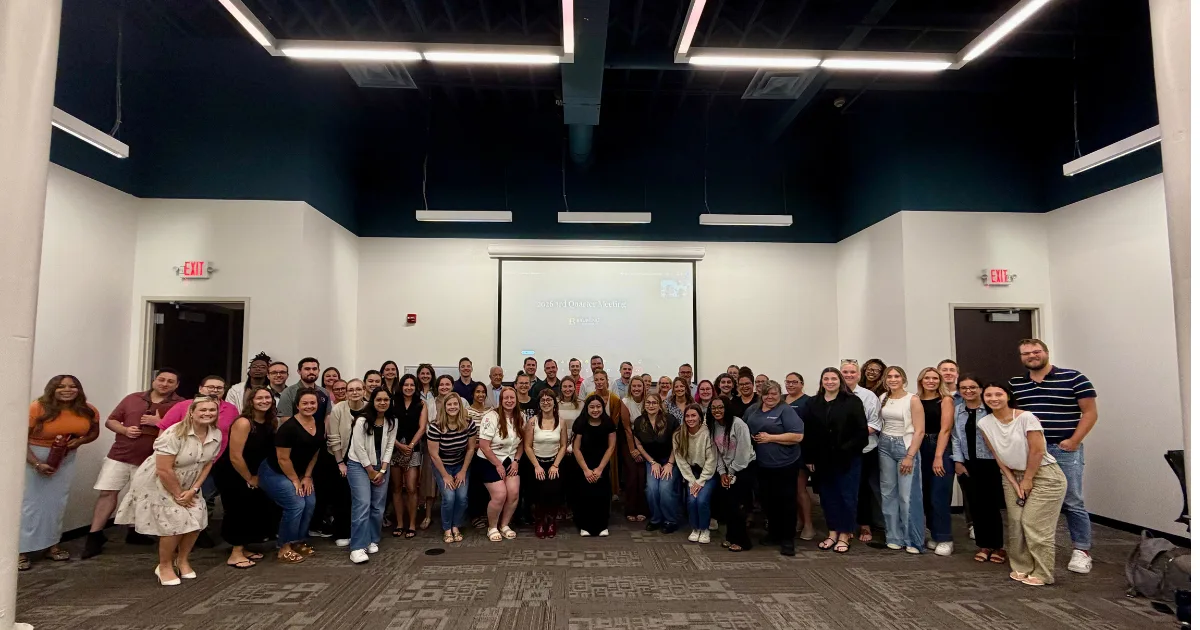
OTSL recently completed its 50th festival season—no small feat for any arts institution, let alone one devoted to a form of theater that’s sometimes misunderstood as a bit stuffy. With Jorgensen at the helm, things at OTSL are on the upswing: Exciting works are on the schedule, and plans for a new home are underway. Jorgensen may be the captain of the ship, but he credits the whole crew for its success. “It truly takes a village to make opera, and most of our team’s contributions don’t happen onstage,” Jorgensen says. “I am constantly awed by the dedication, creativity, and brilliance of our ensemble—our community is just so enriched by their contributions.”
2026 QUESTIONNAIRE
What advice would you give to the next generation of St. Louis entrepreneurs or leaders? Always stay connected to your community, even as you think globally. No matter how far your reach goes, remember where the heart of your work and growth lies—in the people and the community around you. As the challenges come (and they will), stay resilient and stay focused on your impact. Surround yourself with a diverse team and lean on their strengths, as well.
What’s a risk you took in business that didn’t pan out—but taught you something valuable? I believe this is a common risk many take across different sectors and industries—we once attempted a large-scale initiative without fully understanding the intricacies of what our stakeholders needed or establishing how we would measure the success of that initiative after the first few years. That experience taught me the importance of deeper research and listening, along with the value of defining an evaluative period following any new program. Being proactive is crucial, but retrospective reflection and iteration is equally vital.
What do you do when you’re feeling stuck or uninspired? When I feel stuck, I seek out different perspectives. Whether it’s from a colleague, mentor, or friend, I find that bouncing ideas off others helps reignite my creativity. And on a personal note, going home to my adorable children (ages 3 and 1) always reenergizes and inspires me. It’s impossible to have a bad day when they’re doing something cute or precocious.
Who in your company (or industry) deserves more recognition for their impact? I am incredibly proud of the people who make up Opera Theatre—the staff, artists, creators, and musicians who bring every program and every production to life. Our annual staff numbers around 46 people, but during our festival season, our numbers swell to nearly 500 company members. It truly takes a village to make opera, and most of our team’s contributions don’t happen on stage. I am constantly awed by the dedication, creativity, and brilliance of our ensemble—our community is just so enriched by their contributions.
What’s a local organization, nonprofit, or initiative that more people should know about—and why? One of our initiatives I think deserves more recognition is our Trailblazers in Opera program from our Education Department. This program spotlights groundbreaking past and present Black opera singers and composers who blazed the trail, both in opera and in American history. This year, Trailblazers will highlight Josephine Baker and Marian Anderson, both titans in their day. Students will get to know these women’s stories through classroom visits (complete with music and conversation) with professional singers. It’s critical to our mission to bring the arts to our entire community and allow everyone the opportunity to experience and engage in cultural enrichment.
2025 QUESTIONNAIRE
PROFESSIONAL ACCOMPLISHMENTS & OPPORTUNITIES
What has you most excited about the future of your company or industry? It’s an incredibly exciting time to be involved in the creation of opera — at its core, opera is storytelling, and we’re working with really exciting artists, creators, and musicians to bring meaningful and resonant stories to our community and to the opera world.
If you could change one thing about your industry, what would it be and why? We are very connected to opera companies across the country, but I want for us to be more ever-more focused and more rooted in St. Louis — mindful that even as we have a national (and international!) profile in the opera world, we primarily serve audiences in this community. We are making meaningful steps toward this goal already, and it is something I hope other arts organizations across the country will join us in prioritizing.
What’s the toughest business challenge you’ve had to overcome (excluding the pandemic) and why? Opera in itself is a business challenge! There’s an old joke that war is the only thing louder and more expensive than opera. Opera relies both upon a huge number of employees (we grow to more than 500 during our season!) and upon philanthropy and very long planning cycles;it’s a combination that is very hard to get right. I’m incredibly proud that OTSL continues to attract attention as one of the finest opera companies in the country — it’s a challenge to operate and maintain that level!
Keep up with local business news and trends
Subscribe to the St. Louis Business newsletter to get the latest insights sent to your inbox every morning.
MENTORS & PEERS
To whom or where do you go for sound business advice? First and foremost, I turn to members of the OTSL board. We are so fortunate to have a wise and deeply committed board, with members who are leaders in so many sectors. From CEOs to community volunteers, these are people who have led large teams and tackled enormously complex issues. For almost every issue I have faced during my time at OTSL, there’s been someone on the board who could help me think it through. I also turn to my YPO Forum, who are all smart leaders of their own organizations, and who help me to think through so many business challenges.
Do you have a business mentor? If so, who and why? I have many of them! I turn to different people for different challenges — my executive coach, former managers from the Kennedy Center and the Metropolitan Opera, my dad, and my husband, just to name a few. I enjoy collecting different viewpoints and benefit hugely from collecting feedback as I look to solve problems.
What piece of advice has had the most significant impact on your career? Most of the time, leadership isn’t about doing things yourself: it’s about working through people, rallying them around a vision, and empowering them to get things done. It took me a long time to learn that, and I’ve learned how much more successful and effective I can be when I leverage all the brilliant team members and colleagues around me.
Who is the most interesting under-the-radar/emerging business leader in St. Louis and why? I’m calling out another arts organization leader — but Erin Prange, the executive director of the recently-renamed St. Louis Dance Theatre, is building an awesome organization and is a powerhouse in our arts community.
What is one thing you would change about the St. Louis metro area business environment and why? While many corporations remain invested in the community, I am worried about the fact that many companies have reduced or withdrawn their support of the community, especially in the arts. These non-profit organizations make St. Louis a great place to live and raise a family, and will result in businesses being able to attract and retain top talent. There’s a synergy there, and a beneficial cycle that I worry may be deteriorating.
BACKGROUND
Where were you born? I was born in Philadelphia, but I primarily grew up in Haddonfield, NJ (a suburb of Philadelphia).
What was your childhood aspiration? I had many aspirations at different times — music, law, politics, business — but none of them long-lasting. A turning point came during college when a mentor opened my eyes to the business of arts administration. Once I realized that was a possibility, the only thing I wanted to do was run an arts organization and an opera company. I’m very fortunate to be living that dream today!
What was your first job, and what did you learn from it? I was an assistant artist manager at Columbia Artists Management, a legendary NYC firm that represented many of the world’s greatest classical singers, instrumentalists, and conductors. I saw hundreds of performances — opera, symphony, instrumental, ballet — in that first year, and it was like getting an advanced degree in classical music. The pay was lousy, but the experiences were invaluable. I loved it.
What educational degrees do you hold, and where were they earned? I earned my bachelor’s in History from Harvard College with a minor in Italian, and an MBA from NYU Stern.
HOBBIES & INTERESTS
If you were not in your current profession, what would you be doing and why? I can’t imagine another job, but I am completely inspired by the volunteer leaders on the OTSL Board and on other STL boards. I’d love to be more active in serving the community as a board member.
What is your favorite St. Louis-area restaurant, and what do you typically order there? Sado — love the tasting menu for the best sushi in St. Louis!
What is one item you recently crossed off your bucket list? My husband and I welcomed our second child, a daughter named Caterina.
What is one book you think everyone should read (or podcast everyone should listen to) and why? My husband and I listen to the podcast “Amicus,” which helps us stay current and understand what’s happening at the Supreme Court — more important now than ever.
What’s your hobby/passion? My family, and especially my children.
What is your most prized possession? My piano — it’s a family heirloom and I try to play as much as I can (though not as much or as well as I wish!)
What would people be surprised to learn about you—a fun fact? I love to bake!
What is your go-to karaoke song? “My Girl”