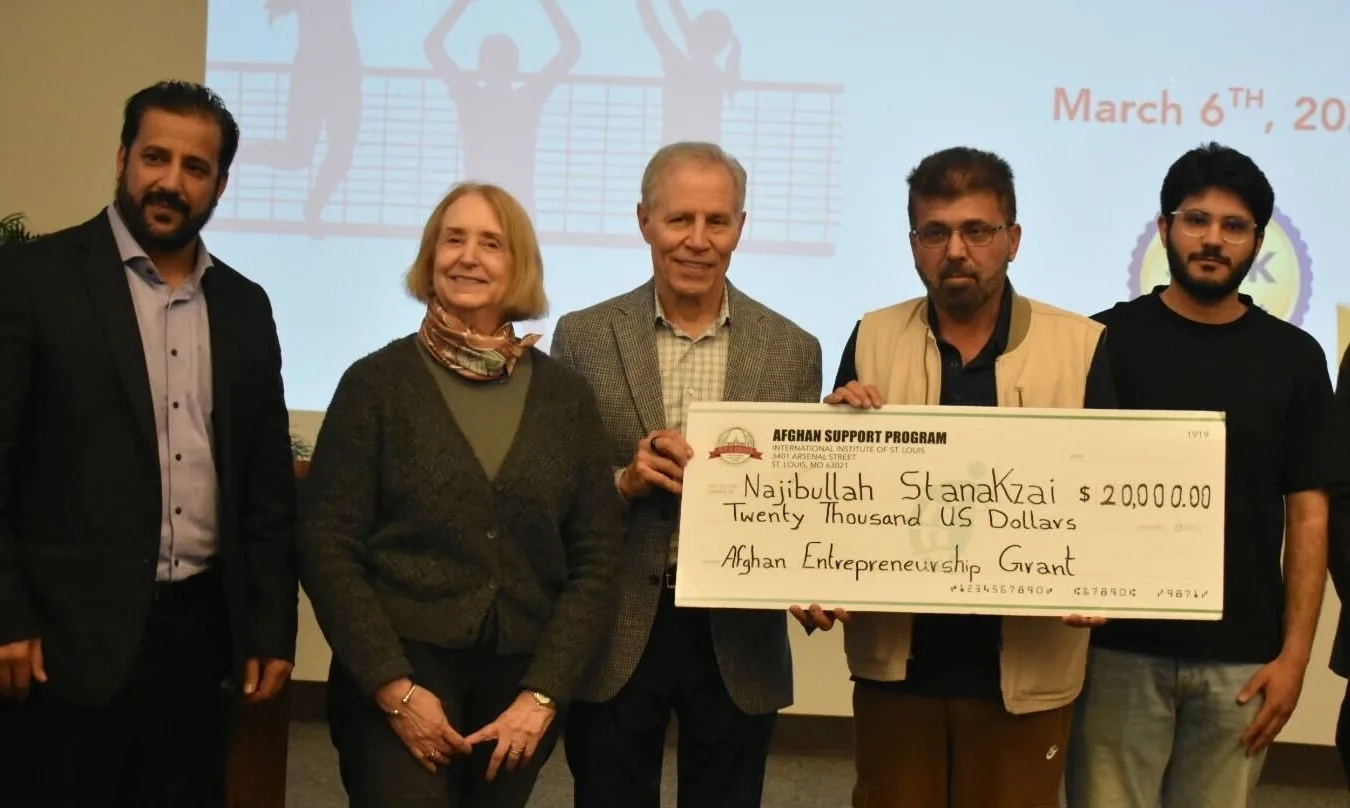
The International Institute of St. Louis commemorated three milestones for the local Afghan community Friday, including the award of a $20,000 grant backed by local philanthropist Jerry Schlichter. The grant will support the Afghan-owned restaurant, Agrippa, set to open in the next two to three months.
Also celebrated Friday was a new cohort’s graduation from the International Institute’s sewing program, aimed at teaching Afghani women skills that could lead to new businesses and create new income streams for immigrant families.
Keep up with local business news and trends
Subscribe to the St. Louis Business newsletter to get the latest insights sent to your inbox every morning.
The Afghan Entrepreneurship Grant was given to Najibullah Stanakzai. His family came to St. Louis around a year ago, said his son Pazhwak, who spoke in English on his father’s behalf. The family first immigrated to Washington state.
“Everything has been a great support and help and has made the resettlement easier for us, refugees and migrants, thank you,” Pazhwak said, translating his father’s remarks into English. The family also thanked the International Institute and other programs for helping them get settled in the U.S.
Now, they’re set to open their Afghan, Turkish, and American fusion restaurant on Manchester Road in Ballwin. The grant, Pazhwak said, will cover one of the more costly aspects of constructing a new restaurant: ventilation.
“The biggest expense a restaurant has is the hood and ductwork, it’s going to go towards that,” he said. “I have enough capital to cover the rest of the equipment, but the vent and the fire suppression system, it costs $15,000 to $20,000, depending on the size.”
That grant program, backed by Schlichter Bogard founder and co-managing partner Jerry Schlichter, has already bolstered businesses across a number of industries including automotive shop Raza Auto Repair, content creation firm Owlsion Pictures, Ferdous Lawn & Landscaping, and others.
The grants have also supported multiple clothing and jewelry companies, including Silk Road Boutique, Zeeb Design, and Asia Lebas Mahal, supporting Afghan entrepreneurs even while allowing others in the community local options for traditional clothing for holidays and events. The clothing stores offer a mix of locally-made and imported garments.
Importing clothing from Afghanistan is often costly, especially when people need them for one-off events, said Hamdullah Hamdard, a one-time grant program recipient and International Institute director of Afghan outreach. Importing heavy textiles that are only worn in Afghanistan can cost upwards of $1,000, he added.
To make it easier for people to make these garments stateside, and potentially spawn new women-owned businesses, the International Institute also has a 12-week sewing course. The idea is that Afghan families in the U.S. can introduce a second income stream. Many Afghan families here operate only on the income of the man, while women focus on childcare. Absent a high-paying job for the breadwinner, that can be unsustainable. The sewing course, which includes education on how to monetize those skills, can lead to further opportunities for entrepreneurship, while also remaining culturally relevant, said International Institute president and CEO Blake Hamilton.
“(We) can help create that sense of familiarity, and also financial independence—we’re not asking you to go become a coder, you’re doing something that you have the skill to do, and now monetizing in a way that improves your families,” Hamilton said. He added that the program has already been “transformative,” and some women have already sold garments to nonprofits and in retail clothing stores.
The International Institute also took time in Friday’s celebration of milestones to commemorate the area’s first Afghan all-girls volleyball team.
Why It Matters: Around 6,000 Afghan immigrants are now living in St. Louis, and the International Institute has worked to support that community by using philanthropic money and local talent to potentially spawn new businesses. That support infrastructure, Schlichter said, is uniquely St. Louis, especially the grant.
“There is nothing like this in America,” he said to the Afghan community Friday. “This is an opportunity to tell your friends (in) other cities [about] the welcome we have here through the International Institute, which is embracing all refugees and all immigrants who come here from other cities.”
The sewing classes also present a potential path to extra income for young families, creating opportunity for upward economic mobility for some of the region’s newest arrivals.
“There are many families where prior to the women enrolling, there was just one earner, maybe in the household, and a large family,” Hamilton said. “Having that added income to connect, to be able to pay all their standard bills and help the family thrive, that’s what all of this is about.”
And by making St. Louis a destination for entrepreneurial Afghans, Schlichter also hopes to boost the region.
What’s Next: The International Institute has carved a pathway through its sewing class to launch multiple new businesses in garment-making and tailoring. Hamdard said the sewing program now has a waitlist; 106 people graduated from it last year, and they plan for a similar number this year.