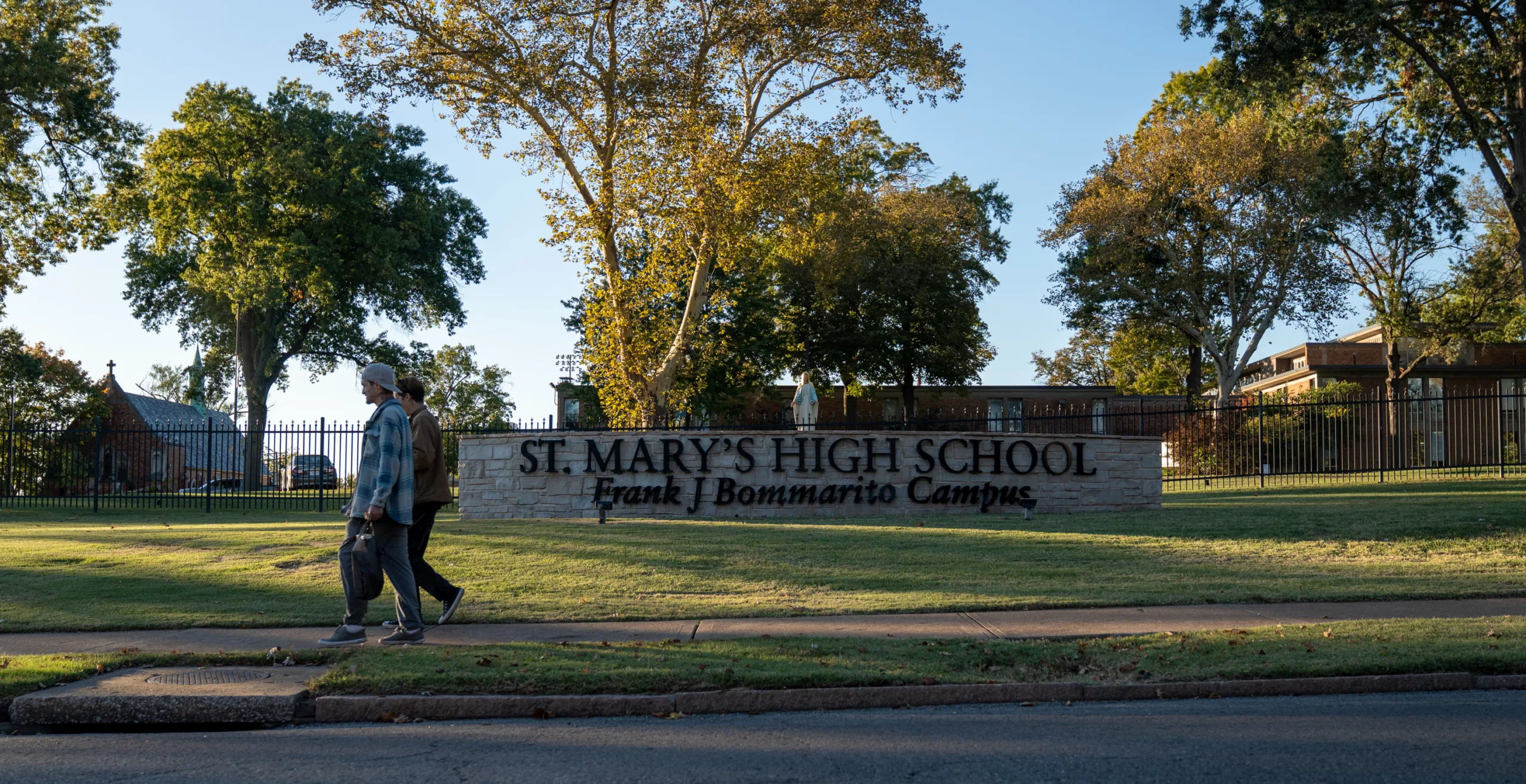
When leaders at St. Mary’s High School needed to act fast to stop the Archdiocese of St. Louis from closing the school, they faced a few obstacles working against them. For one, while the school had a nine-decade history in the community, it had never existed as a standalone entity.
“Ever since we became independent of the archdiocese and formed our own separate 501(c)(3), we call ourselves a 94-year-old startup,” says president Mike England. “We had to start from the beginning. When you’re a startup, you don’t have credit.”
Keep up with local business news and trends
Subscribe to the St. Louis Business newsletter to get the latest insights sent to your inbox every morning.
And they needed money. While the new nonprofit was renting their building from the archdiocese on a three-year lease and raising money for its purchase, the roof over the gym failed. England was quoted $235,000 to fix it—and, as he soon learned, under the terms of the lease, it was the tenant’s responsibility to cover it.
“The realization was that we have to pay $235,000 of our money for something that we don’t own,” England says. “We realized, We’ve got to own the property.”
That might have proven impossible, though, if not for IFF. Originally called the Illinois Facilities Fund, the organization set out to help social services agencies in Chicago finance projects like insulation and ceiling fans—capital improvements that could save money over time, but often couldn’t be paid for by service fees.
After formally incorporating in 1988, IFF has grown to specialize in non-appraisal-based loans for nonprofits, becoming the largest nonprofit Community Development Financial Institution in the Midwest. CDFIs include banks, credit unions, loan funds, microloan funds, and venture capital providers. What they have in common is a focus on helping underserved communities. In IFF’s case, that means taking money that banks, foundations, or well-meaning individuals choose to invest with them, and not only pushing funds into projects that serve the greater good—but also delivering returns back to their investors.
“Over the course of the past 38 years, we’ve lent over $1.6 billion on a non-appraisal basis, and we’ve never lost a single dollar for any of our investors,” says Stephen Westbrooks, executive director of the Southern Region of IFF, which is based in St. Louis, in the Delmar Divine. (St. Louis was actually IFF’s second office, opening in 2006.)
In addition to making loans that aren’t tied to an appraisal—critical for, say, a nonprofit headquartered in North St. Louis, where appraisals are lower than other parts of town—Westbrooks says the organization does its best to work with borrowers. They don’t have operating covenants, like some banks, which can require nonprofits to maintain a certain level of cash on hand, and they work with borrowers who run into cashflow trouble (say, a government contract that is slow to pay up). In that case, says Westbrooks, “It’s like, OK, How can we work with you to maybe restructure the loan, or hit pause on the loan, or make it interest only for a period of time while you work through those challenges?”
He adds, “We really tried to simplify the loan product or platform that we have, to make it as easy as possible for nonprofits to focus on their mission. It’s really designed to be really flexible for the nonprofits that access this capital.”
After contemplating the cost of fixing St. Mary’s gym roof, in early 2025, England got connected to IFF by Neal Richardson, then head of the St. Louis Development Corporation. It only took a few months to obtain a $1 million loan, which allowed the school to buy its own building, establish independence, and raise the money it needed to ensure its future.
St. Mary’s purchased its property from the archdiocese in July 2025. England says that was critical not just for its independence, but its future success. “Leading up to this, there were still people that had doubts whether we could make it,” he says. “So this was a huge, huge step forward for us.”
England adds he especially appreciated how IFF demonstrated they understood St. Mary’s goals. “They wanted to financially support that mission and work, and they could understand why this was important to us to get done,” He says. “They’ve been a partner in this.”
For Westbrooks and his colleagues, that’s just another day on the job. They’ve worked to become the go-to lender for worthy organizations that need help at the spot where facilities meet finance. “We may lend $150 to $180 million across the Midwest,” he notes. “But our goal that we talk about internally is not to do $150 or $180 million. We just want to help as many nonprofits as possible.”
Editor’s note: A previous version of this story included inaccurate timeline info. IFF’s initial involvement began in early 2025, not 2023. We regret the error.