By the time Tuesday’s Franklin County Planning and Zoning Commission kicked off, it was standing room only. Despite folding chairs shoehorned into the commission chambers, many dozens of residents spilled into the hallway and a nearby room, where they watched a slightly delayed livestream. That alone drew more than 600 viewers at various points in an evening that was long, contentious, and made clear just how much animosity data center developments face in Franklin County, and especially a project proposed for 600 acres adjacent to Shaw Nature Reserve.
Testimony against the proposal continued for four hours, with just about every comment negative towards that proposal and data centers in general. At times, testimony was met with a chorus of boos or cheers from the live audience, with similar reactions following about 30 seconds later from those watching the livestream down the hall.
Keep up with local business news and trends
Subscribe to the St. Louis Business newsletter to get the latest insights sent to your inbox every morning.
Ultimately, commissioners decided to table considering any data center regulations for at least six months.
In addition to the regulations, the commission was also considering both a pair of rezoning requests to facilitate a new data center development (39.1 acres owned by Diamond 66 LLC and 574.3 owned by Diamond Farms LLC, both directly southwest of I-44), which were also tabled after the commission punted on recommending any new regulations for such projects.
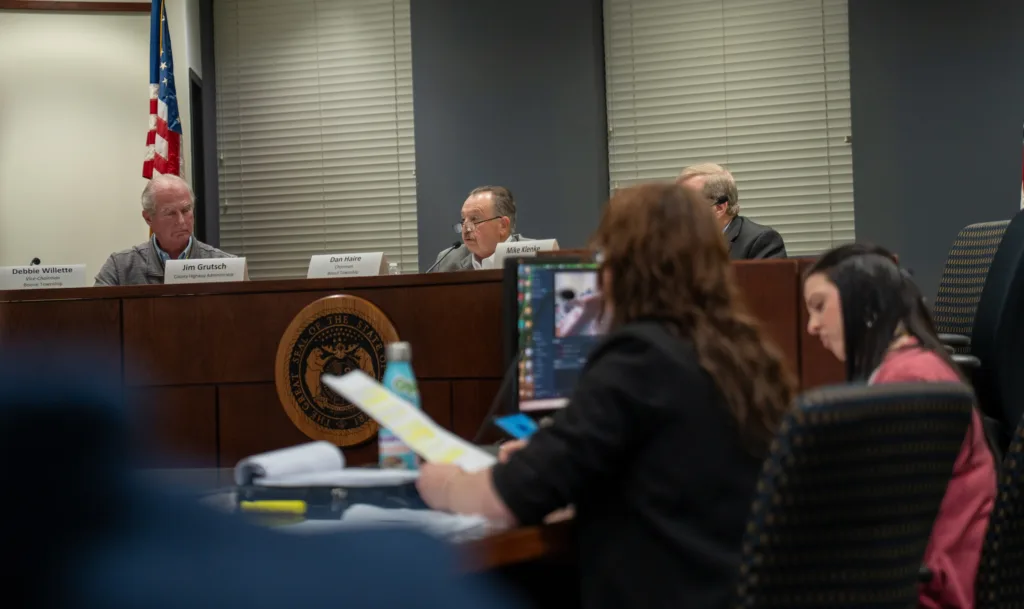
The meeting was tense from the beginning—and so long that the commission took multiple breaks to allow more people into the room and twice to restart its livestream. At times the commissioners appeared outmatched by the size of the crowd, with chairman Dan Haire repeatedly asking for people to curb their outbursts.
“You may not agree, but give the people the opportunity to state their opinion,” he said during testimony in support of the county’s proposed data center regulations.
Those included a minimum 400-foot setback of all buildings, equipment, and accessory structures from property lines, which increases to 1,000 feet for data centers next to areas broadly zoned for residential housing, public parks, agriculture, and a few other similar uses, which is the case for the acreage owned by Diamond Farms LLC. The county also wants to limit how much sound any data center could emit, a maximum of 60 decibels between 7 a.m. and 10 p.m. and 50 decibels all other hours as measured from the property line of the site.
Mark Baxa, a resident of Desloge Estates directly south of the Diamond Farms property, took issue with the setback distances and the proposed sound levels, which, under the county’s proposed rules, would only be studied and measured once every three years.
“When data centers surge they can very easily go to 100 decibels. You have to protect us now,” Baxa said, suggesting the county require noise studies every three months rather than years.
Others agreed with this sentiment. Sherman Smith testified that the two-and-a-half decades he spent working in data centers caused the loss of his hearing. “Do you think that low hum doesn’t do anything to you consistently?” he asked.
Cameron Scholden made a similar argument, pointing out that 60 decibels may be comparable to human speech.
“Personally, if I were having a barbecue in my backyard and there was a constant drone at the volume that I’m speaking, that wouldn’t make me happy,” he said. “I don’t think that restriction is set low enough.”
Scholden punctuated one of the other key tensions attached to this specific proposal: its location directly next to the Missouri Botanical Garden’s Shaw Nature Reserve.
“I also think that data center locations should be, broadly speaking, not placed near commonly public open spaces,” he said. “I don’t think that’s conducive to the environment. There’s plenty of industrial parks in the county already where something like this would not be nearly as obstructive.”
And Patricia Schuba noted how the proposed zoning regulations, if passed, would apply to the whole county, a risk she contended the commission shouldn’t take.
“If you’re going to propose it, make it a conditional use permit. But you clearly said this is a permitted use,” she said. “Once you agree on whatever your regulations are, this company, another company can come in and say, ‘We want this site,’ click on the requirements that you’ve agreed on, and then that’s applied to every site across Franklin County. We all know different plots of land have different characteristics.”
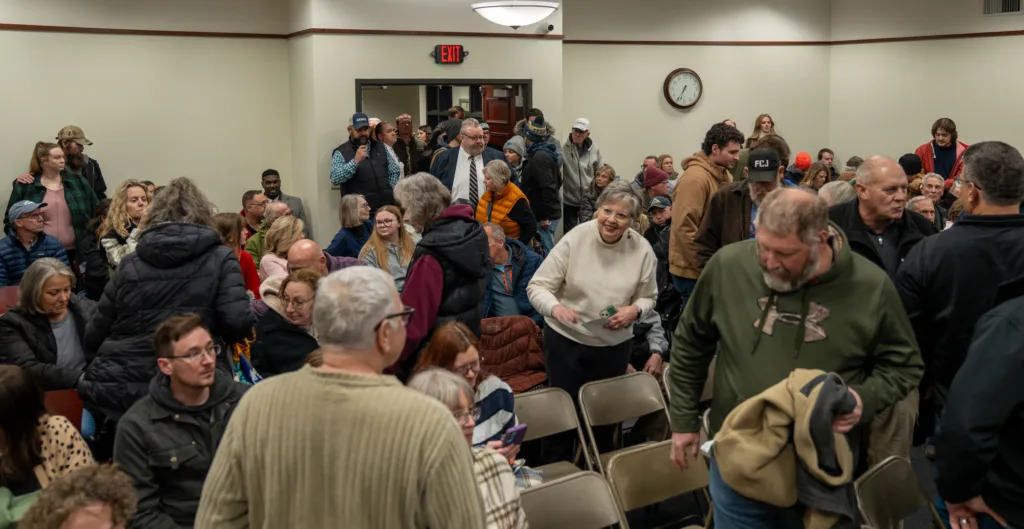
The overwhelming majority of those in attendance who spoke were opposed to a data center coming to their community, and shared concerns expressed by residents in other area communities about potential data center developments: their water and power use, the potential for air pollution from onsite backup generators, and grid reliability. Other sticking points included how little notice they’d gotten about Tuesday’s meeting and the potential development. Many said it was only a few days.
“It was only by accident that I heard about this. I don’t care what the law says you have to do, it’s what you should do,” testified Nancy Wood to a chorus of cheers. “If people are going hush-hush about stuff, it’s because they’re doing stuff that they shouldn’t do. Based on that, I can only surmise that you know nobody’s gonna like this, and it isn’t right.”
There were a few voices in favor. One of the more notable speakers was Leon Backes, the Chairman/CEO and founder of Texas-based Provident Realty Advisors, a data center developer whose portfolio lists Missouri among its operating places. Other speakers with positive feelings included those representing labor unions and touting the potential construction jobs these facilities would bring.
Some of the most robust applause came following comments from Tim O’Connell, an attorney with the Bryan Cave Leighton Paisner, who appeared on behalf of the Missouri Botanical Garden and Shaw Nature Reserve. O’Connell thanked the planning staff for the effort they put forward in developing restrictions and regulations, but asked that the commission hold off from making any decisions until a future meeting.
“To that end, we have a number of additional specific protections that we think are warranted in Franklin County general regulations, and we ask this commission to support consideration of that again by staying action till a future meeting,” he said.
After more four hours of public testimony, the commissioners first considered tabling the proposal for a month before realizing they needed more time. Vice chairman Debbie Willette suggested following St. Charles’ lead and enacting a year’s moratorium, to much applause.
But after the members were told that, legally, they couldn’t recommend a one-year moratorium without triggering the need for a new public hearing, the commissioners instead voted unanimously to table the proposal for six months.
Immediately following that, the commissioners were poised to consider the two rezoning requests. But attorney David Baylard, who was representing the applicants, said that six-month pause on data center regulations made the rezoning request moot. He asked the commission to table the requests for six months, making clear he was not withdrawing them, and they agreed.
A rally beforehand
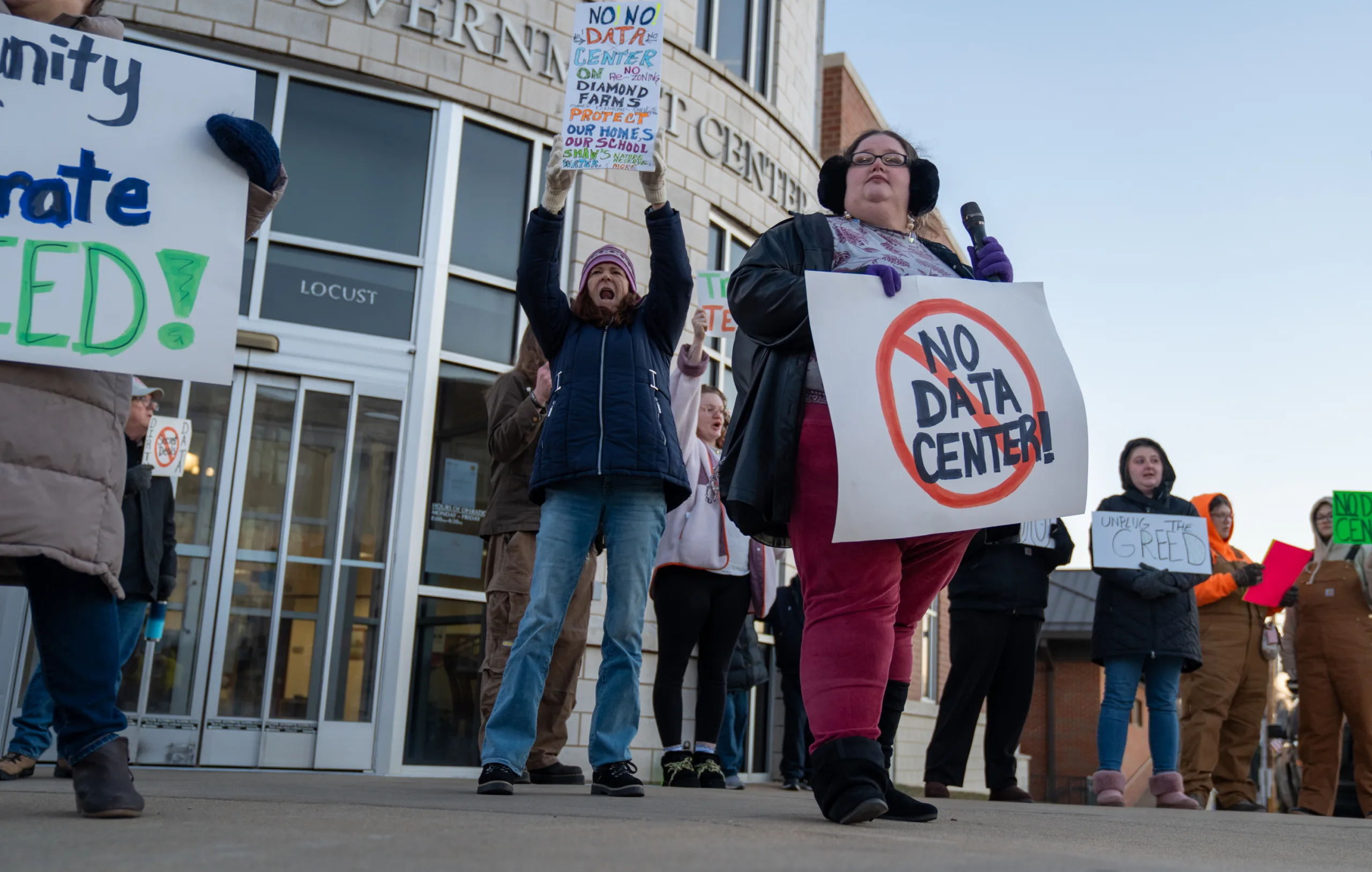
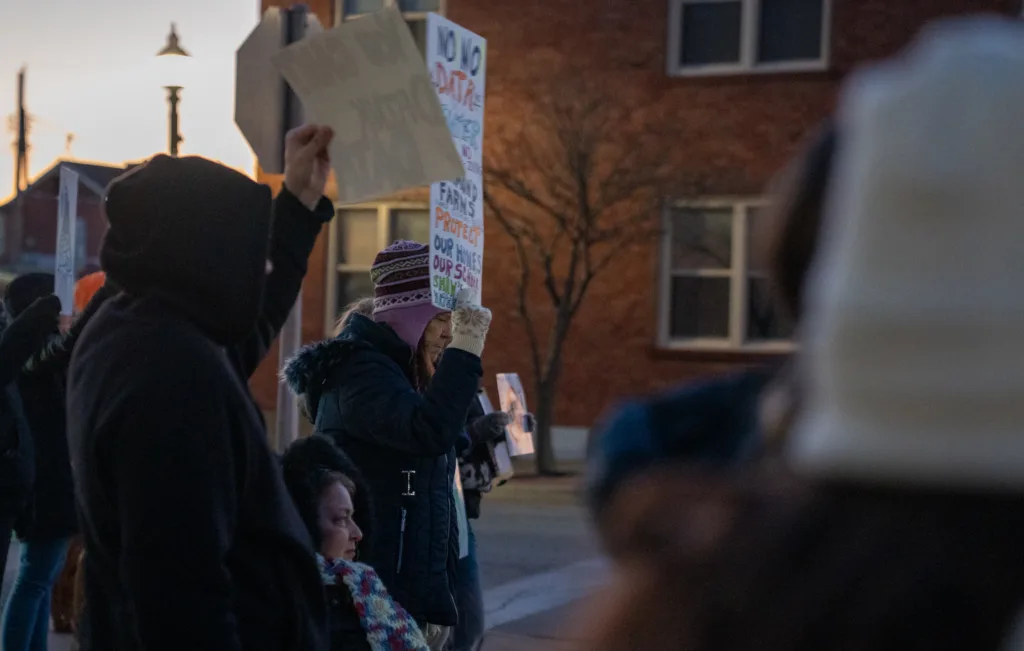
In the hours before the meeting room opened, a steady trickle of people joined a planned protest against the data center staged outside the Franklin County Government Building. The crowd armed with homemade signs grew from a few dozen people to more than 100, even as the sun slipped behind the horizon and temperatures dropped.
Amid chants of “the earth is not your hard drive” and “save Shaw Nature Reserve,” several cars passed, honking their support, while other drivers waved or gave enthusiastic thumbs-up gestures.
Tasha Smith, who organized the protest, remarked it was a “good turnout for the amount of time we had to prepare.” Adds Smith: “It shows our community comes together when there’s something like this we care about.”
Many who joined in the public demonstration ahead of the Planning and Zoning Commission meeting shared concerns with those who later spoke at the meeting. Some took issue with the planned development of rural land, parcels that data center developers are increasingly eyeing for developments.
“Rural areas are where people go for quiet. It doesn’t need to be here,” says Sierra Enloe, who took turns leading the growing crowd in chants outside the Franklin County Government Center.
Adds Beccah Meyer: “We don’t want to turn this area into a metropolis like St. Louis or New York. That’s the whole reason we live out here.”