The way Connie Bowen sees it, the most enduring and thorny challenge in the world of agriculture is labor.
“We’ve yet to figure out how to actually affordably feed the world in a way that doesn’t exploit anyone and in a way that’s sustainable for farmers and farm operations,” she says.
Keep up with local business news and trends
Subscribe to the St. Louis Business newsletter to get the latest insights sent to your inbox every morning.
As such, Bowen has organized the investment fund she founded in St. Louis almost five years ago, Farmhand Ventures, to focus on identifying and betting on startups pursuing innovation that tackles these challenges. She’s determined to find solutions that work for all parts of a farming operation, from farmer to farmworker, and that recognize how difficult it is to find and retain solid workers.
“Oftentimes in agtech, products have required additional labor inputs. That’s not scalable. Period,” she says. “We really look for founders who understand from the jump that they need to be integrating products into farm operations.”
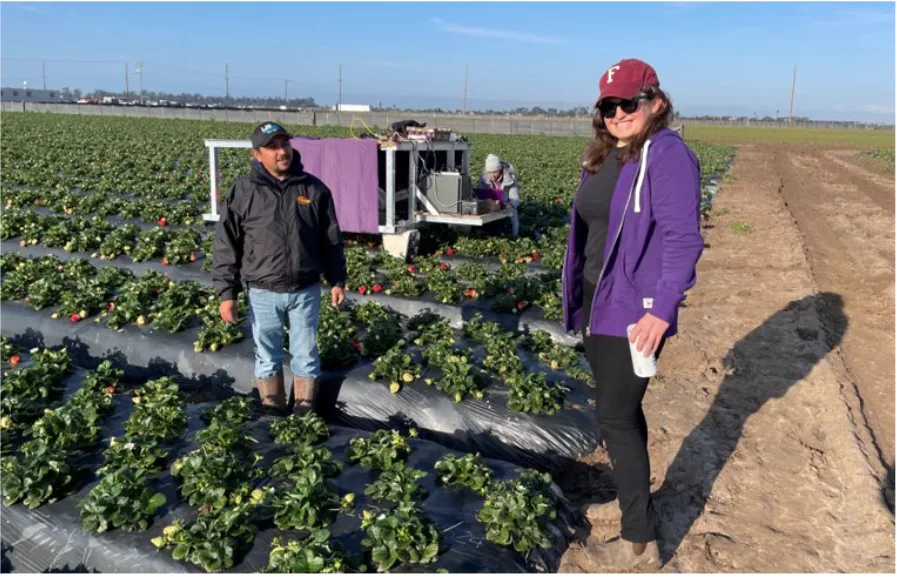
To this end, Farmhand Ventures’ portfolio includes a company developing AI-powered robots that can selectively harvest strawberries and one pursuing an AI-enabled platform that helps vineyards better optimize their operations. The local agtech firm also has stakes in a company developing industrial hemp seed genetics, as well as one behind an alternative to swine castration.
“To be clear, when I say I’m looking at labor, I believe there will be people working in agriculture for a very long time to come,” Bowen explains. “I’m interested in automation, but collaborative automation. And I’m interested in solutions that enable farms to retain top talent and that enables socioeconomic mobility for farmworkers.”
She says it’s imperative to make work in agriculture “really attractive,” a departure from today where the industry continues “bleeding talent throughout the whole system.” The recent bouts of extreme heat and humidity in the Midwest and South underscore this point.
“If you just want to go pure economics, that’s a bigger disruptor to agricultural productivity—the impact on the ability of people to do work outside without dying—than the impact of climate change on crop yield,” Bowen says. “And we don’t talk about it at all.”
A native of New Jersey, Bowen found her way into St. Louis and the world of agtech investing via a Venture for America fellowship a decade ago, which gave way to stints at Cultivation Capital, The Yield Lab, and a few other venture organizations in the Midwest. In that time, she got well acquainted with a common theme in the industry, that agtech struggles to attract meaningful investment in the way other industries do.
Part of that, she says, comes down to how fragmented the agricultural landscape is and how little exposure people with innovative ideas have to these complexities.
“Blueberry production in Oregon is totally different than blueberry production in Florida [and] totally different than blueberry production in Peru. Let alone saying, ‘I can do something in blueberries and cherries,’” Bowen says. “There’s just so much diversity that you need to design for in many parts of agtech that you run into real troubles if you try to do everything all at once.”
But she believes Farmhand Ventures is up to the task of cracking the code to agtech investing by specifically building out its portfolio with startups developing technology that will solve on-farm challenges around climate, sustainability, nutrition, or others.
“At the end of the day, the thing that actually matters when you’re investing is dollars back and multiples on dollars back,” Bowen says. “It’s, ‘I gave you $1. Are you going to give me more than $3 back at the end of 10 to 15 years?’ And if it’s high risk, then you better give me a higher multiple on that.’”
The firm recently put out a call to hire a full-time employee to enhance the firm’s operations, as Bowen has previously only had part-time operational partners and associates.
While Farmhand Ventures also has a presence in California, running field days in collaboration with the University of California Agriculture and Natural Resources where young companies can show off their technology and generate sales and new relationships, Bowen says she has plans to do similar events in the Midwest. Given St. Louis’ concentration of agricultural industry expertise, she believes keeping the firm based here is essential.
“St. Louis has a lot of advantages for building an agtech firm,” she says. “I’m not gonna force any company to be here, but I will make them aware of all of the resources that are available.”
To that end, Bowen says she’s exploring how to relocate one of the companies in her firm’s portfolio to Missouri.