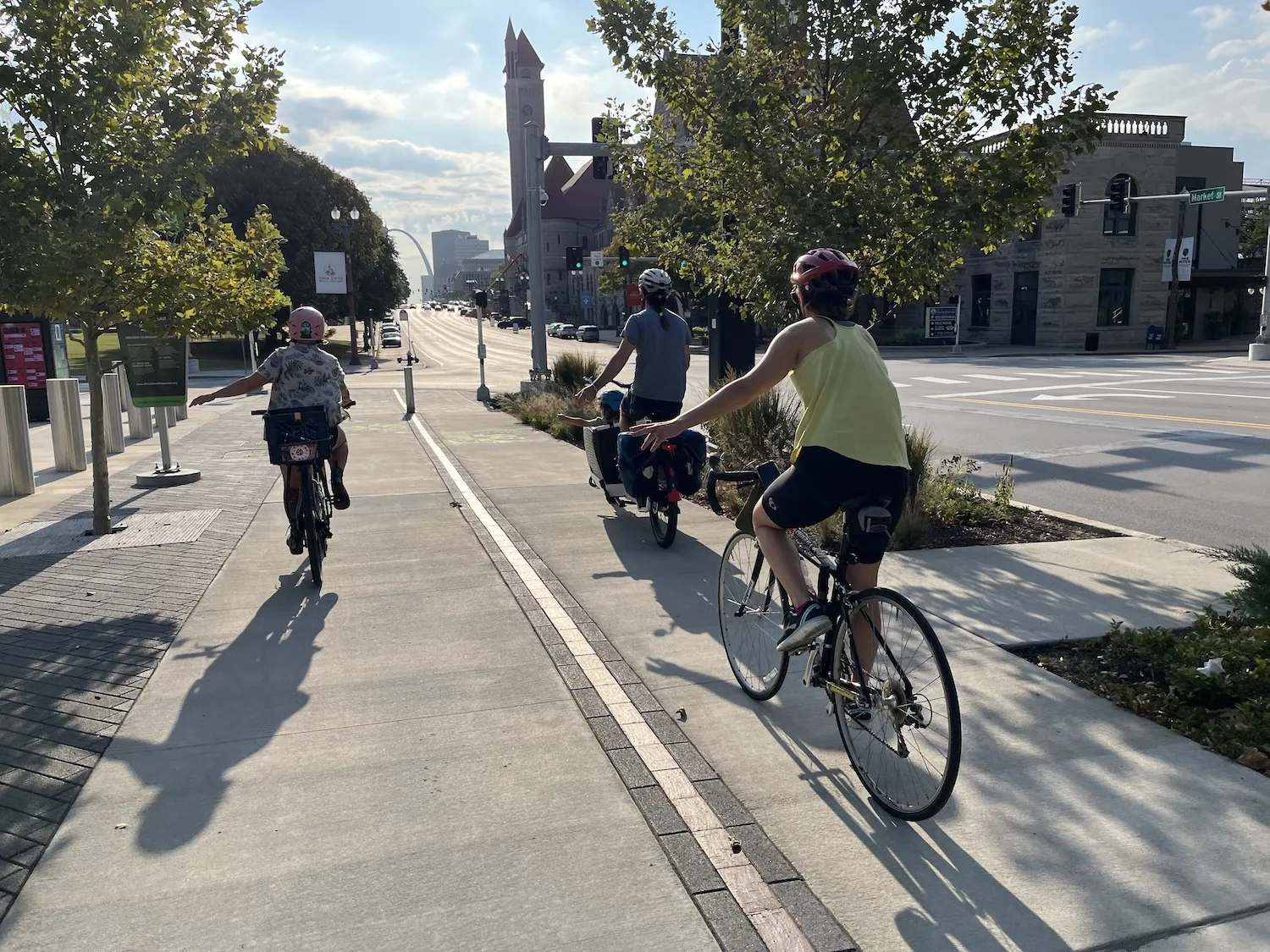
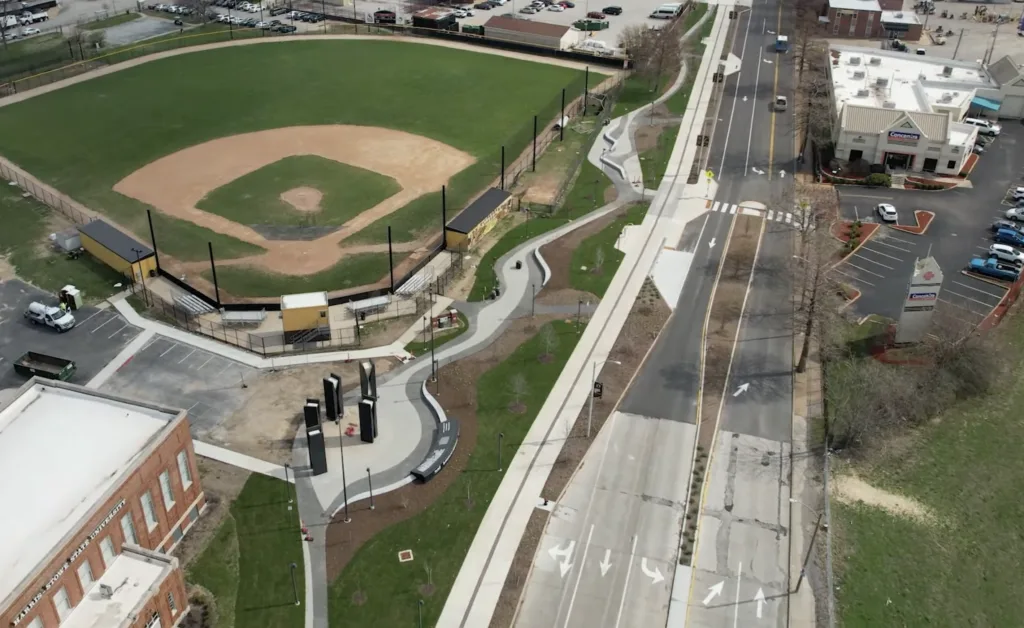
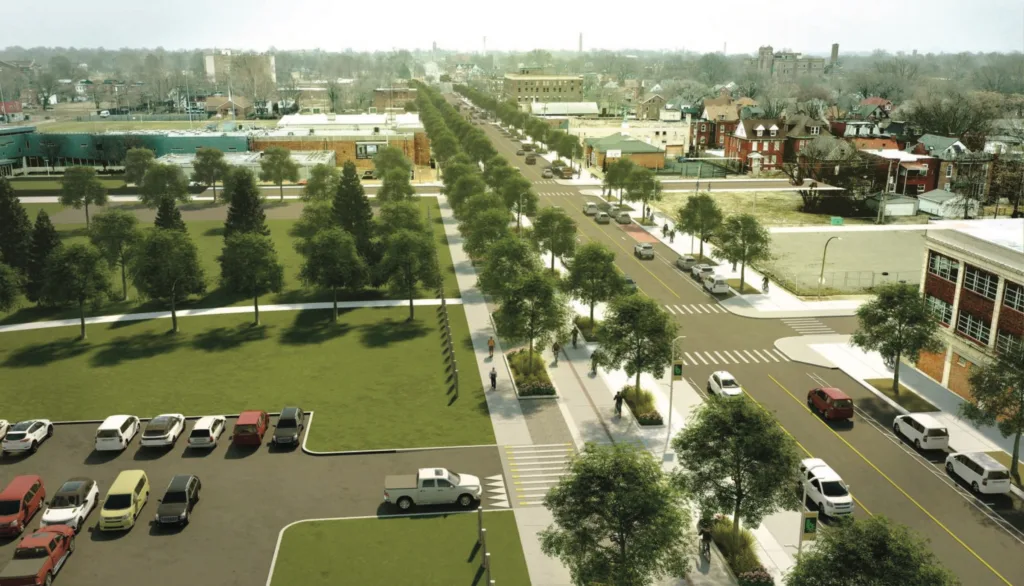
Last month, Great Rivers Greenway officially opened one of the first major segments of the much anticipated Brickline Greenway, the massive $245 million project to connect Forest Park to the Arch Grounds and Tower Grove Park to Fairground Park with bike and pedestrian paths.
Front of mind for leaders of the project is its potential to drive sustained economic transformation in parts of North St. Louis that badly need it. In that regard, the Brickline follows in the footsteps of projects in other cities that are further along, both looking to replicate their successes as well as avoid the mistakes they made.
Keep up with local business news and trends
Subscribe to the St. Louis Business newsletter to get the latest insights sent to your inbox every morning.
And the early indicators are strong.
“You’re doing all this learning right so you don’t make the mistakes that the rest of us have,” says Rachel Frierson, chief operating officer of the Detroit Riverfront Conservancy, which operates and maintains Detroit’s riverfront, as well as three greenways.
That learning has taken local leaders here to Atlanta to study its Beltline, and specifically challenges around affordability and displacement, which was an unintended outcome in some predominantly Black and lower-income neighborhoods in Atlanta as a result of the project, says Kelvin Collins, vice president of economic development with the Atlanta Beltline.
“I acknowledge that the Atlanta Beltline has learned a number of lessons along the way,” he says. “The Brickline is very curious about what those are, and that level of curiosity will provide the best practices to accelerate their investment and will allow them to sidestep some of those challenges.”
These kinds of large scale infrastructure projects have the power to drive private investments once they’re complete. In Atlanta, Collins says, the city has seen $14 billion in private sector investment catalyzed by the Beltline.
“We can shout to the rooftops with that, but if it doesn’t create value for local residents and small businesses, and bringing that investment into historically disinvested areas, then it’s all for nothing,” he adds.
When the initial results of the project started bringing in private investment, Collins says his organization had to course correct to manage its success and prioritize job and small business growth in lower income communities. They also adjusted the construction timeline, moving up parts of the city that were historically under-invested in, after initially launching elsewhere.
He says they’re intent on ensuring that the growth catalyzed by the Beltline is balanced and allows current residents to benefit from the new jobs created and small businesses that may form as a result.
“Communities want to benefit from the amenity, but don’t want to be kicked out. It’s just a human condition,” he says. “The quality of life [improvement] should also be for those who have lived there, and have suffered through disinvestment, and have suffered through lack of amenities. You must put strategies in place to protect residents of those communities. It’s not going to organically happen.”
He sees his St. Louis counterparts as being in a much better position to proactively manage what may come, given the local organization has already established a community development corporation. The new Brickline North Community Development Corporation received its 501(c)(3) nonprofit designation last year, allowing it to acquire property and work towards other development priorities.
Frierson also praises GRG for creating that structure early on. “They can hold onto [property with] the [community development corporation], hold on to the value, and then later, when a neighbor wants to do something, their barrier to entry is much lower, or nonexistent at all,” she says.
After property values start to rise, money to acquire won’t go as far, says Scott Kratz, president and CEO of Building Bridges Across the River in Washington, D.C. His organization is leading the transformation of an old freeway into a new public park.
“Once that property appreciation flywheel really starts to take off, it’s going to move much faster than nonprofits or even the city can respond to it,” he says. “Understanding early about where there might be some real key parcels to acquire where you can be a little bit more masters of your own destiny.”
Kratz, Collins, and Frierson also agree that GRG putting the North Grand Boulevard part of the Brickline at the front of the queue helps strengthen trust within the community that the project will actually deliver results for North St. Louis.
“For a long time we asked communities that have gotten less investment to be the ones to stick it out and that things will get better, things will reach them, eventually,” Frierson says. “Starting a project that can be transformative in those communities actually signals to them, ‘Hey, we are here for you.”
Collins adds that this is an area where the Beltline initially fell short, having piloted a section of their greenway in more affluent parts of the city in eastern Atlanta, before shifting to prioritize western neighborhoods that were skeptical the Beltline would reach their side of town.

Once more Brickline segments start to connect, Collins says there’s opportunity to use the Brickline to positively define St. Louis’ image.
“That Market Street trail segment that recently opened up was done to perfection,” he says. “It’s beautifully designed: the quality of infrastructure, the artwork. All of that is telling me that there’s something special here that could be packaged and marketed that there’s vibrancy happening. There’s an energy happening along the Brickline.”
That looks like strong branding and marketing to extend the reach of the greenway to places that may seem unconventional. The Beltline, for example, has agreements with global airport concession operators, such as Hudson Group to open a Beltline-branded retail store, which advertises the project in front of the millions of people who pass through Atlanta’s airport.
“They are paying us a royalty fee to use the Beltline’s brand,” he says of Hudson Group. “So that’s an example of a revenue generating opportunity for the Brickline or GRG to consider. Beltline also got a chance to bring along small businesses that are located along the trail into those stores to sell their products, giving them access to foot traffic, to a customer base that they would not have easily had access to elsewhere.”


