Last week, the Board of Aldermen passed a resolution to convert the city to clean energy by 2035.
St. Louisans looking to reduce their personal contribution to climate change are already taking small, simple steps to lighten their carbon load: hopping on a bike, shopping local, or cutting consumption. But in light of potential budget cuts at the national level and recent natural disasters across the country, some local environmental groups and citizens continue to advocate for larger-scale changes across the board.
Ed Smith, policy director at the Missouri Coalition for the Environment, and Andy Knott, senior campaign representative at the Sierra Club Missouri Chapter shared some practical actions St. Louisans are taking to encourage renewable energy systems and sustainable technology in the St. Louis region.
1. Paying attention to Resolution 124
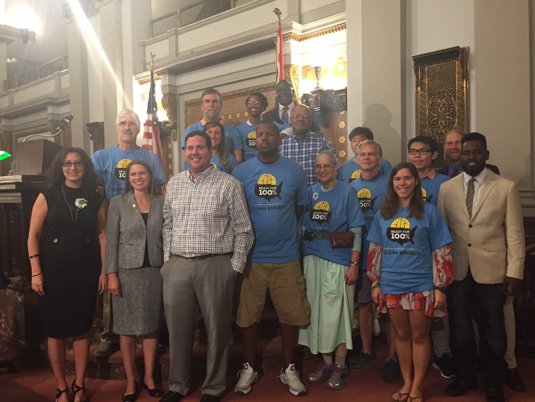
Last month, Lewis Reed, president of the Board of Aldermen, introduced Resolution 124, a call for “100 percent clean energy in the form of wind and solar and energy efficiency measures within the electricity sector by 2035.” An educational hearing occurred on October 19, after which the board of aldermen unanimously passed the resolution. This means the city will begin turning away from fossil fuels, and city officials are beginning to meet with outside groups to develop a plan for the next few decades.
2. Pushing updated building codes in St. Louis
“Locally, St. Louis County has done a poor job of updating building codes,” says Smith. “Strong building codes mean that new buildings will be built as energy efficiently as possible, which reduces the amount of energy needed to heat and power a building over its lifetime. Buildings are one of the largest users of electricity.” According to the U.S. Environmental Protection Agency, residences account for 37 percent of all electric use. St. Louisans can weatherize their own home or apartment. But, adds Smith, environmental groups want the county and city to adopt the latest International Energy Conservation Code guidelines “without weakening amendments.”
3. Voting for “green” policies in local and national elections
The EPA has recently proposed to repeal the Clean Power Plan, which would have been the first national plan to reduce greenhouse gas emissions from our electric sector. Missourians who want to focus on reducing emissions locally, says Smith, are voting for candidates ranging from the city council to the United States Senate who want to address climate change. Smith urges citizens to become educated about their candidate’s emphasis on carbon reduction goals before heading to the polls.
4. Eating a vegetarian diet
Agriculture is one of the leading contributors of greenhouse gas emissions, but meat production releases the most emissions of all. A 2010 National Geographic report found that the production of one pound of beef requires 1,857 gallons of water. In 2014, Datafiniti reported St. Louis had a low number of vegetarian restaurants compared to other metros. But since then, many new restaurants have opened, and others have begun offering robust vegetarian options. To lower emissions at home and at restaurants, some St. Louisans are sticking to grass-fed and pasture-raised livestock, according to the 2014 St. Louis Regional Food Study; LocalHarvest is also a great resource for finding CSAs and connecting with local growers within the St. Louis region.
5. Lobbying for the Mayors for Clean Energy pledge
The Mayors for Clean Energy pledge is a nationwide push to get mayors to commit to support a transition to 100 percent clean and renewable energy. In our region, the mayors of Chesterfield, Dellwood, Florissant, Maplewood, St. Peters, University City, and Wentzville have signed on so far—but the advocacy groups like the Sierra Club Missouri Chapter is pushing for city residents to contact Mayor Lyda Krewson to commit to the pledge.
Krewson already made a pledge to uphold the goals of the Paris agreement on climate change as a member of Climate Mayors. President Trump is currently in negotiations to withdraw the United States from the Paris deal—a move which some advocacy organizations say amplifies the call for St. Louis residents to push for climate change polices on a local level.
6. Evaluating energy usage at home
Energy efficient practices are one of the safest, cleanest, and cheapest ways to reduce greenhouse gas emissions. Locals can use tax and rebate incentives available from utility companies to update home systems in ways that decrease their utility bills. Ameren offers some rebates for replacing air conditioners and heat pumps, for instance.
Property Assessed Clean Energy is now available in the St. Louis region for residential and commercial building owners. Smith recommends the following resources for achieving a lower utility bill: Set the PACE, Show Me PACE, MO Clean Energy District, Ameren Missouri Business & Residential Energy Efficiency Programs, and Spire Gas Business & Residential Rebates. Energy is also conserved with energy efficient light bulbs, a programmable thermostat, and by flipping the lights off when you’re not at home.
Just last week, the NAACP released a report on Missouri’s energy sector and recommendations for how to reduce greenhouse gases.