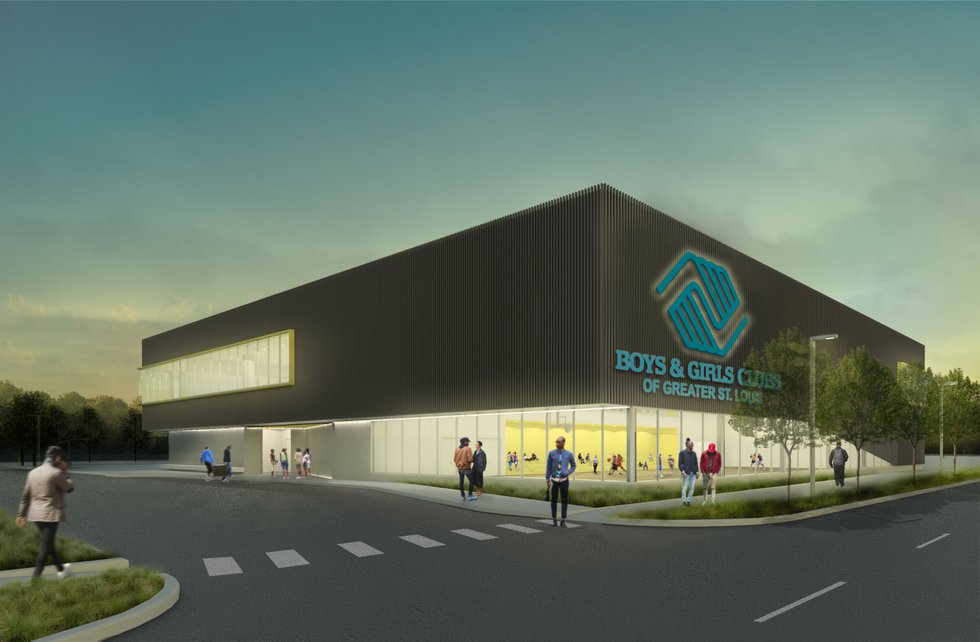
When the Boys & Girls Clubs of Greater St. Louis asked the youth involved in its programs what amenities they would want in the nonprofit’s new Teen Center of Excellence in Ferguson, the answers were both as simple and complex as you’d expect from humans transitioning into adulthood. They wanted a new gym at the $12.4 million, 26,856-square-foot facility. But the survey also revealed that teenagers want a safe place to hang out. They want to learn about careers. They want to see their friends and interact with adults. And they want to stay physically active—and that’s where the gym comes in. “When we looked at the plans, and realized we needed to scale back, they wanted to cut the gym—but that was the top request,” said Flint Fowler, Boys & Girls Clubs of Greater St. Louis president.
On Thursday, the club will break ground on the Center of Excellence. It’s going to have the gym, and also music and art studios, a garden, a kitchen, an auditorium, and an innovation center. But what Fowler is most excited about is the Intellectual Commons, the space where kids can lounge, do their homework, and catch up with friends. “There are times when we might pose a question, and we might have a debate,” Fowler said. “To me, that’s pretty exciting.”
Get a fresh take on the day’s top news
Subscribe to the St. Louis Daily newsletter for a smart, succinct guide to local news from award-winning journalists Sarah Fenske and Ryan Krull.
In planning the center, the Boys & Girls Clubs sought input from thought leaders in the military, law enforcement, and health care—including Express Scripts—in addition to the teens. They wanted to determine how the center might provide leadership and civic engagement; opportunities for STEAM (STEM plus Arts); a role in health in wellness, not only physical fitness but social, emotional, and mental well-being; and education and workforce development. The biggest challenge of planning the center (outside of raising money)? “It’s always important that you be in touch with people in the community, that people are committed to how you would fit in, so to speak,” Fowler said. “Our goal is not to displace anyone, but to supplement.”
The center is scheduled to open for the 2019-2020 academic year. The year 2019 will mark the five-year anniversary of Michael Brown’s death. Brown was a Ferguson teen shot and killed by Police Officer Darren Wilson in August 2014. Immediately following his death, the Ferguson community broke out in a series of demonstrations protesting police brutality, and three months later, a grand jury decided not to indict Wilson. That the center is set to open in 2019 is significant to Fowler. “It’s interesting that people always look for physical change as a measure of progress,” he says. “I’m excited we’re going to have a physical change. We have programs, but they’re in already-existing schools.
“We’re letting people know that change might not be as fast as you like, but that doesn’t mean that it’s not in progress.”