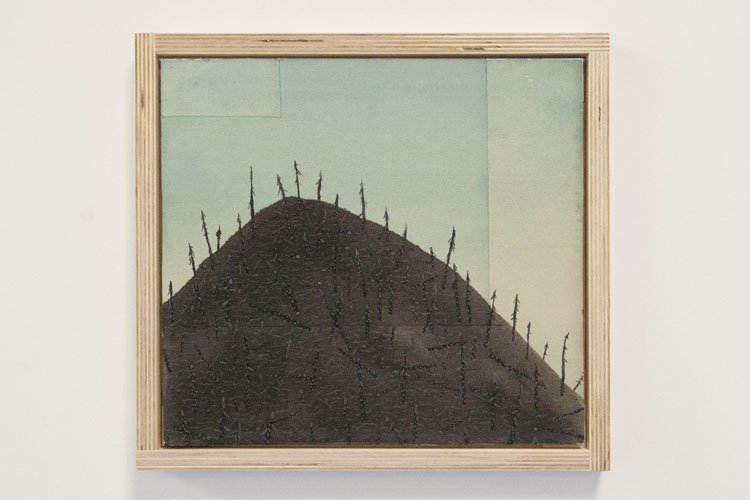
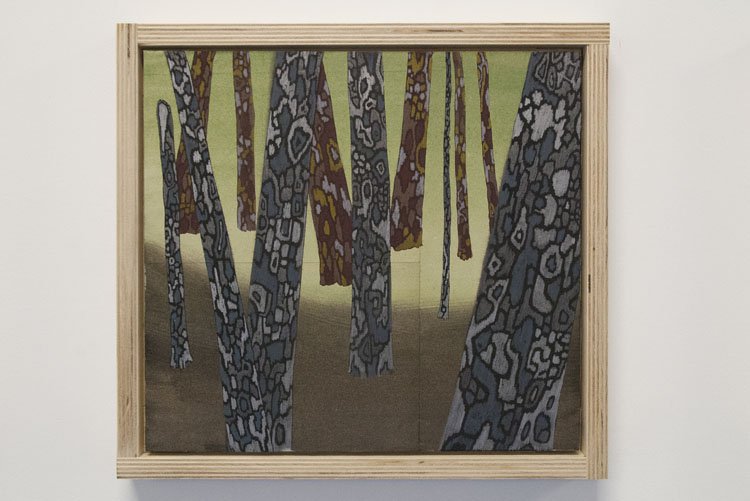
Tom Reed’s solo exhibit at Museum Blue, the in-between, combines sculptural components, mixed media drawings, and sound—transforming the gallery into a make-believe flooded valley. Taking inspiration from transitional moments like floods—as well as dusk and dawn—Reed constructs an invented environment that looks like a scene from one of his drawings. In both his drawings and installation, there is a playful exploration of materials and imagery, and a bricoleur’s sense of thrift.
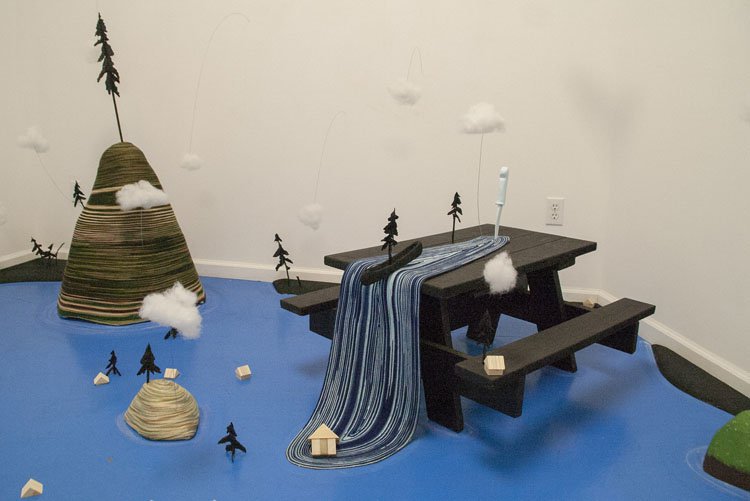
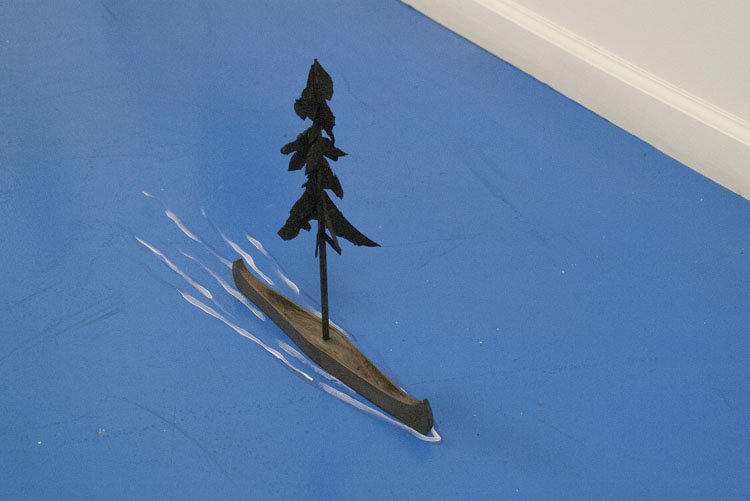
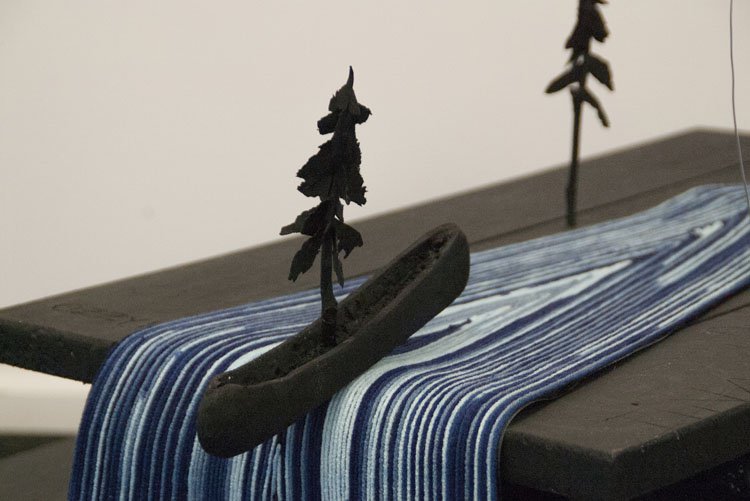
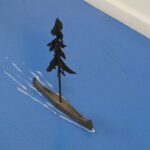
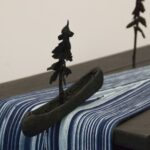
By the entrance, a child-size picnic table sits in a corner; made from foamcore and painted black, the table’s surface is inscribed with faux woodgrain and generic graffiti—sweethearts’ initials enclosed by a heart, a penis, a sword. Embedded in the table top, a carved foamcore knife stands on end, point down. While the table looks believable as an actual table, the knife is left unpainted, and there is no attempt to disguise its artifice. Unadorned, the commonplace object affects light-hearted poignancy; because of its material, the pathetic Excalibur is too fragile to cause harm and induces sympathetic humor rather than menace. The interaction of these two objects is the cause of the imaginary flood that seeps through the rest of the space. Starting beneath the the point of the knife, a sheet of mylar (cut into an irregular ellipse and covered in blue, variegated yarn) is draped across the table and cascades onto the floor. A miniature canoe teeters at the table’s edge, about to be swept away by the yarn waterfall.
Stay up-to-date with the local arts scene
Subscribe to the weekly St. Louis Arts+Culture newsletter to discover must-attend art exhibits, performances, festivals, and more.
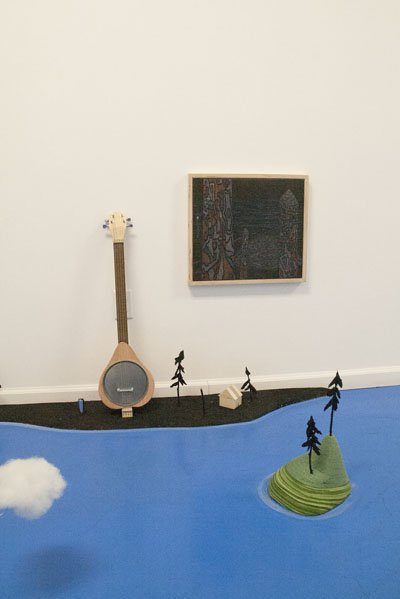
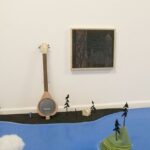
Utilizing the gallery’s prominent blue floor, Reed re-imagines it as a rising flood, painting water rings around objects placed directly on the floor. Small houses made from wood scraps are flanked by landmasses covered in winding skeins of yarn. The houses look submerged; a lucky few are placed on higher ground. Foam core banks hug the gallery’s baseboard, usually in odd corners, and are dotted with trees made from thin dowels, twigs, and foam core shavings; painted black, they look like remnants from a recent forest fire. On one shore, an instrument constructed by Reed, Gourdjo (2014), leans against the wall and elicits the presence of a person no longer there. A looped recording of the artist playing the instrument emanates from a nearby hilltop, and resonates throughout the installation. Played with a slide, the plaintive song is slow and repetitive, like the ebb and flow of a tide. Clouds of polyester stuffing are stuck onto wires protruding from walls and sculptures; the flimsy supports droop comically under the weight, and the clouds feel heavy with moisture. The assorted objects are tightly arranged by the entrance but become sparser throughout, as if dispersed by a current.
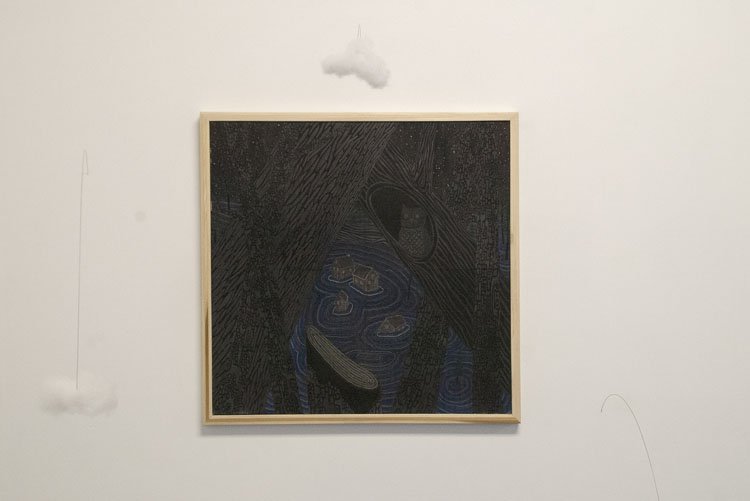
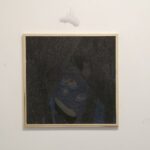
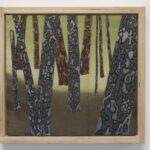
Mixed media drawings on found paper depict similar imagery as the installation and hang amid suspended clouds. In flood at night (2014), a solitary owl looks out from a tree hollow, a witness to the flood engulfing a group of houses in the background. The owl and trees are rendered in graphite on a black gessoed ground, and concentric lines of blue colored pencil encircle each house. In this low-key drawing, Reed masterfully deploys subtle shifts in value that evoke night. The drawing is almost obsessive in its rendering, its entire surface touched and carefully considered. Tree bark and water ringlets are portrayed as flat areas of intricate pattern, but rather than looking overworked or busy, the composition exacts quietude. Beneath the drawing, a substrate of collaged words peeks through, occasionally interrupting the layers of graphite, colored pencil, and gesso.
The concept of in-betweenness informs the show, not only in subject matter, but also through incongruities of scale and levels of finish. A small picnic table dwarfs houses, trees, and canoe; a banjo looms large on a shore. While the disparity of scale does not make logical sense, it feels appropriate within the confines of Reed’s invented environment. There’s a playfulness in the objects’ proportions to each other that is further heightened by Reed’s impulse to combine studio scraps, found paper, and craft materials with more traditional art supplies. Sometimes these materials are left to look like themselves; sometimes they are adeptly manipulated and masquerade as near replicas. Usually they fall somewhere between these two realms. Aptly named, the in-between, the exhibition presents works that are often at odds with each other, sometimes with themselves, resulting in an installation that is delightfully problematic with deliberate contradictions.
Museum Blue hosts a reception for Tom Reed’s the inbetween Friday, February 19 from 7 to 9 p.m. Museum Blue is located on the fourth floor of City Museum, 750 N 16th Street. For more information, go to museumblue.com or visit the exhibition’s Facebook event page.